Backup Generator Installation Cost: What to Expect in 2026
Understand backup generator installation cost in 2026, from equipment and labor to permits, fuel setup, and quotes. Plan your budget with real price ranges.
Most U.S. whole-house standby generator installations land between $8,000 and $16,000 in 2026, with broader project ranges of about $7,000 to $25,000 depending on generator size and installation scope. The final backup generator installation cost reflects far more than the equipment sitting on the pad.
You may be looking at quotes after a storm, a string of outages, or a recent conversation with a neighbor whose lights stayed on while yours went dark. The headline number is easy to find, but the useful number is the all-in installed price. That means understanding what the installer is supplying, connecting, preparing, permitting, and testing.
A standby system can appear affordable until the estimate adds a transfer switch, gas piping, electrical work, a concrete pad, permits, and inspection fees. Treating the project as a layered recipe makes those additions easier to understand and gives you a practical way to request matching line items from every installer.
Table of Contents
- Why Two Quotes Can Differ by Thousands
- The Cost Stack Behind Any Installed Price
- Equipment, Transfer Switch, and Labor Line Items
- Size, Fuel Type, and Site Readiness
- Reading Two Real Regional Quotes Side by Side
- Financing Options That Change the Monthly Picture
- Getting Accurate Estimates Through the Installer Directory
- Putting It All Together for Your Project
Why Two Quotes Can Differ by Thousands
Two quotes arrive for what appears to be the same 22 kW standby generator. One says $11,400, while the other says $17,900. Both are labeled “fully installed,” so the homeowner naturally wonders whether one contractor is overcharging or whether the lower quote leaves something out.
Usually, the answer is in the scope rather than the label. One proposal might include the automatic transfer switch, a short gas connection, permits, a standard pad, and no panel work. The other might include a longer fuel run, a service-rated switch, electrical upgrades, a reinforced pad, municipal inspections, and more difficult conduit routing.
The national market supports this kind of spread. A widely cited 2026 range places backup or whole-house standby installation at about $8,000 to $16,000, while broader industry ranges often reach $7,000 to $25,000 or more for complex projects, as summarized by HomeAdvisor's generator installation cost guide.
What “fully installed” should tell you
That phrase should describe a finished, code-compliant system that starts automatically and safely supplies the intended circuits. It shouldn't leave you guessing about the following items:
- Equipment: The generator model, output, enclosure, and included controls.
- Electrical equipment: The transfer switch, disconnects, wiring, conduit, and panel modifications.
- Fuel connection: Gas-line extension, propane work, regulators, shutoff valves, and testing.
- Site work: The pad, trenching, surface restoration, clearances, and access.
- Approval: Permit applications, inspections, utility coordination, and final commissioning.
Practical rule: A lower headline price isn't useful until every major scope item has a matching inclusion or exclusion.
Ask both contractors to rewrite their estimates using the same categories. A quote that costs more may be the more accurate one because it recognizes difficult access, a distant meter, or local inspection requirements. A cheaper quote may still be legitimate, but only if you know which layers it includes and which costs could appear later.
The Cost Stack Behind Any Installed Price
Think of backup generator installation cost as a five-layer stack. Each layer represents work or material required to turn a generator unit into a functioning home backup system. Installers may bundle the layers into one price or list them separately, but the underlying work still has to be completed.
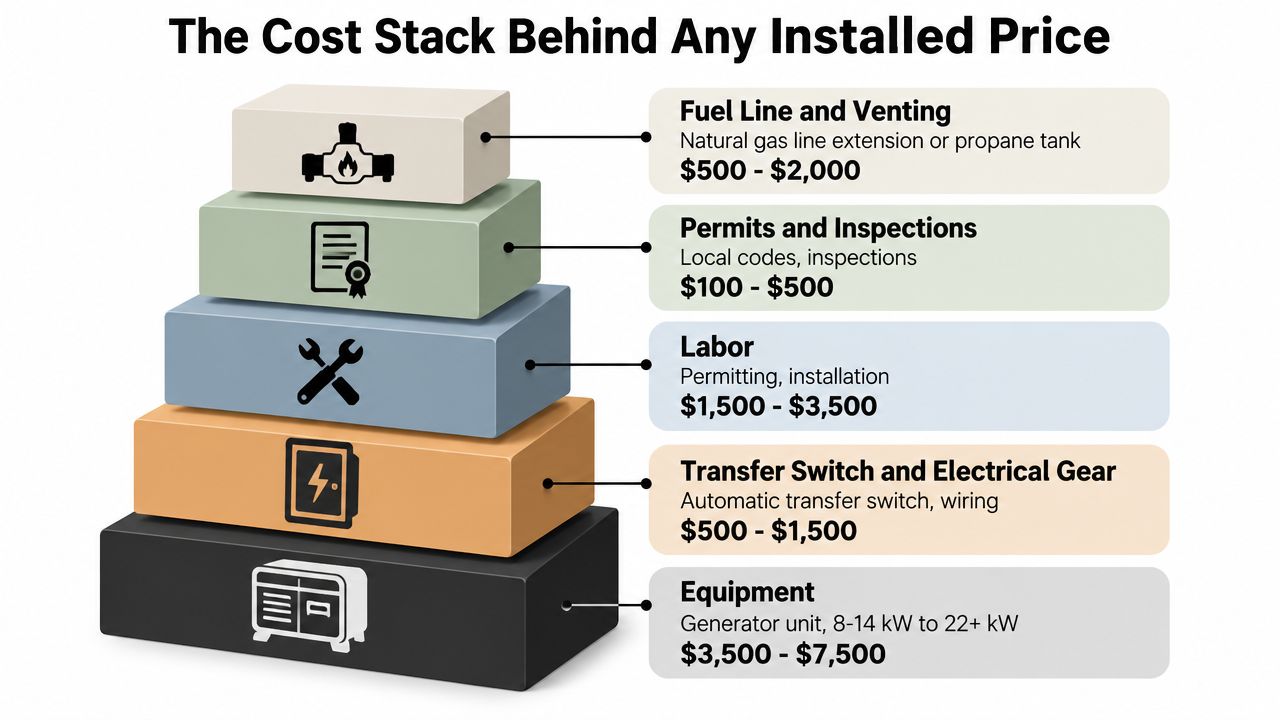
The five ingredients
- Equipment is the generator itself, sized for the home's electrical demand and chosen for its fuel system and enclosure.
- Transfer switch and electrical gear connect the generator safely to the home and control the changeover from utility power.
- Labor covers installation, wiring, mounting, testing, and commissioning.
- Permits and inspections bring the project into compliance with local electrical, fuel, zoning, and safety rules.
- Site preparation and fuel work create a stable location and connect the unit to natural gas or propane.
The analogy is simple. You can't bake the dish by buying only the main ingredient. A generator sitting outside the house isn't a completed backup system, just as a quote for the unit alone isn't an installed price.
A buyer-focused whole-house generator cost guide can help you separate the equipment portion from installation-related work, but your installer still needs to verify the property.
How to compare the stack
Put each quote into a small worksheet with these columns:
- Line item
- Included scope
- Excluded scope
- Allowance or estimated quantity
- Final-price conditions
Look for missing quantities. “Fuel connection” is less useful than a stated piping length, material, and route. “Electrical installation” should identify the transfer-switch rating, panel work, conduit, and any load-management equipment.
The stack protects you from comparing a bundled price against a partial price. Once the ingredients are visible, you can ask precise questions instead of negotiating from a number you can't interpret.
Equipment, Transfer Switch, and Labor Line Items
The three most visible parts of an estimate are the generator, the transfer equipment, and the installation labor. They also produce some of the most common misunderstandings because a contractor may bundle one into another or use different assumptions about the home's existing electrical service.
For a typical whole-house system, equipment may run about $4,000 to $9,000, depending on capacity, product tier, and configuration. An automatic transfer switch may add roughly $800 to $2,500, with smart load-shedding equipment generally costing more. Standard installation labor often falls between $2,500 and $5,000, and can rise when the project needs panel upgrades, long fuel runs, or difficult conduit routes. These planning bands come from the scope guidance in the 2026 standby generator installation cost guide.
What changes each line
A larger air-cooled unit usually carries a different equipment price from a smaller system. Liquid-cooled equipment, higher output, upgraded controls, and premium enclosure features can move the unit cost upward. The installer should identify the exact model rather than writing only “22 kW generator.”
The transfer switch deserves equal attention. A service-rated switch may handle the main service arrangement differently from a non-service-rated switch. A smart switch or load-management module can reduce the need to power every large load simultaneously, but it adds equipment and configuration work.
Labor is where scope assumptions diverge most sharply. A generator placed close to the service equipment and fuel connection may require a straightforward route. A unit located across a finished area, behind restricted access, or far from the panel can require more trenching, conduit, protection, and restoration.
| Line Item | Typical Range | What Pushes the Price Up |
|---|---|---|
| Generator equipment | $4,000 to $9,000 | Higher output, liquid-cooled design, premium controls |
| Automatic transfer switch | $800 to $2,500 | Service-rated equipment, load management, complex wiring |
| Installation labor | $2,500 to $5,000 | Panel upgrades, long runs, difficult access, complex conduit |
| Site and fuel work | Project-dependent | Trenching, gas-line extension, pad construction, restoration |
The categories in this table should appear separately in a quote, even if the installer offers a bundled total. For technical background on automatic switching and generator connections, the following video can help you visualize the equipment before discussing a proposal:
Ask whether labor includes start-up, testing under load, homeowner instruction, and correction of inspection issues. Those details distinguish a completed commissioning visit from a delivery-and-connection appointment.
Size, Fuel Type, and Site Readiness
Generator size is the first decision because it determines how much electrical demand the system can serve. A home that protects only refrigerators, heating controls, lights, and selected outlets needs a different design from a property that wants air conditioning, electric cooking, pumps, and other large loads operating together.
A utility-linked Houston example places a typical standby system for a 2,000-square-foot home at 16 to 18 kW, with an installed price of about $8,500 to $12,000 when the project includes roughly 6 feet of electric and gas line work, permits, and licensing. That example illustrates why square footage is only a starting point. The installer must still calculate the actual electrical load.
Size bands are planning tools
A major-market guide estimates about $4,250 to $6,600 for 17 to 20 kW systems serving 1,500 to 3,000 square feet, $5,125 to $8,875 for 22 to 25 kW systems serving 3,000 to 5,000 square feet, and $11,335 to $22,000 for 30 to 48 kW systems serving homes of 5,000 square feet or more, as reported in The Spruce's whole-house generator cost guide.
Fuel and site conditions then add their own layers:
- Natural gas: Often simpler when the meter and service line are already close to the proposed location.
- Propane: Requires tank planning and may involve new piping, regulators, excavation, or storage requirements.
- Diesel: Can require specialized storage, ventilation, and enclosure arrangements.
A consumer market guide estimates gas-line or propane-tank work can add about $500 to $2,000 on average, while some propane-tank installations may add $5,000 to $8,000 in more demanding cases, according to ConsumerAffairs' whole-house generator installation cost guidance.
Site readiness is part of the price
The pad must be stable, level, accessible, and positioned with required clearances. Trenching, finished landscaping, retaining features, tree removal, and distance from windows can all increase labor. Ask the estimator to show the proposed location on a site sketch and identify the route for fuel, power, and communications wiring.
For sizing questions, use this generator sizing guide as a starting point, then have a qualified installer complete the load assessment. Don't choose a larger unit just because the nameplate sounds safer. Oversizing can increase equipment and installation requirements without solving the right electrical problem.
Reading Two Real Regional Quotes Side by Side
A side-by-side comparison can reveal the reason for a price gap in a few minutes. Consider two hypothetical proposals for the same 20 kW standby generator, with each contractor pricing a different property context.
Quote A comes from a Midwest installer. It includes a 200-amp service-rated transfer switch, 10 feet of gas line, a concrete pad, and permit fees, for a total of $13,400. Quote B comes from a Northeast dealer and totals $17,950. It includes the same generator capacity, but the meter sits farther away, the town requires a separate electrical inspection, and the property needs additional cold-weather site preparation.
| Line Item | Quote A, Midwest | Quote B, Northeast |
|---|---|---|
| Generator | 20 kW air-cooled unit | Same 20 kW unit |
| Transfer equipment | 200-amp service-rated switch | Transfer switch plus load-shedding module |
| Fuel connection | 10 feet of gas line | 35 feet of gas line |
| Site preparation | Standard concrete pad | Upgraded freeze-proof pad |
| Approval costs | Permit fees included | Permit and town electrical inspection fee |
| Total | $13,400 | $17,950 |
Neither quote is automatically wrong. Quote B includes more piping, an added control component, a more involved pad specification, and an extra local approval step. The geographic label matters less than the physical and municipal conditions behind it.
Questions that expose the difference
Ask both installers to state:
- Fuel distance: How many feet of gas or propane piping are included?
- Pad specification: What material, dimensions, anchoring, and drainage work are covered?
- Electrical scope: Is the transfer switch service-rated, and are panel changes included?
- Inspection fees: Which permits and inspections are included, and which are billed separately?
- Restoration: Will the contractor repair trench routes, paving, lawn, or planting areas?
A quote becomes comparable when the assumptions match, not when the totals look similar.
Regional labor markets and local code requirements can affect the estimate, but the largest practical differences usually appear in the work description. Requesting the same written scope from each contractor turns a confusing price comparison into a clear review of quantities and responsibilities.
Financing Options That Change the Monthly Picture
A standby generator is a substantial household purchase, so monthly financing can make the project easier to fit into a budget. It can also make an expensive project look smaller than it is if you compare payments without checking the cash price, interest, fees, and promotional conditions.
Common arrangements include manufacturer promotional financing, sometimes advertised at 0% APR for 12 to 24 months for qualified buyers. Longer dealer loans may run 5 to 12 years with fixed APRs commonly between 7% and 12%. Home equity loans and lines of credit can offer different rates and repayment structures, but they use home equity and may include closing costs. These structures are outlined in the GeneratorInstallerList financing guide.
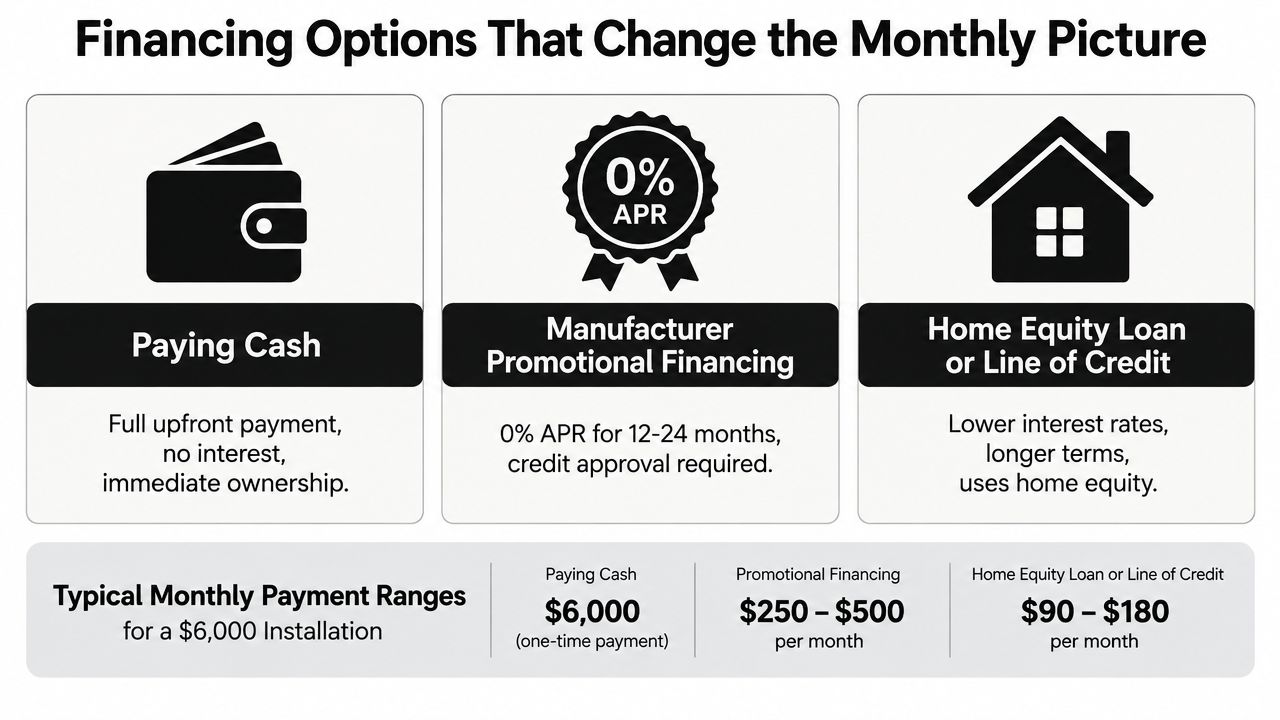
Compare the total, not just the payment
Before signing, ask the lender or dealer for a written schedule showing:
- Total repayment: What will the project cost after interest and fees?
- Promotional expiry: Does the rate change after the introductory period?
- Deferred interest: Is interest charged retroactively if the balance remains?
- Prepayment: Are there penalties or restrictions on early repayment?
- Financed scope: Are permits, taxes, site work, and upgrades included?
A monthly figure only makes sense beside the exact financed balance and term. If one contractor finances the generator, switch, and installation while another finances only the equipment, the payments aren't comparable.
Confirm the all-in cash price first. Then compare financing options using the same project scope. If a utility or state program offers an incentive for managed load equipment, ask whether the benefit applies to the complete system or only a qualifying component, and verify the current rules before relying on it.
Getting Accurate Estimates Through the Installer Directory
An installer directory works best as part of a quoting process, not as a list of phone numbers. Start by identifying contractors whose own websites show clear standby or whole-house generator work, then check whether they describe installation, service, maintenance, commissioning, and the brands they support.
Prepare one written scope before contacting anyone. Include the desired generator capacity or the request for a load calculation, fuel type, transfer-switch amperage, panel location, proposed equipment location, and known obstacles such as long distances, finished landscaping, narrow access, or an older electrical service.
Send every contractor the same brief
Your request should ask for separate prices for:
- Generator equipment: Exact manufacturer and model.
- Transfer switch: Amperage, service rating, and load-management components.
- Electrical work: Wiring, conduit, disconnects, panel changes, and utility coordination.
- Fuel work: Piping length, tank work, regulators, valves, trenching, and testing.
- Site preparation: Pad type, excavation, anchoring, drainage, and surface restoration.
- Approvals: Permit applications, inspection fees, and corrections.
- Completion: Start-up, commissioning, homeowner orientation, and warranty registration.
Ask each estimator to list assumptions in plain language. If the price assumes the gas meter is within a certain distance or that the existing panel has enough capacity, that condition belongs in the proposal.
Verify the proposal, not just the company profile
Schedule a short call with each estimator. Ask who performs the load calculation, whether a site visit is included, who coordinates permits, and what happens if an inspector requires a change. Review licensing and insurance directly with the contractor because directory information isn't a substitute for credential verification.
Keep a spreadsheet with the total price, included equipment, excluded work, fuel distance, pad details, timeline, payment schedule, warranty terms, and maintenance options. A contractor who answers scope questions clearly gives you more useful information than one who offers only a fast headline price.
Putting It All Together for Your Project
Start with the load assessment. Decide whether the home needs essential-circuit coverage, broader partial-home coverage, or a larger whole-home arrangement. The correct output range becomes the foundation for every later decision, including equipment selection, transfer-switch design, fuel demand, and site placement.
Next, match the fuel choice to the property. Existing natural gas service may simplify the connection, while propane or another fuel arrangement can require storage and additional site planning. Confirm local clearance, placement, electrical, and fuel requirements before treating any estimate as final.
Build the budget in the right order
Use this decision path:
- Confirm the load: Have a qualified professional calculate the required capacity.
- Select the system: Identify the exact generator, transfer switch, and load-management equipment.
- Map the site: Measure the fuel route, electrical route, pad area, access, and required clearances.
- Request comparable quotes: Give at least three installers the same written scope.
- Check financing: Compare terms only after you know the complete cash price.
- Approve the survey: Have the preferred installer verify the property before signing.
Treat equipment and transfer gear as the base of the project. Labor and approvals form the variable layer, while fuel routing, pad work, electrical upgrades, and difficult access create the contingency. This approach won't predict the final invoice without a site survey, but it will show why the estimate moves and whether two bids cover the same work.
Review each proposal line by line, then ask the preferred installer to confirm the load calculation, site layout, permit responsibility, commissioning process, and warranty path in writing. That sequence keeps the budget grounded and reduces the chance of discovering an omitted connection or upgrade after installation begins.
GeneratorInstallerList offers a ZIP-based directory of standby and whole-house installers, with filters for generator installation signals, service language, and major brands. Visit GeneratorInstallerList to create a consistent scope, identify potential contractors, and request quotes you can compare line by line.
- backup generator installation cost
- standby generator cost
- whole house generator
- generator installer
- generator installation
Ready to find who to call?
Open your state page or search by ZIP for a distance-sorted list.