Best Whole House Generator Natural Gas: 7 Top Picks
Compare the best whole house generator natural gas models for value, noise, warranty, capacity, and installer support in 2026.
The biggest number on a generator label can mislead you. Many standby units advertise their LP capacity, while their natural-gas output is lower, so shoppers comparing only headline kilowatts may buy less usable capacity than expected. A sound comparison starts with the natural-gas rating, then examines load management, motor-starting performance, noise, warranty terms, equipment-price signals, expected runtime, and the installation conditions that can change the final quote.
Natural gas remains a common choice for residential and small-business backup where pipeline service is already available. One industry source reports more than 250 gigawatts of standby generator power installed in the United States, with over 15 gigawatts of new capacity added each year. It also reports that natural gas approaches 70% of installations below 150 kW in demand driven by voluntary residential and small-business projects. Industry market analysis
The seven models below aren't ranked by nameplate size alone. The best whole house generator natural gas choice depends on your home's loads, gas service, outage duration, budget, local permitting, and whether a qualified installer can support the brand. GeneratorInstallerList offers an independent, brand-agnostic starting point for finding generator-focused installers. Its listings aren't endorsements or license verification, so confirm credentials directly.
Table of Contents
- 1. Generac Guardian 26 kW Model 7291
- 2. Kohler 26 kW 26RCA and 26RCAL
- 3. Cummins QuietConnect RS20A 20 kW
- 4. Briggs & Stratton PowerProtect 26 kW
- 5. Champion 22 kW Home Standby
- 6. Generac Protector 27 kW RG027 Liquid-Cooled
- 7. Kohler 30 kW 30RCLA Liquid-Cooled
- Top 7 Natural Gas Whole-House Generators Comparison
- Turn the Shortlist Into a Quote You Can Compare
1. Generac Guardian 26 kW Model 7291
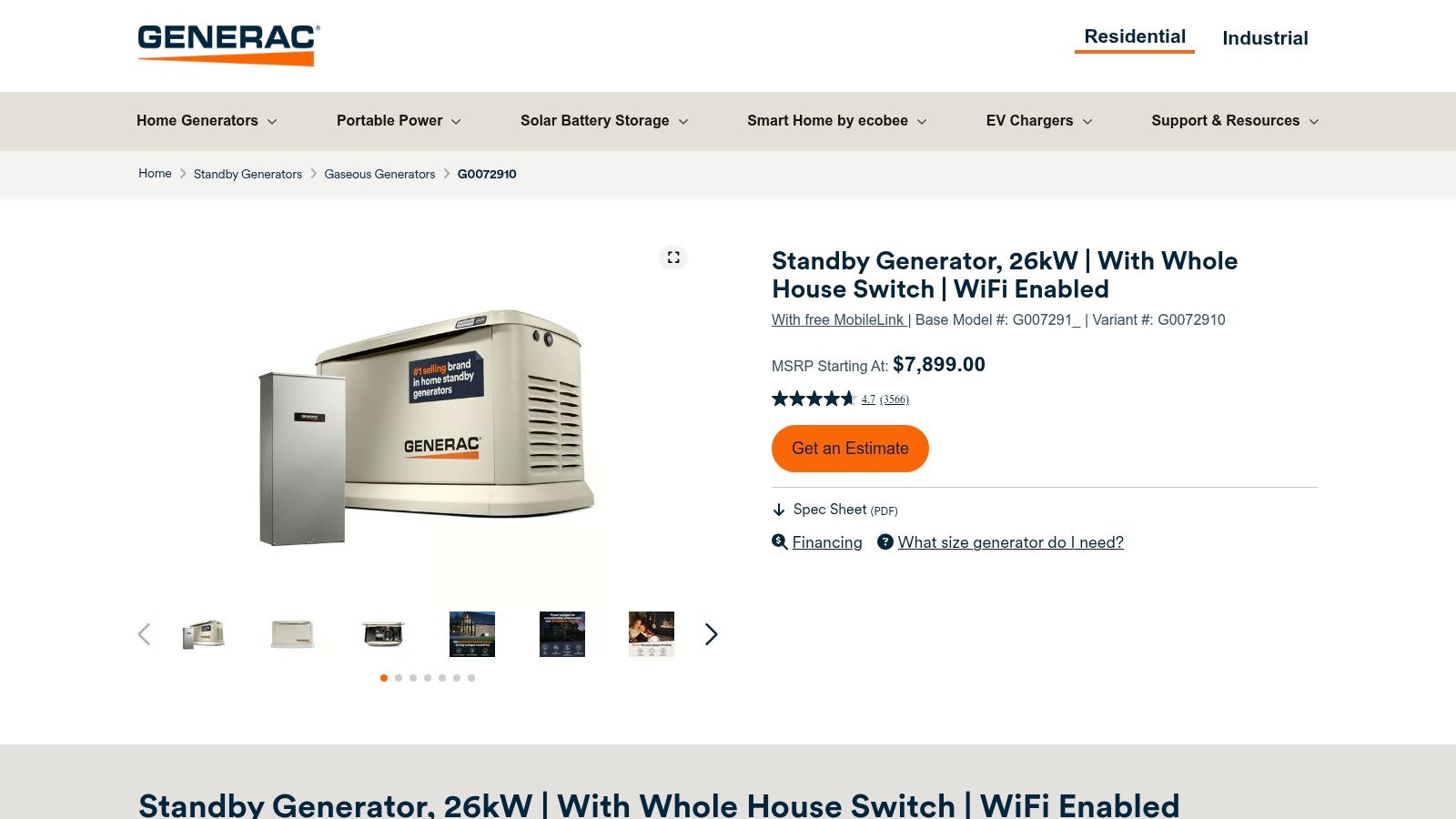
The Generac Guardian 26 kW Model 7291 is one of the strongest air-cooled candidates for a large home that already has suitable natural-gas service. The important distinction is its fuel-specific rating: the unit produces 26 kW on LP but 22.5 kW on natural gas, according to Generac's product specifications.
That output can cover substantial household demand, but it doesn't automatically guarantee that every load can start together. Central air-conditioning compressors, pumps, electric ranges, water heaters, and other large loads may require a load-management strategy. The platform supports Generac automatic transfer switches and Smart Management Modules, allowing an installer to prioritize or shed selected circuits rather than oversizing the generator.
Why the service network matters
Generac's major practical advantage is its broad U.S. dealer and parts footprint. That doesn't make every local dealer equally capable, but it can improve the odds of finding maintenance and warranty support after installation. Mobile Link monitoring adds remote visibility through Wi-Fi or cellular connectivity, depending on the configuration.
Noise is less attractive than the output suggests. Generac lists 67 dB(A) at 23 feet under load and 57 dB(A) during Quiet-Test exercise on its product materials. The 3600-rpm air-cooled design is compact and familiar to installers, but it can be louder and less comfortable for extended operation than a liquid-cooled platform.
Natural-gas comparison rule: Compare the 22.5 kW NG rating with your actual load plan, not the 26 kW LP headline.
For the fuel-system side of the decision, compare this model's gas requirements with the guidance in natural gas versus propane generator planning. A strong installer should verify the meter, regulator, pipe route, pressure under load, and local setback requirements before promising whole-house coverage.
2. Kohler 26 kW 26RCA and 26RCAL
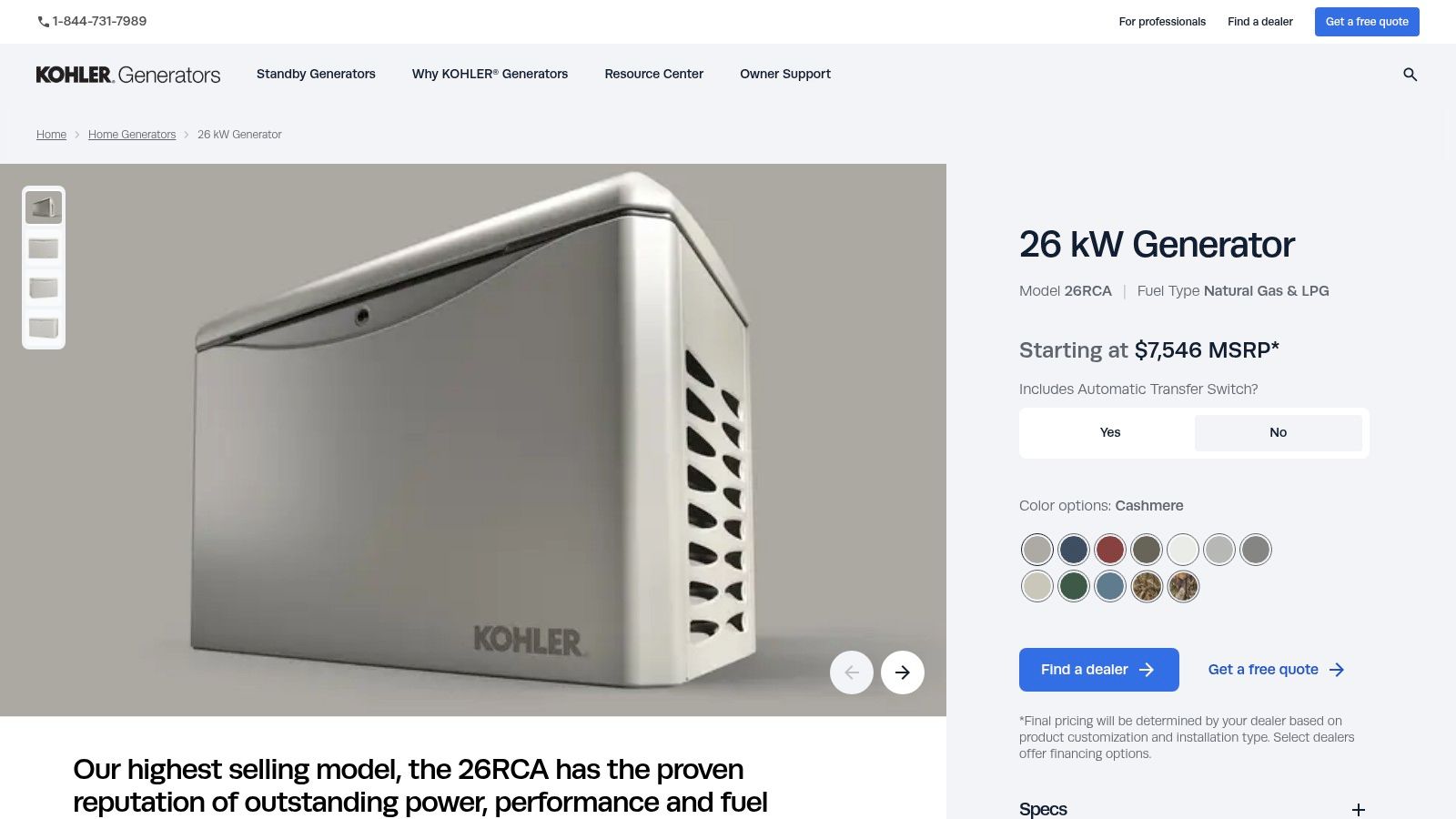
Kohler takes a more favorable approach to natural-gas transparency than many shoppers expect from an air-cooled generator. The 26RCA and 26RCAL are rated at 26 kW on LP and 24 kW on natural gas, so the gap between fuels is narrower than the Generac Guardian's listed difference. Kohler's product page provides the model and warranty details.
The RCA is the generator-only configuration, while the RCAL package includes the associated switch arrangement. That distinction matters because a generator-only price isn't the same as a complete transfer-and-installation package. Ask the dealer to separate the generator, automatic transfer switch, wiring, gas work, permits, pad, commissioning, and maintenance terms in the quote.
Quiet operation and warranty clarity
Kohler lists a 56 dB(A) quiet exercise mode and approximately 67 dB(A) at full speed. Quiet exercise is useful in neighborhoods where a weekly test can disturb occupants or neighbors, but it shouldn't be confused with the sound level during a real outage. Voltage regulation is another selling point for homes with sensitive electronics, though the installer still needs to confirm that the transfer equipment and load plan match the property.
The model carries a five-year limited residential warranty, which gives buyers a clear comparison point against products whose warranty details may be less visible during online shopping. Kohler lists an MSRP starting at $7,546 before installation, but that figure is an equipment signal, not a completed project price.
A dealer's quote can rise when the gas line needs modification, the electrical service requires reconfiguration, the pad location is difficult, or local approvals add work. Kohler is therefore a strong choice for buyers who value a relatively high NG rating, quieter exercise operation, and documented warranty coverage, provided the local dealer's total installed price remains competitive.
3. Cummins QuietConnect RS20A 20 kW
The Cummins QuietConnect RS20A makes its case through a conservative capacity target rather than a race to the largest air-cooled nameplate. It carries a 20 kW standby rating and supports both natural gas and LP, according to Cummins' RS20A product information.
That capacity can suit a home whose essential loads and selected comfort systems fit within a disciplined load plan. It may be less forgiving in a larger property with multiple air-conditioning compressors, electric resistance heat, well equipment, pool equipment, or other motors that can start at the same time. The right question isn't whether 20 kW sounds large. It's whether the installer can demonstrate which loads operate concurrently and which loads will be managed.
A quieter middle-capacity option
The QuietConnect enclosure targets the 65 dB class, with a sound-attenuated, weather-protective design. Noise depends on operating condition and site layout, so buyers should ask for the manufacturer's test condition and discuss nearby windows, bedrooms, property boundaries, and reflective walls.
Cummins Connect Cloud and app-based monitoring can help homeowners and service providers identify operating status or alerts without visiting the unit. That feature becomes more useful when the installer actively monitors or maintains the system, rather than merely enabling the homeowner's app during commissioning.
The RS20A's limitation is also its decision advantage. A smaller generator can force a clearer load hierarchy instead of encouraging buyers to assume every appliance will run simultaneously.
Cummins' nationwide dealer presence is valuable, but local support still controls the ownership experience. Before selecting it, use a documented whole-house generator sizing guide and request a written load calculation. This model is best for buyers who prefer a quieter, measured 20 kW platform and can accept load management where a larger home would otherwise exceed its natural-gas output.
4. Briggs & Stratton PowerProtect 26 kW
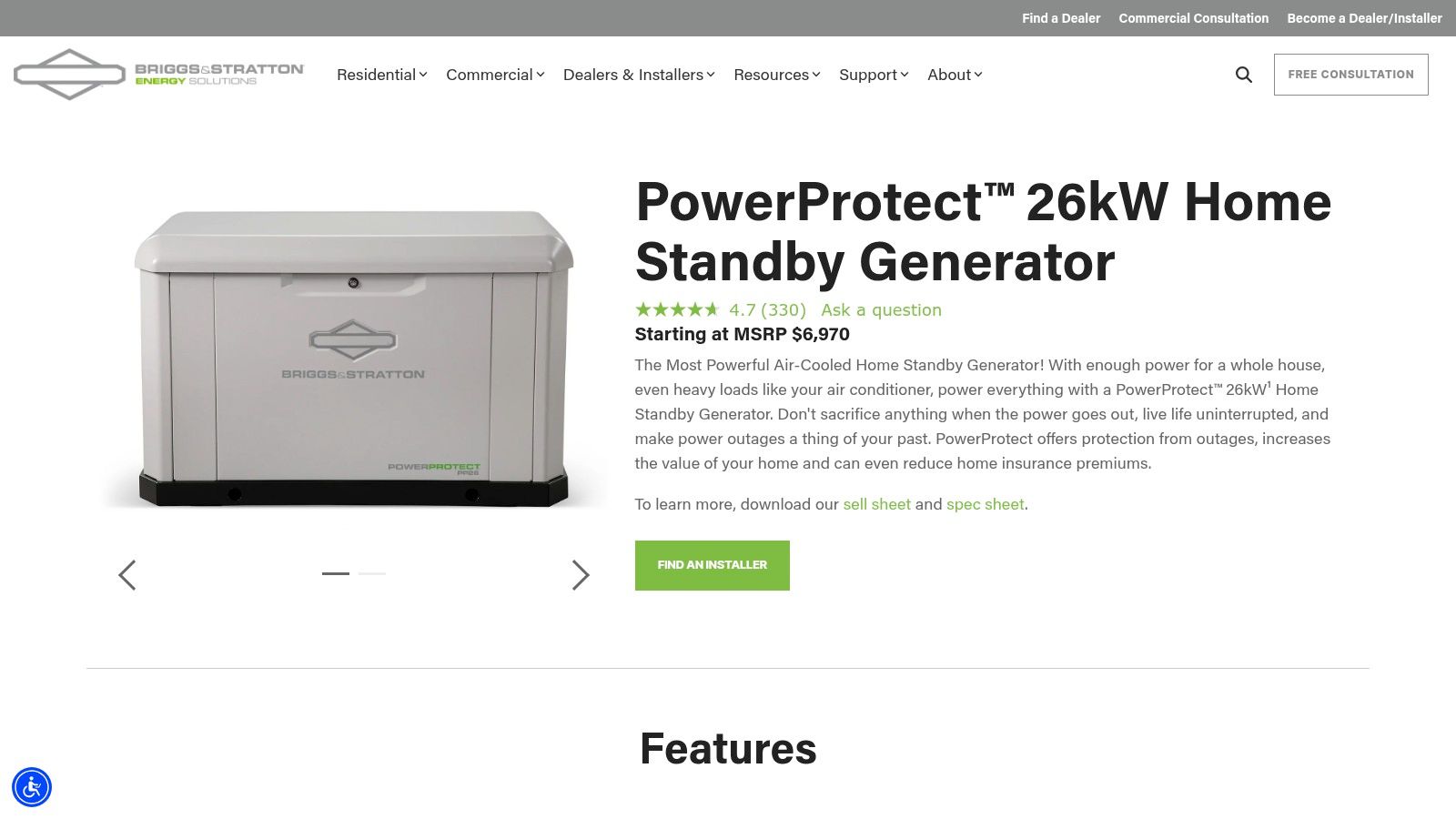
The Briggs & Stratton PowerProtect 26 kW belongs on a shortlist when local installer support is stronger than the brand's visibility in a particular market. It is a 26 kW-class air-cooled standby generator compatible with natural gas and LP, with an aluminum enclosure and remote monitoring availability. Briggs & Stratton's product page lists generator-only MSRP starting at $6,970 before installation.
That price is a useful equipment comparison signal, not evidence of lower total ownership cost. A lower generator-only price can disappear if the dealer must travel farther, if parts availability is weaker nearby, or if the quote excludes the transfer switch, gas work, electrical modifications, permits, pad, and startup testing.
The installer can decide the value
The PowerProtect's headline capacity shouldn't be treated as its natural-gas capacity unless the manufacturer supplies the fuel-specific rating for the exact configuration. Ask for that number in the quote and compare it with the home's calculated running and starting loads. If the dealer can't explain the NG output, regulator requirements, and planned load-management equipment, the apparent price advantage isn't yet meaningful.
The aluminum enclosure can help with outdoor durability, while remote monitoring may simplify status checks. Those features matter less than whether a local authorized technician can perform scheduled service and respond during a regional outage.
Briggs & Stratton can be a sensible value choice where an authorized installer has a strong service operation, keeps common parts available, and provides a complete scope of work. It is a weaker choice when buyers select it solely from the published MSRP and discover later that the local dealer network can't match the support available for more established competitors.
5. Champion 22 kW Home Standby
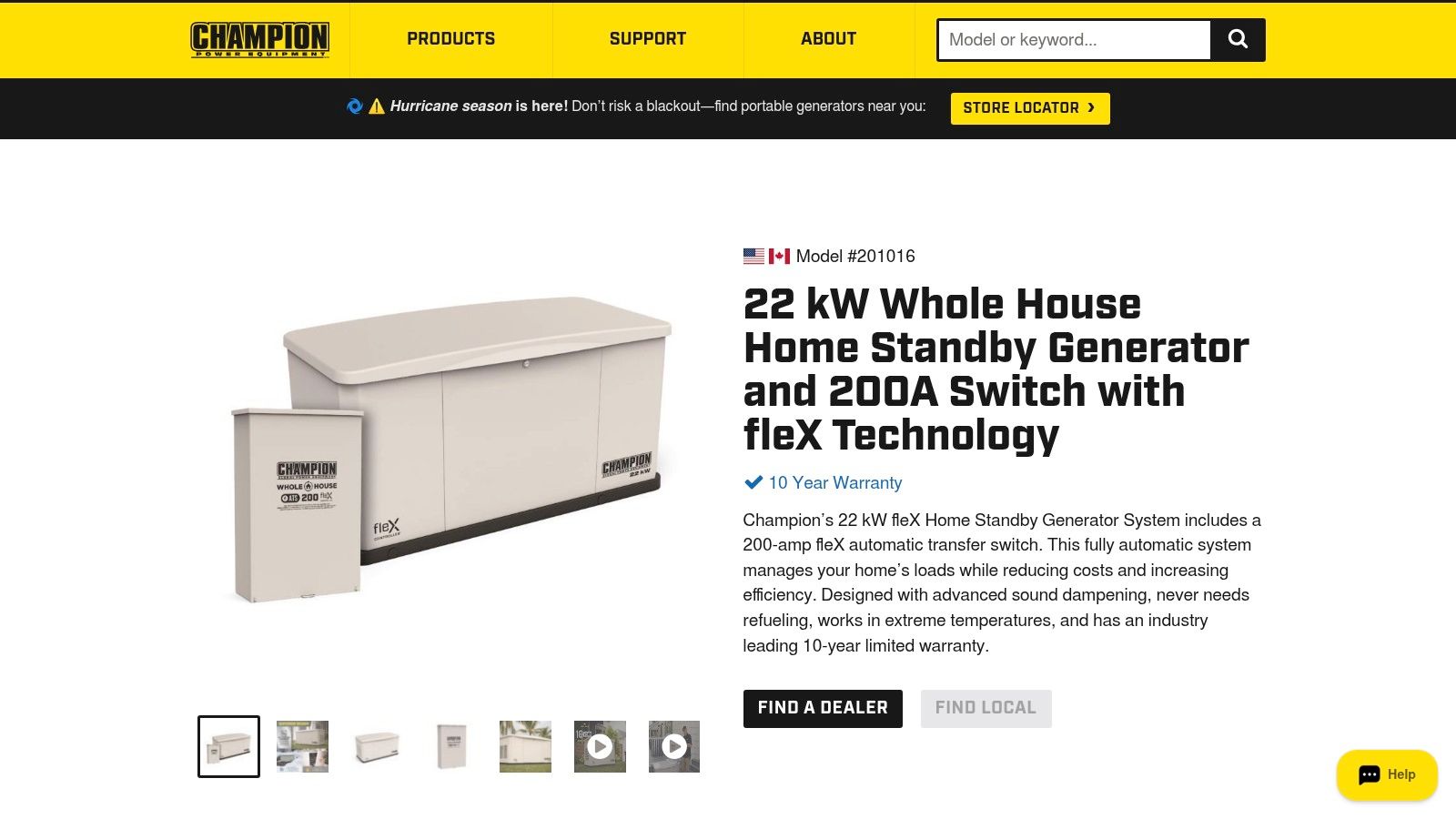
Champion's 22 kW Home Standby system is aimed at buyers who want transparent retail access and built-in control over competing loads. The model is rated at 22 kW on LP and 19.8 kW on natural gas, and the fleX Controller supports load management, according to Champion's product listing.
The natural-gas rating places it below the 24 kW and 22.5 kW NG outputs listed for some larger competitors. That doesn't make it unsuitable for whole-house backup. It means the electrical design must be more deliberate, especially in homes with multiple large motors or electric heating loads.
Retail availability versus installation responsibility
Champion is widely available through retail channels and dealer networks, including packages associated with a 200 A whole-house switch or a 100 A switch option. Retail availability can make equipment pricing easier to see, but it doesn't solve the difficult parts of the project. A retailer generally isn't the party that verifies gas pressure, obtains permits, sizes the service conductors, installs the pad, or guarantees future maintenance.
Ask for the load-management sequence: The installer should identify which appliances start first, which loads are delayed, and what happens when two high-demand devices request power together.
The fleX Controller is the reason this model can remain useful despite its lower NG output. Properly configured, load management can protect the generator from overload while preserving priority circuits. Poorly configured, it can create frustrating interruptions when the homeowner expects unrestricted whole-house operation.
Champion is a practical value candidate for buyers who can identify a competent local installer, accept a tighter natural-gas capacity margin, and want an accessible purchase channel. It isn't the automatic best choice for a large home because its LP label reaches 22 kW.
6. Generac Protector 27 kW RG027 Liquid-Cooled
The Generac Protector RG027 changes the comparison from compact air-cooled convenience to liquid-cooled endurance. Its 27 kW platform operates at 1800 rpm, and Generac positions it for heavier motor starting and longer runtimes than smaller air-cooled sets. Generac's RG02724 product page lists Mobile Link connectivity and the broader Protector QS family.
Lower engine speed and liquid cooling can improve the platform's suitability for extended operation, but the buyer pays for that capability through a larger footprint, more complex equipment, and a more demanding installation. The unit may require more site planning for the pad, service clearances, electrical connections, and gas delivery.
Capacity is only half the upgrade
The liquid-cooled design is most compelling for a large home with several HVAC systems, substantial motor loads, or a serious concern about long outage operation. It can also provide a more comfortable acoustic experience than a comparable high-speed air-cooled set, although buyers should still request the exact sound specification for the installed configuration.
Natural gas infrastructure becomes a critical constraint at this scale. A published Briggs & Stratton reference shows that larger natural-gas units can consume approximately 893,000 BTU per hour at 50% load for a 100 kW-class generator, while 150 kW and 200 kW units consume approximately 1,105,000 and 1,494,000 BTU per hour at that same load condition. The manufacturer's larger-generator data illustrates why gas capacity, line sizing, and regulator selection deserve engineering attention as generators grow.
Use whole-house generator cost guidance to separate equipment cost from site work. The Protector is a premium choice when durability, motor-starting headroom, and long-run comfort justify a higher project scope. It can be excessive for a smaller home whose loads fit comfortably within an air-cooled system.
7. Kohler 30 kW 30RCLA Liquid-Cooled
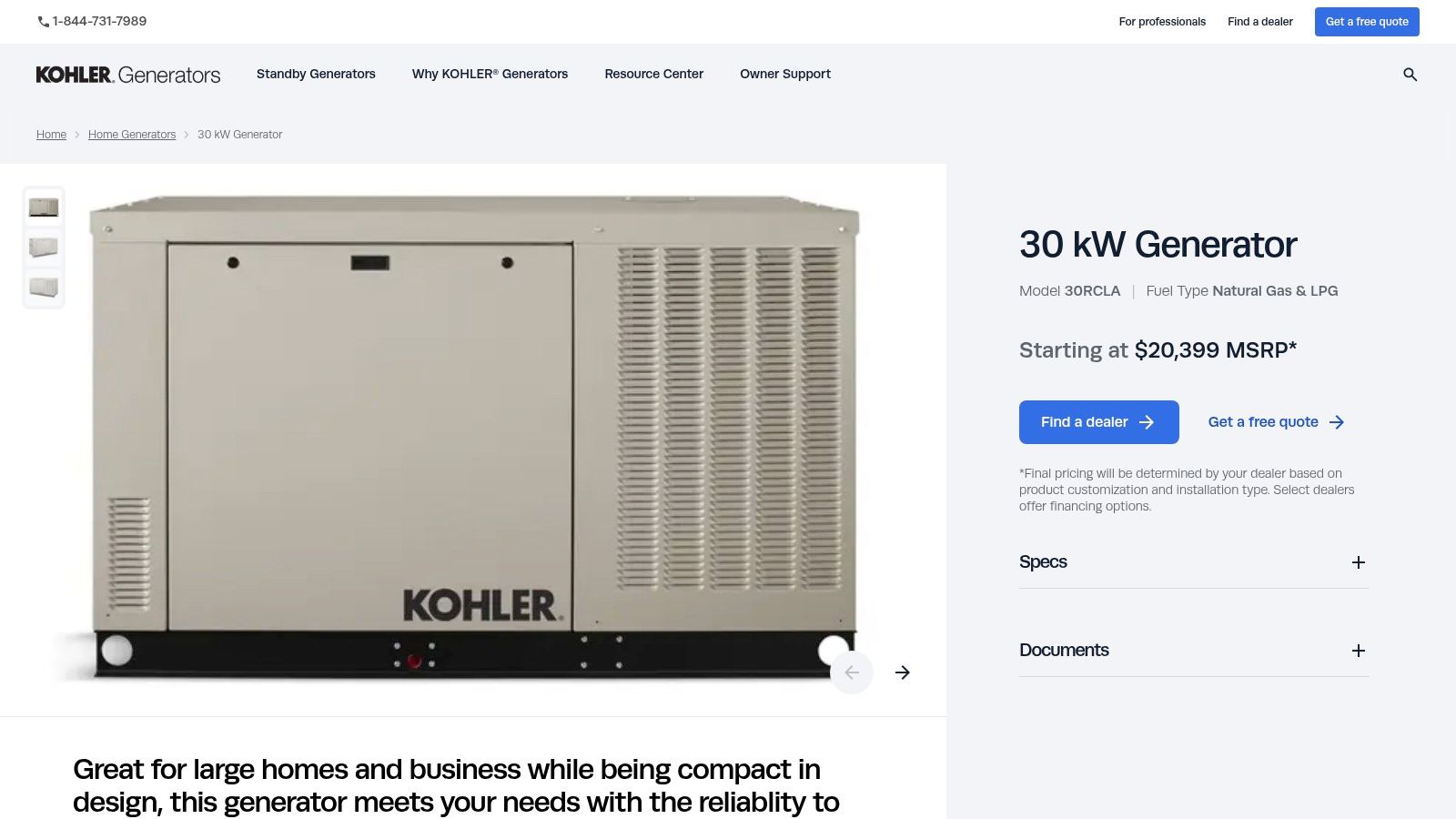
The Kohler 30RCLA is the clearest choice here for buyers who need substantial natural-gas headroom and don't want the NG rating reduced below the LP rating. Kohler lists 30 kW on both natural gas and LP, using a liquid-cooled 1800-rpm design with a 2.2-liter engine. Kohler's 30RCLA specifications also list a five-year limited residential warranty.
That full NG rating can matter more than the jump from a 26 kW label to a 30 kW label. A home with multiple HVAC compressors, pool equipment, EV charging, electric cooking, or other high-demand systems may benefit from the additional operating margin. The installer still needs to calculate starting loads, because extra capacity doesn't eliminate poor sequencing or inadequate gas delivery.
Quiet, robust, and expensive
Kohler lists 62 dB(A) at full speed and 54 dB(A) in exercise mode. Those figures make the unit attractive for properties where noise matters, while liquid cooling supports the long-runtime use case better than a compact air-cooled platform.
The equipment cost is substantial. Kohler lists MSRP starting at $20,399 before installation, so the final quote can rise further when the project needs a larger pad, upgraded gas piping, electrical work, permits, or difficult access. The heavier enclosure and expanded service requirements also affect placement and maintenance planning.
This model makes sense when the buyer values quiet operation, full natural-gas output, documented warranty terms, and long-run capability more than a low initial purchase price. It doesn't make sense to pay for this platform when the home's verified loads are modest and a smaller unit can meet them with an appropriate load-management plan.
Top 7 Natural Gas Whole-House Generators Comparison
| Product | Implementation Complexity 🔄 | Resource Requirements ⚡ | Expected Outcomes 📊 | Ideal Use Cases 💡 | Key Advantages ⭐ |
|---|---|---|---|---|---|
| Generac Guardian 26 kW (Model 7291) | Moderate, 3600 rpm air‑cooled; standard pad & NG tie‑in | High capacity wiring (110 A breaker); broad dealer/parts network; moderate equipment cost | ~22.5 kW on natural gas; louder than liquid‑cooled; reliable service access | Large single‑family homes with 200 A panels needing max air‑cooled output | ⭐4/5, Wide installer network and high air‑cooled headroom |
| Kohler 26 kW (26RCA / 26RCAL) | Moderate, dealer install, app monitoring setup | Higher MSRP and dealer installation costs; good dealer availability | 24 kW on natural gas; quiet exercise (56 dB); strong voltage regulation | Homes wanting quieter operation and accurate NG rating | ⭐4.5/5, Quiet operation and strong voltage control |
| Cummins QuietConnect RS20A (20 kW) | Low‑Moderate, smaller air‑cooled footprint; standard install | Lower capacity wiring needs; nationwide dealer support; moderate cost | 20 kW conservative rating; quieter enclosure (~65 dB) | Moderate‑load homes prioritizing noise and conservative specs | ⭐3.5/5, Trusted brand with quieter enclosure |
| Briggs & Stratton PowerProtect 26 kW | Moderate, air‑cooled 26 kW; dealer installation recommended | Attractive MSRP; dealer density varies by region | 26 kW class NG/LP capability; whole‑home potential where supported | Cost‑sensitive buyers with local Briggs‑authorized installers | ⭐4/5, Competitive price for 26 kW class |
| Champion 22 kW Home Standby (fleX Controller) | Lower, widely stocked retail bundles; fleX controller integration | Lower equipment cost; widely available through big‑box retailers | 19.8 kW on natural gas; may require load management for large homes | Value buyers and easy‑purchase retail channels (Lowe's, etc.) | ⭐3.5/5, Strong value and retail availability |
| Generac Protector 27 kW (RG027), Liquid‑Cooled | High, 1800 rpm liquid‑cooled; larger pad, coolant/plumbing needs | Significantly higher equipment & install costs; larger site/gas/electrical needs | 27 kW liquid‑cooled; quieter, better for heavy motor starts and long runtimes | Large homes, multi‑AC properties, long runtimes, heavy motor starts | ⭐4.5/5, Superior runtime, quieter, strong motor‑starting |
| Kohler 30 kW (30RCLA), Liquid‑Cooled | High, heavy 1800 rpm liquid‑cooled unit; substantial site prep | Very high equipment cost and installation requirements; strong dealer support | Full 30 kW on natural gas; quiet (62 dB) and robust under load | Estates, light commercial, pools, EV charging, multiple HVAC units | ⭐5/5, Holds full NG rating; highest capacity and durability |
Turn the Shortlist Into a Quote You Can Compare
A generator quote becomes useful only when it shows what the equipment can deliver on natural gas and what the contractor will install. Start with two scenarios, essential-load backup and whole-home operation. Then ask the installer to calculate running demand, motor-starting demand, and the combinations that may operate simultaneously.
Next, verify each model's natural-gas output from the manufacturer's documentation for the exact model and configuration. Don't infer NG capacity from the LP nameplate. The difference is material, as the models above demonstrate, and the gas supply may become the limiting factor before the electrical panel reaches its theoretical maximum.
Questions that belong in every quote
- Load calculation: Request the method, assumptions, running loads, starting loads, and excluded circuits.
- Load management: Identify every managed appliance, the controller or module used, and the priority sequence.
- Gas service: Confirm meter capacity, inlet pressure, regulator arrangement, line size, pipe route, and pressure under generator load.
- Site and permits: Require the pad, clearances, electrical work, gas work, permit fees, inspections, and final commissioning to appear in writing.
- Ownership support: Ask who handles warranty claims, scheduled maintenance, emergency service, parts, battery replacement, and remote-monitoring alerts.
- Noise planning: Confirm the tested sound condition and review the proposed location relative to windows, neighbors, and property lines.
A 35 kW natural-gas standby generator can require approximately 5 to 14 inches of water column inlet pressure, while fuel draw may rise from roughly 184 scfh at 25% load to 446 scfh at full load, according to Briggs & Stratton's generator documentation. That example explains why an electrical load calculation alone isn't enough. A gas utility or qualified gas professional must confirm the supply and regulator path.
Natural gas also isn't an automatic guarantee of unlimited runtime. Pipeline interruptions, grid failures that affect gas infrastructure, and extreme-weather demand spikes can challenge the assumption that utility gas will always remain available. Consumer coverage of whole-house generators highlights the gap between convenience-focused buying advice and the harder question of fuel resilience during a prolonged outage.
Air-quality rules deserve the same attention. EPA-related standby guidance and permitting discussions indicate that emergency-rated gas generators are generally limited to approximately 100 hours per year for non-emergency use, while emissions compliance can vary with engine type, altitude, and local requirements. The referenced technical permitting discussion shows why buyers in stricter jurisdictions should ask the installer about emissions classifications, permits, operating restrictions, and any required controls before purchasing equipment.
GeneratorInstallerList can help you build the installer side of the comparison. Its directory covers 9,020 researched companies across all 50 states, with ZIP-radius searches, standby and whole-house filters, service and maintenance signals, and optional brand filters for Generac, Kohler, Cummins, and Briggs & Stratton. The directory uses evidence from installers' own websites and reviews, but it isn't a licensing check or endorsement. Verify licenses, insurance, authorization status, references, and warranty responsibilities directly.
Compare at least two complete installed quotes, not two generator-only prices. The strongest proposal will connect the model's NG rating to your load calculation, show the gas and electrical scope, name the responsible service provider, and explain what happens when the outage lasts longer than expected.
Use GeneratorInstallerList to find standby and whole-house generator installers by ZIP code, radius, state, service signal, and selected brand. Start with the models that fit your natural-gas load plan, then contact local companies to compare the complete installation, permitting, maintenance, and warranty scope in writing.
- best whole house generator natural gas
- natural gas generators
- whole house generators
- generator comparison
- generator installers
Ready to find who to call?
Open your state page or search by ZIP for a distance-sorted list.