Generator Maintenance Checklist: 8 Essential Tasks
Use this generator maintenance checklist to schedule oil, fuel, battery, cooling, electrical, testing, and professional service tasks safely.
The utility has failed, the house is dark, and the generator starts cranking without carrying the load. A unit can exercise regularly and still fail because of a weak battery, restricted air filter, fuel problem, transfer-switch fault, or output that nobody has tested under demand. A reliable generator maintenance checklist has to verify the complete system, not just whether the engine makes noise.
Use the checklist by frequency. Perform safe pre-start observations before exercise runs, complete monthly checks and loaded operation, prepare before seasonal storm risk, and schedule deeper annual service. The owner can usually handle visual checks, status displays, fluid-level observations, and log updates. Fuel work, energized electrical equipment, transfer switches, load banks, coolant flushing, and ignition diagnostics belong with a qualified technician and the manufacturer's instructions.
Safety first: Never work on energized equipment, fuel leaks, hot fluids, or exhaust components. Prevent backfeeding into utility lines, keep clear of carbon monoxide hazards, and follow the owner's manual and local requirements.
Keep a maintenance log with the date, operating hours, parts installed, fault codes, test readings, and technician findings. That record turns “it was serviced” into evidence that the generator was inspected, tested, and left ready for the next outage.
Table of Contents
- 1. Oil and Filter Changes
- 2. Fuel System Inspection and Stabilization
- 3. Air Filter Replacement and Cleaning
- 4. Coolant System Maintenance for Liquid-Cooled Generators
- 5. Load Bank Testing and Exercise Loading
- 6. Battery, Spark Plugs and Ignition System Inspection
- 7. Transfer Switch Testing and Electrical Connections
- 8. Control System and Automatic Shutdown Mechanism Testing
- 8-Point Generator Maintenance Comparison
- Turn Maintenance Into Verifiable Readiness
1. Oil and Filter Changes
Oil protects bearings, pistons, valve-train components, and other moving parts while the engine runs under heat and load. Over time, heat, oxidation, moisture, and combustion byproducts reduce its protective value. A generator that only runs during short exercises still needs calendar-based service because low annual runtime doesn't prevent oil from aging.
A common standby benchmark is annual oil and filter service, or service after 100 to 200 operating hours, whichever comes first. That cadence is summarized in current generator maintenance guidance from Safe Electric's generator repair statistics overview. Your model manual controls the final interval, oil grade, fill quantity, and filter specification.
What to verify
Check the oil level with the engine off and at the condition specified by the manufacturer. Look for an unexplained drop between inspections, fuel smell, milky contamination, metal particles, or a level that rises rather than falls. Each finding points to a different investigation, and topping up the crankcase can hide a developing problem.
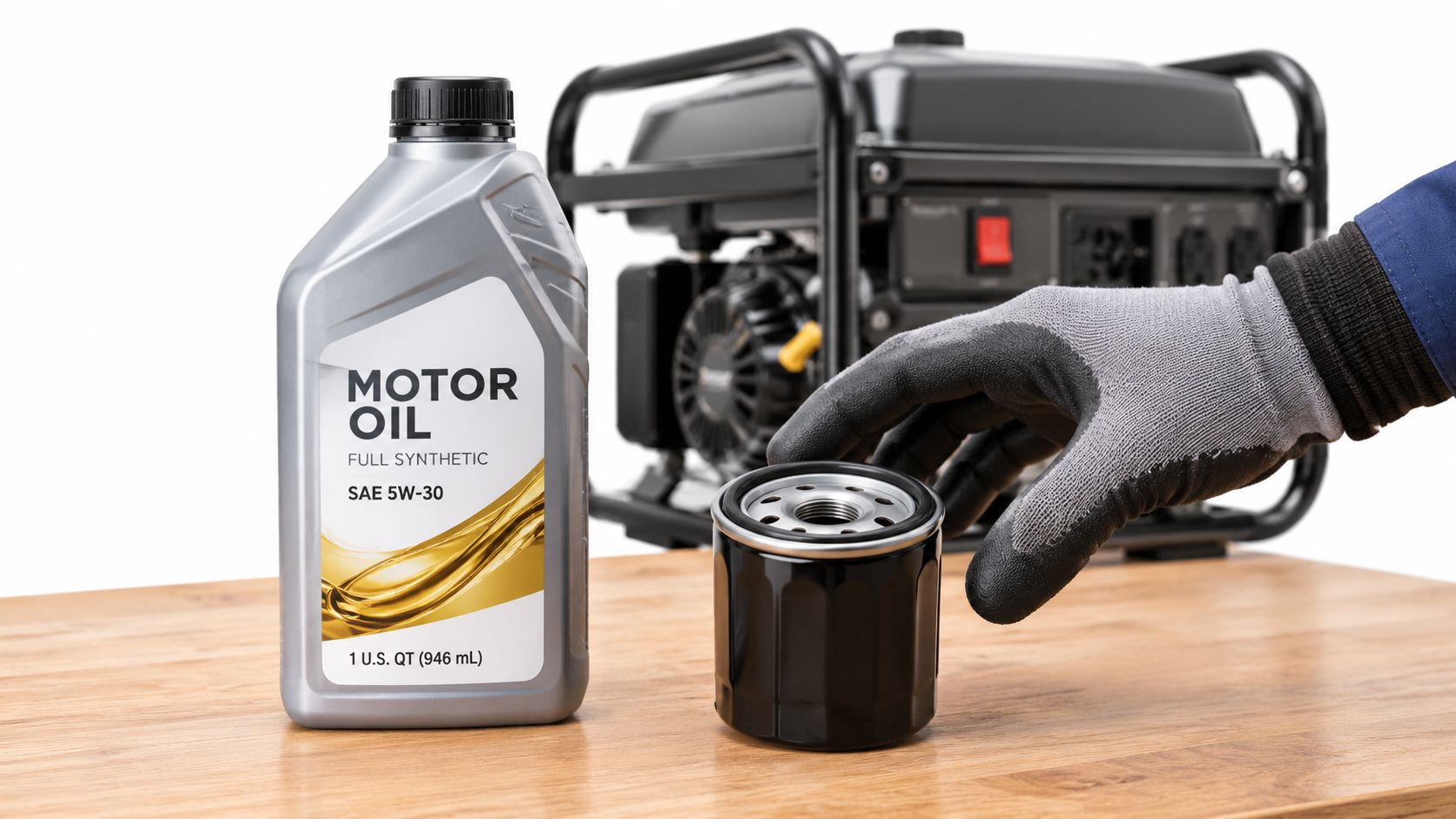
Use the specified oil grade and an approved filter. A Generac residential unit, a Kohler liquid-cooled set, and a Cummins diesel genset may have different lubrication requirements, so don't generalize from one installation to another. Record the brand and grade used, filter part number, operating hours, and the technician's observations.
Schedule oil service alongside a planned performance test when practical. Combining visits reduces disruption, but it shouldn't replace a proper test report.
An owner may check the level and note visible abnormalities. Draining oil, replacing the filter, handling hot fluids, resetting service indicators, and diagnosing contamination should be left to a trained person. Ask for the removed filter or a written record of its condition if the technician found unusual sludge, metal, or fuel dilution. For warranty-related questions, review the requirements in this generator maintenance and warranty guide.
The first image illustrates the basic service task, but the correct oil and filter still depend on the generator's model and manual.
2. Fuel System Inspection and Stabilization
A generator can have a healthy engine and still fail because fuel doesn't reach it at the required pressure and flow. The inspection changes with the fuel type. Propane and diesel systems require attention to stored liquid fuel, tanks, filters, moisture, and line condition. Natural gas systems require inspection of regulators, shutoff devices, connections, and delivery pressure.
Start with a visual check for leaks, damaged lines, corrosion, loose fittings, unusual odors, tank damage, and blocked vents. Don't operate a system with a suspected fuel leak. Close the appropriate shutoff only if you can do so safely, then call a qualified service provider.
Evidence from the service visit
Ask the technician to document:
- Fuel type and condition: Record whether the unit uses natural gas, propane, or diesel, along with relevant tank or supply observations.
- Filter status: Note the filter part number, replacement date, and any restriction or contamination found.
- Delivery verification: For a loaded test, record whether the fuel system maintained the pressure and flow needed for stable operation.
- Tank findings: For liquid fuel, document water, sediment, microbial contamination, corrosion, or other evidence requiring treatment.
Fuel stabilizer isn't a universal cure. Use only a product and treatment method approved for the fuel and generator. Diesel storage may require professional sampling, water removal, or fuel conditioning. Natural gas installations need qualified pressure and regulator checks, not improvised adjustments.
A generator that starts without load hasn't proved that its fuel supply can support the building's demand.
Prepare before the region's peak storm season rather than waiting for a warning. The technician should verify fuel delivery during a controlled loaded test and explain any limitation, such as a nearly empty tank, undersized piping, regulator damage, or a filter approaching its service interval. Keep the last inspection date and fuel findings in the log so seasonal preparation is based on evidence rather than memory.
3. Air Filter Replacement and Cleaning
The air filter protects the engine from dust, pollen, insects, and debris. A restricted filter reduces the air available for combustion and can contribute to poor running, reduced output, and accelerated engine wear. The right replacement interval depends on runtime and environment. Construction dust, agricultural debris, wildfire smoke, and heavy pollen can load a filter much faster than a clean suburban enclosure.
Don't treat every filter as washable. Many residential standby units use pleated paper elements that should be replaced, not cleaned. If the filter is damaged, wet, deformed, incorrectly seated, or bypassed by a gap in the housing, replacement alone won't solve the problem.
A practical inspection routine
Inspect the air-intake path during monthly checks and after severe weather. Look at the enclosure louvers, screens, filter housing, seals, intake ducting, and surrounding vegetation. Rodent nests and leaves can restrict airflow even when the filter itself looks acceptable.
A technician should provide:
- Filter condition: A written note or photograph showing whether the element was clean, loaded, damaged, or replaced.
- Restriction evidence: The reading from a restriction indicator, where fitted, or the technician's reason for replacement.
- Installation confirmation: Confirmation that the new element is correctly oriented and sealed.
- Environmental recommendation: A revised inspection interval if dust, smoke, pollen, or debris is shortening filter life.
Keep a spare approved filter on site, but don't install an unverified aftermarket part because it fits. Filter dimensions, sealing surfaces, and filtration performance matter. A monthly visual check is appropriate for an owner. Opening a contaminated housing, cleaning intake systems, diagnosing smoke, or investigating lost output deserves qualified service.
A homeowner in a dusty area may need more frequent inspections than the generic schedule. The useful record isn't just “filter changed.” It should show operating hours, environment, filter condition, and the reason the interval was selected.
4. Coolant System Maintenance for Liquid-Cooled Generators
Liquid-cooled generators depend on stable coolant level, correct chemistry, clear airflow, and sound hoses. A low reservoir may indicate a leak rather than normal consumption. A damaged hose, blocked radiator, failed fan, or incorrect coolant mixture can turn a routine outage into an over-temperature shutdown.
This task doesn't apply to every air-cooled home standby unit. First identify the cooling design from the model documentation. If the generator has a radiator, recovery tank, hoses, and a jacket-water circuit, treat coolant maintenance as a dedicated service item rather than folding it into a quick visual inspection.
What the owner can observe
With the engine cool, check the reservoir level and look for staining around hoses, clamps, the radiator, water pump, and enclosure floor. Check that vegetation, nesting material, and debris aren't blocking the radiator or ventilation openings. Don't remove a hot radiator cap. Never run a liquid-cooled engine with inadequate coolant.
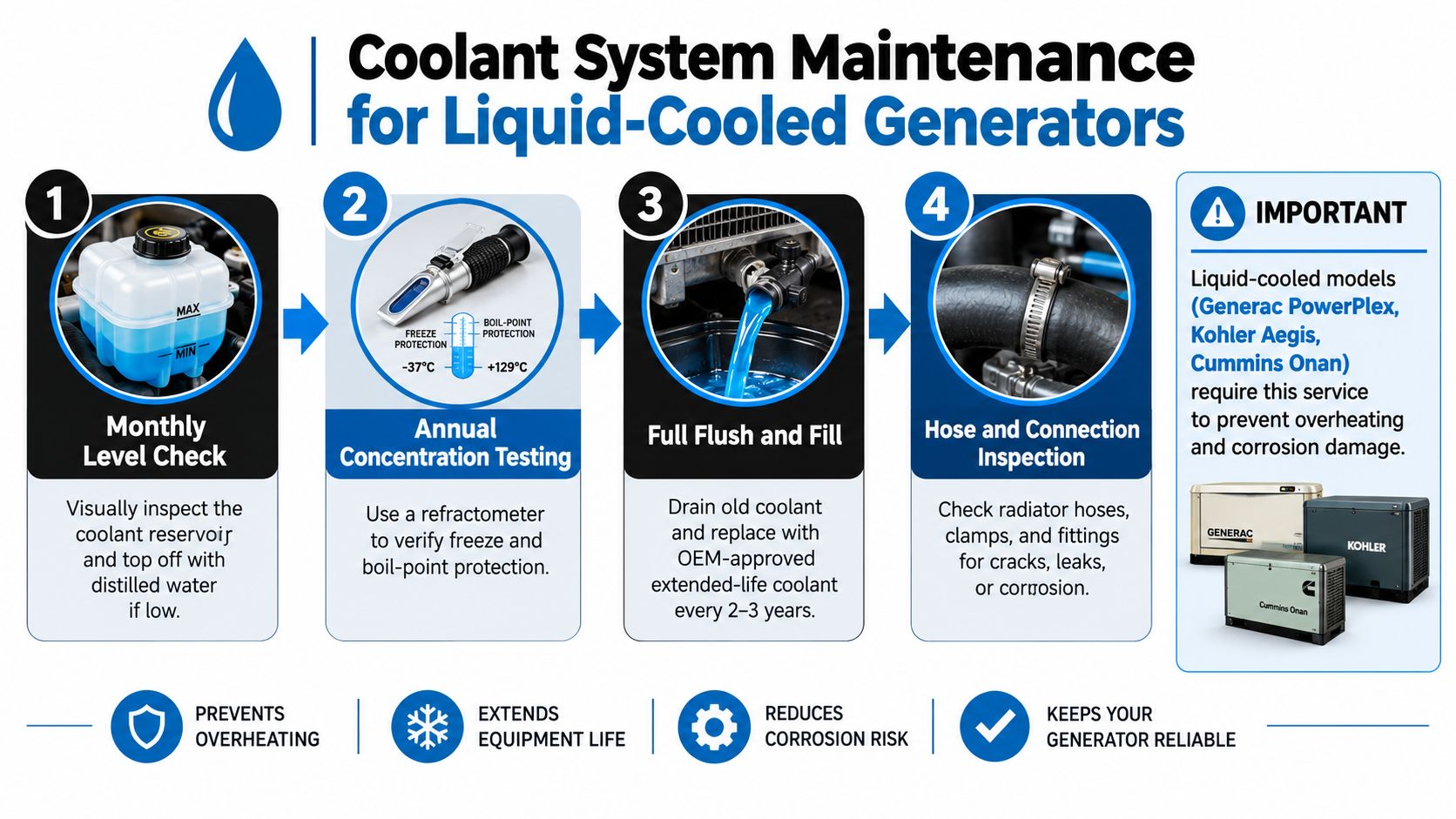
A technician should test concentration with the correct instrument, inspect hoses and clamps, and confirm that the coolant chemistry matches the manufacturer's specification. Mixing incompatible coolant types can create deposits or reduce corrosion protection. If topping off is permitted, use the fluid specified by the manual, not an improvised mixture.
The maintenance plan should identify the next flush or replacement date. Current practical guidance often places full coolant service on a two-to-three-year interval, but the owner's manual and the generator's operating conditions take precedence. Cold climates need particular attention to freeze protection, while hot or dusty locations may need closer inspection of radiator cleanliness and airflow.
Coolant level is an observation, not a diagnosis. A reservoir that keeps dropping needs leak investigation.
Request evidence of the concentration test, fluid used, hose and clamp findings, and any pressure or leak testing performed. Coolant flushing, disposal, radiator work, and repairs around hot or pressurized systems belong with a qualified technician.
5. Load Bank Testing and Exercise Loading
An unloaded exercise run proves that the engine can start and rotate. It doesn't prove that the alternator, governor, fuel system, cooling system, transfer switch, and protection controls can support the connected demand. Load bank testing adds a controlled electrical load so the technician can evaluate output and system stability under conditions closer to an actual outage.
A widely used maintenance pattern includes monthly loaded exercise runs of about 30 minutes and a deeper annual service that can include load-bank testing, as summarized by Pacific Northwest National Laboratory's standby-generator guidance. For systems where monthly loaded testing was missed for a month or longer, NFPA-aligned municipal guidance cited by Oxmaint's generator maintenance schedule guide describes an annual 1.5-hour load test as a corrective benchmark. Confirm the requirement for your system, jurisdiction, insurer, and manufacturer.
What the report should show
Don't accept “load test passed” as the complete record. Request readings at each test stage, including:
- Electrical output: Voltage, frequency, current, and kW.
- Engine response: Oil pressure, coolant temperature, speed stability, and abnormal smoke or vibration.
- Transfer operation: Start command, transfer, retransfer, cooldown, and any time delays relevant to the installation.
- Exceptions: Any failure to reach rated output, unstable frequency, overheating, fuel restriction, alarm, or shutdown.
Testing with the building's actual load can reveal behavior a portable load bank won't, especially where motors, pumps, compressors, or sensitive equipment create changing demand. A load bank offers repeatable conditions and avoids placing unnecessary stress on occupied spaces. The technician should explain which method was used and what it proves.
Schedule testing before the season when outages are most likely. Combine it with oil or filter service only if the technician can still provide separate records for each task. A result that shows reduced output should trigger investigation, not a casual note to “monitor.”
The process below illustrates a coolant-focused service sequence. It doesn't replace the electrical and engine readings required in a load test.
For planning a contractor visit or comparing service scope, GeneratorInstallerList's generator installer directory can be a starting point, but confirm credentials and testing capability directly.
6. Battery, Spark Plugs and Ignition System Inspection
The starting system deserves more attention than its size suggests. Historical research cited in Old Dominion University's generator reliability thesis links standby-generator failure analysis to a 0.0135 failure rate per start attempt in a survey referenced by IEEE 493-2007. That older baseline helps explain why a generator maintenance checklist puts battery condition, charger operation, terminals, and start-cycle verification near the center of the program.
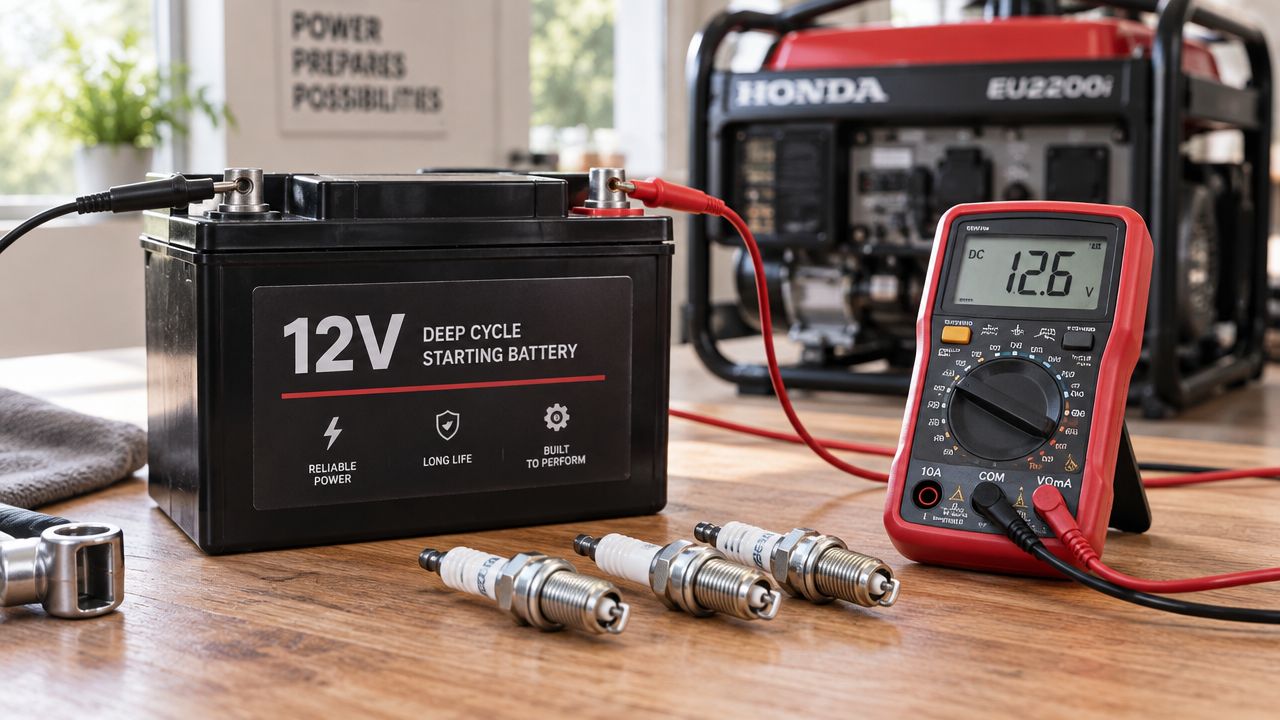
Begin with the battery and charger. Look for swelling, cracks, leakage, loose terminals, corrosion, damaged cables, and a charger that isn't reporting normal status. A voltage reading alone may not show how the battery behaves during cranking. Ask for a documented battery test under load or with the manufacturer-approved conductance method.
Ignition checks for spark-ignited units
Propane and gasoline generators use spark plugs and ignition components that need model-specific inspection. A technician should check plug condition, correct type, gap, ignition leads, coils, and starting behavior. Soot, oil fouling, or abnormal wear can provide clues about mixture, oil control, or combustion problems, but the technician should interpret the evidence in context rather than replace parts blindly.
Practical battery records should include:
- Battery identity: Type, installation date, and replacement date.
- Charger result: Status and measured output where applicable.
- Connection condition: Terminal tightness, corrosion, cable condition, and cleaning performed.
- Test result: The method used and whether the battery passed, weakened, or requires replacement.
Field guidance commonly emphasizes battery replacement around two to three years for standby applications, but climate, battery type, charger health, and the manufacturer's instructions matter. The cited Safe Electric summary also reports starter battery failures as 30% of genset failures, a useful reminder that a clean exterior doesn't demonstrate starting readiness.
An owner can inspect the display and visible battery condition. Electrical testing, terminal work, spark-plug replacement, ignition diagnosis, and starter repairs should be performed by someone qualified for the equipment.
7. Transfer Switch Testing and Electrical Connections
The transfer switch can make a well-maintained generator useless. It detects a utility failure, sends the start command, moves the building from utility to generator power, and later manages retransfer and cooldown. A generator that runs perfectly during a local exercise can still leave the property dark if the automatic transfer switch doesn't sense, command, transfer, or retransfer correctly.
Electrical connections need equal attention. Loose or overheated lugs, damaged insulation, arcing marks, corrosion, incorrect torque, and undersized equipment create safety and reliability risks. Never remove covers or tighten conductors in energized equipment as an owner task.
What a professional visit should establish
A licensed electrician or qualified generator technician should inspect the transfer switch and document:
- Control response: Whether a simulated utility failure initiated the correct start sequence.
- Transfer sequence: Whether the switch moved the intended load to emergency power.
- Retransfer: Whether utility restoration produced the correct return and cooldown sequence.
- Connection condition: Whether lugs, conductors, contactors, and terminals showed heat, corrosion, pitting, or arcing.
- Protection: Whether backfeed protection and anti-islanding functions are correctly installed and operating.
A manual transfer switch still needs a defined procedure. The responsible person should know which loads are permitted, how to verify utility isolation, and how to avoid energizing circuits beyond the generator's capacity. Automatic systems need controlled testing under the conditions permitted by the installation and local rules.
Ask the installer to explain the switch's fault indicators and any time delays. Keep the test date, result, defects, corrective work, and next recommended test in the log. For installation context, use this transfer-switch installation guide, then confirm the actual installation with a licensed professional familiar with local requirements.
8. Control System and Automatic Shutdown Mechanism Testing
A modern generator controller watches the engine and electrical system while coordinating automatic operation. It may monitor oil pressure, coolant temperature, battery condition, voltage, frequency, overspeed, overcrank, and other inputs. The controller's display can look normal while a sensor, configuration, charger, or transfer signal remains unverified.
Start with the status screen. Confirm the unit is in the correct automatic mode, has no active alarm, and shows a sensible operating-hours reading. Review stored fault history instead of clearing it automatically. A recurring alarm that disappeared after a reset is still a diagnostic lead.
Test protection, don't just read it
During qualified annual service, ask the technician to verify each applicable shutdown and alarm according to the manufacturer's procedure. The technician should record the simulated condition or test method, the response, the displayed code, and the reset process. Low-oil and high-temperature protections are intended to prevent severe damage, but improper testing can create its own risk, so don't defeat sensors or induce faults without the correct procedure.
Remote monitoring can add value when it reports loss of utility, low battery, controller alarms, or failed exercises. It isn't a substitute for local inspection or a loaded performance test. Configure notifications, confirm the account is active, and document who receives alerts.
Request a report showing:
- Controller status: Operating mode, active alarms, stored codes, and runtime hours.
- Shutdown results: Protection functions tested and their responses.
- Settings review: Relevant delays, sensing parameters, and transfer coordination.
- Monitoring status: Communications, notification recipients, and any unresolved signal fault.
- Owner handoff: Clear instructions for reading the panel and escalating an alarm.
A service visit should leave you with more than a cleared display. It should show that the control system can detect abnormal conditions, command safe shutdown, and coordinate the sequence expected during an outage.
8-Point Generator Maintenance Comparison
| Item | Complexity 🔄 | Resources ⚡ | Expected Outcomes ⭐ / 📊 | Ideal Use Cases 📊 | Key Advantages / Tips 💡 |
|---|---|---|---|---|---|
| Oil and Filter Changes | Low, routine service, simple steps 🔄 | Low, oil, filter, disposal supplies ⚡ | High ⭐, protects engine, extends life; measurable by oil condition 📊 | All standby units; annual or 100–200 hr intervals 📊 | Use OEM oil/filters; log service; schedule with other visits 💡 |
| Fuel System Inspection & Stabilization | Medium, inspections & tank work; some regs 🔄 | Medium, stabilizers, filters, possible tank cleaning; pro labor ⚡ | High ⭐, prevents start failures, improves combustion; long-term fuel health 📊 | Propane/diesel storage, long idle periods, storm prep 📊 | Use stabilizer, inspect before storm season, follow NFPA/regs 💡 |
| Air Filter Replacement & Cleaning | Low, quick visual and swap or clean 🔄 | Low, replacement filters or compressed air for foam ⚡ | Medium–High ⭐, improves efficiency, prevents contaminant ingestion 📊 | Dusty/smoke/pollen-prone environments; frequent-run units 📊 | Use OEM filters; inspect during monthly tests; keep spares on hand 💡 |
| Coolant System Maintenance (Liquid‑Cooled) | Medium–High, testing, flushing, leak checks 🔄 | Medium, OEM coolant, refractometer, trained tech; proper disposal ⚡ | High ⭐, prevents overheating/corrosion; protects engine longevity 📊 | Liquid‑cooled units; cold climates or heavy-duty usage 📊 | Test concentration annually; flush every 2–3 years; use distilled water & OEM coolant 💡 |
| Load Bank Testing & Exercise Loading | High, specialized equipment and skilled techs 🔄 | High, portable load bank, fuel consumption, technician time ⚡ | Very High ⭐, verifies full output, exposes hidden faults; documented results 📊 | Critical facilities, medical, data centers, commercial standby 📊 | Combine with oil/filter service; request detailed kW/voltage reports; test semi‑annually or quarterly 💡 |
| Battery, Spark Plugs & Ignition Inspection | Low–Medium, simple tests; some replacements more involved 🔄 | Low, battery, plugs, multimeter; occasional replacement costs ⚡ | High ⭐, ensures reliable starts; diagnoses engine conditions 📊 | Cold climates, older batteries, units with frequent starts 📊 | Test voltage monthly; replace battery every 3–4 yrs; clean terminals; use OEM plugs 💡 |
| Transfer Switch Testing & Electrical Connections | Medium, electrical testing, contactor checks 🔄 | Medium, inspection tools, licensed electrician; possible parts ⚡ | High ⭐, ensures safe automatic transfer, prevents backfeed and fires 📊 | Whole‑home/automatic systems; newly installed or modified systems 📊 | Verify sizing, tighten connections annually, test during load bank runs; use licensed techs 💡 |
| Control System & Automatic Shutdown Testing | Medium–High, diagnostics, firmware and sensor checks 🔄 | Medium, controller tools, possible firmware or replacement, remote subs ⚡ | High ⭐, prevents unsafe shutdowns, enables remote alerts and data logging 📊 | Units with remote monitoring, critical or unattended installations 📊 | Test shutdowns during load; keep firmware updated; enable remote monitoring; document fault codes 💡 |
Turn Maintenance Into Verifiable Readiness
A checklist protects you only when someone owns the schedule and records the result. Use monthly owner observations to look for leaks, debris, blocked ventilation, abnormal smells, visible corrosion, low fluid levels, charger warnings, and controller alarms. Run the generator according to the manual and site requirements, then record the date, runtime, operating mode, and any abnormal sound, smoke, vibration, or message.
Before the region's high-risk storm season, review fuel condition, battery age, spare filters, enclosure access, drainage, exhaust clearance, and transfer-switch readiness. Confirm that the service provider can respond with the right parts and understands the generator's fuel type, model, and connected loads. Seasonal preparation is also the right time to resolve small defects that don't yet prevent a start.
Annual professional service should cover the deeper parts of this generator maintenance checklist. That includes oil and filter service, battery testing, fuel-system inspection, coolant testing or flushing where applicable, air and exhaust inspection, controller and shutdown verification, transfer-switch testing, and loaded performance validation. Model-specific hour intervals still apply, especially after extended runtime during a prolonged outage.
Separate safe owner work from specialist work. Owners can perform visual checks, review status displays, verify that the unit is accessible, update the log, and report defects. Qualified technicians should handle fuel pressure and leak work, energized electrical equipment, transfer switches, load banks, coolant flushing, ignition diagnostics, protection settings, and repairs that could affect warranty or safety.
Require an itemized service report
A useful report should identify the generator by model and serial number and show:
- Operating history: Service date and engine hours.
- Fluids and filters: Oil grade, filter parts, coolant findings, fuel findings, and work completed.
- Starting system: Battery test method and result, charger status, and connection condition.
- Electrical performance: Transfer-switch results, voltage, frequency, kW output, and load-test conditions.
- Controls: Active and stored fault codes, shutdown tests, settings reviewed, and unresolved alarms.
- Defects and parts: Problems found, parts used, photographs where useful, and corrective recommendations.
- Next actions: The next calendar date, operating-hour trigger, and any seasonal follow-up.
This documentation supports practical decisions. It shows whether output is trending down, whether the battery has reached its replacement date, whether a filter is loading prematurely, and whether a contractor tested the transfer sequence rather than only starting the engine.
When comparing service providers, GeneratorInstallerList can help buyers find generator-focused installers by ZIP radius and filter for visible service and maintenance language. Its listings are independent research, not licensing verification or endorsement. Confirm credentials, insurance, brand capability, response scope, and the exact maintenance work included directly with each provider.
A generator is ready when the complete chain is supported by evidence: fuel reaches the engine, the battery starts it, the cooling and air systems sustain it, the alternator produces stable power, the transfer switch moves the correct load, the controller protects the equipment, and the log proves what was tested. That standard is more useful than a sticker showing a recent service date.
GeneratorInstallerList offers a ZIP-based directory of standby and whole-house generator installers, including listings with visible service and maintenance signals. Use GeneratorInstallerList to compare generator-focused providers near your property, then confirm credentials and request an itemized maintenance scope before booking.
- generator maintenance checklist
- standby generator maintenance
- generator service
- backup power maintenance
- generator safety
Ready to find who to call?
Open your state page or search by ZIP for a distance-sorted list.