Kohler vs Briggs Stratton
Kohler vs briggs stratton. Kohler vs Briggs & Stratton compared on reliability, warranty, dealer coverage, noise, and value to help you pick the right standby
Most advice on Kohler vs Briggs Stratton starts in the wrong place. People obsess over wattage, decibels, and engine size, then act surprised when the generator they bought on paper becomes a headache in the first real outage. The better question is simpler, and much more useful, which brand can be serviced where you live, by an authorized dealer, before your patience runs out.
That's the part most comparison charts skip. A standby generator is not a one-time appliance, it's a service relationship, and the local dealer usually matters more than the badge on the enclosure. Kohler tends to sit in the premium, quieter lane, while Briggs & Stratton often competes harder on warranty terms and broad residential value, but those advantages only matter if the install and service path are realistic in your zip code.
| Brand | Best fit | Main strength | Main risk |
|---|---|---|---|
| Kohler | Buyers who want premium positioning and quieter operation | Strong industrial legacy and quiet reputation | Smaller service footprint in many areas |
| Briggs & Stratton | Buyers who want value, broader residential reach, and stronger warranty appeal | Wide product span from home to commercial standby | Warranty fulfillment can be awkward if local authorized service is thin |
Table of Contents
- Why Brand Choice Matters Less Than You Think
- Brand Background and Where Each Stands in 2026
- Whole-House Lineups and Standout Models
- Reliability, Warranty, and Noise Compared
- Dealer Coverage and Service Realities
- Installed Cost and Lifetime Value
- Which Brand Fits Your Situation
Why Brand Choice Matters Less Than You Think
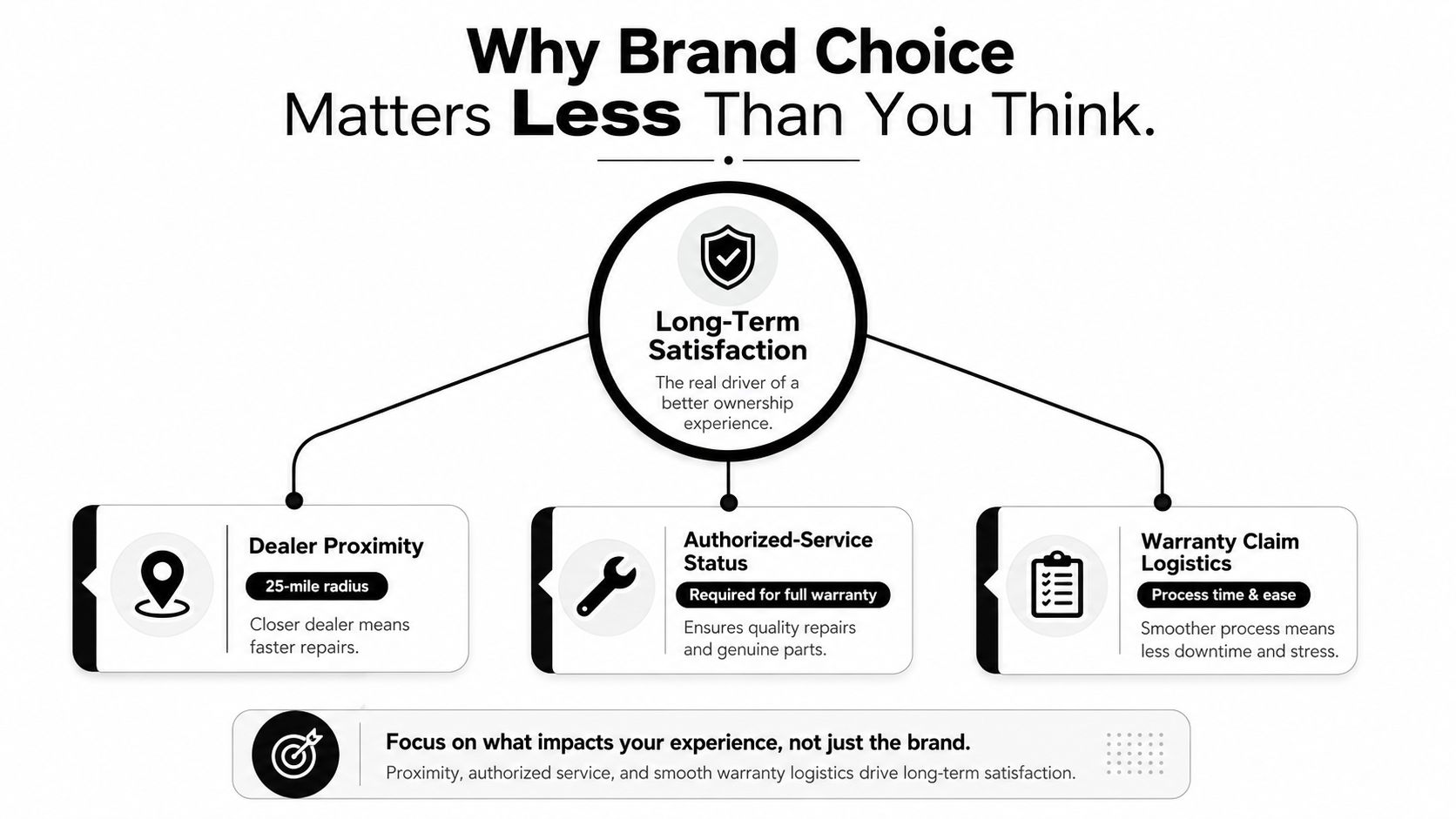
The usual Kohler vs Briggs Stratton debate starts with specs, and that's exactly why buyers make bad decisions. A generator that looks better on paper but can't be serviced quickly is a worse purchase than a slightly less glamorous unit with a dealer who answers the phone. Independent comparison guidance keeps landing on the same practical truth, dealer coverage and warranty logistics shape long-term satisfaction more than the badge itself, especially because Briggs requires warranty repairs to be done by an authorized dealer in its stated process (Generators Guide on home standby service logistics).
What buyers usually miss
Both brands are competing in the same broad standby category, so the real-world gap is narrower than the marketing suggests. Kohler's generator line carries a long industrial legacy inside a much older company, while Briggs & Stratton spans residential and commercial-scale standby demand, but neither brand wins by magic alone. The outcome usually comes down to who installed it, who sold it, and who will come back when something faults.
Practical rule: if the nearest qualified dealer is unreliable, the “better” generator becomes the worse ownership experience.
That matters because standby generators are judged on the worst day of the year, not the day they're installed. A responsive local dealer turns a warranty promise into an actual repair path, while a distant one turns a coverage clause into frustration. In practice, that's why I tell buyers to stop asking “which brand is better?” and start asking, “who is going to service this thing for the full warranty period?”
The real buying filter
If you're comparing these two brands, use serviceability as the first screen. Ask which dealer will register the unit, who handles warranty claims, and whether the local shop stocks parts for that brand. The spec sheet matters, but only after the service map makes sense.
Brand Background and Where Each Stands in 2026
Kohler's generator story starts early, with roots going back to 1920, when Kohler began manufacturing generators, and broader company history reaching to 1873, when John Michael Kohler founded Kohler Co. in Wisconsin (Today's Mower on major generator manufacturers in Wisconsin). That history still shows up in how buyers think about the brand, as a premium, industrial-leaning choice with a long memory. The important 2026 twist is that Kohler's energy division was sold in 2024 to Platinum Equity and rebranded as Rehlko, with reporting that previously valued the deal at around $3 billion (Today's Mower on the 2024 energy-business separation).
Why the name still matters to buyers
For a homeowner, the nameplate can still say Kohler, but ownership and dealer dynamics changed. That can affect how people interpret warranty support, parts continuity, and the way local installers talk about the brand. The hardware may look familiar, but the commercial reality around it shifted, and that shift is the part buyers need to notice.
Briggs & Stratton sits in a different posture. It's still a widely recognized power-equipment name, and its standby range clearly spans residential through commercial demand. The current lineup shows that span well, from a 26 kW home standby unit to a 200 kW natural-gas platform, which tells you Briggs is not just playing in the small-home corner (Briggs & Stratton PowerProtect+ 26 kW home standby generator, Briggs & Stratton 35 kW standby generator).
What this means in 2026
A buyer in 2026 should care less about old reputation and more about the current support structure. Kohler still carries premium recognition, but it now does so under a changed corporate umbrella. Briggs still leans into residential accessibility and broad product reach. The central question isn't which company has the richer history, it's which one the nearby dealer can still support cleanly.
Whole-House Lineups and Standout Models
The practical way to compare Kohler vs Briggs Stratton is by looking at the tiers buyers quote: roughly 12 kW, 20 kW, and then the upper residential or light-commercial range. Briggs publishes concrete home-standby specs on the 26 kW PowerProtect+ unit, including a 993 cc Vanguard engine, 65.5 kVA motor-starting capability at a 35% voltage dip, 65 dBA operating sound, 235,000 BTU/hr propane use at 50% load, and 206,000 BTU/hr natural-gas use at 50% load (Briggs & Stratton PowerProtect+ 26 kW home standby generator). That's the kind of data that helps you decide whether the unit belongs on a tight suburban lot or in a more forgiving install zone.
Reading the lineup like an installer
Briggs also shows how far upmarket its range goes. Its 35 kW standby generator is rated at 145 A on both propane and natural gas, uses a 4,300 cc engine, and lists 68 dBA normal operating sound with 262,000 BTU/hr propane consumption and 258,000 BTU/hr natural-gas consumption at 50% load (Briggs & Stratton 35 kW standby generator). At the top end, the 200 kW natural-gas platform reaches up to 694 A, uses an 11,100 cc engine, runs at 72 dBA, and consumes 1,494,000 BTU/hr at 50% load (Briggs & Stratton 35 kW standby generator). That spread shows a brand that isn't trapped in one market segment.
Kohler's lineup in the comparison brief centers on the 8RESCL, 12RESVL, 20RESCL, and 38RCLA, while Briggs' practical comparison set includes 12 kW, 17 kW, 20 kW, 26 kW, and the 50 kW Fortress liquid-cooled model. The takeaway is simple, Kohler's catalog is often discussed as the premium home-and-larger-residential choice, while Briggs gives buyers a wider practical ladder from basic whole-house coverage to commercial-scale standby.
| Model | Brand | Rated Watts (NG/LP) | Noise @ 23 ft (dB) | Fuel Draw @ Full Load (NG cfh) | Transfer Switch |
|---|---|---|---|---|---|
| 8RESCL | Kohler | Not provided in verified data | Not provided in verified data | Not provided in verified data | Not provided in verified data |
| 12RESVL | Kohler | Not provided in verified data | Not provided in verified data | Not provided in verified data | Not provided in verified data |
| 20RESCL | Kohler | Not provided in verified data | Not provided in verified data | Not provided in verified data | Not provided in verified data |
| 38RCLA | Kohler | Not provided in verified data | Not provided in verified data | Not provided in verified data | Not provided in verified data |
| 12 kW | Briggs & Stratton | Not provided in verified data | Not provided in verified data | Not provided in verified data | Not provided in verified data |
| 17 kW | Briggs & Stratton | Not provided in verified data | Not provided in verified data | Not provided in verified data | Not provided in verified data |
| 20 kW | Briggs & Stratton | Not provided in verified data | Not provided in verified data | Not provided in verified data | Not provided in verified data |
| 26 kW PowerProtect+ | Briggs & Stratton | Not provided in verified data | 65 dBA | Not provided in verified data | Not provided in verified data |
| 50 kW Fortress | Briggs & Stratton | Not provided in verified data | Not provided in verified data | Not provided in verified data | Not provided in verified data |
The model range matters less than the load profile. A quiet 20 kW unit that starts your home cleanly beats a louder machine that overshoots what you really need.
For buyers sorting through quotes, the comparison is at the capacity tier that matches the house, not the biggest number on the brochure. If your shortlist lives in the 12 kW to 26 kW range, you're comparing how each brand handles whole-house essentials, motor starting, and sound. If you're in the upper tier, you're usually comparing install complexity and service footprint as much as the generator itself.
Reliability, Warranty, and Noise Compared
Reliability is where brand arguments get lazy. The cleaner comparison is not “who never breaks,” because both brands have enough field history to show they're legitimate standby players. The actual question is whether the ownership path feels stable when a claim needs attention, and whether the unit is pleasant enough to live with near a bedroom wall or fence line.
Warranty structure changes the game
Briggs has been aggressive on warranty positioning. The verified data notes 10-year parts, 5-year labor limited warranty coverage on Fortress models, and 6-year coverage on Premium units, while Kohler's standard coverage is a 5-year limited warranty (Generators Guide on best home standby generators). That doesn't automatically make Briggs “better,” but it does mean the paperwork can look stronger on select Briggs models, especially if you're comparing premium residential configurations.
Noise is the other ownership metric that gets felt every day. The comparison brief points to Kohler models like the 14RESA and 20RES sitting at roughly 67 dB(A), while Briggs Fortress and Premium units land in the 64 to 73 dB range (GensizeCalculator on best standby generators). Briggs' own 26 kW PowerProtect+ is listed at 65 dBA, which puts it in the same quiet-enough zone for many neighborhoods (Briggs & Stratton 26 kW PowerProtect+).
Side-by-side ownership factors
| Metric | Kohler 14RESA / 20RES | Briggs Fortress 26 kW | Briggs Premium 20 kW |
|---|---|---|---|
| Reliability signal | Premium, established standby reputation | Strong warranty appeal on select models | Value-focused with longer coverage on some units |
| Warranty | 5-year limited (GensizeCalculator) | 10-year parts, 5-year labor limited on Fortress (GensizeCalculator) | 6-year on Premium units (GensizeCalculator) |
| Noise | Around 67 dB(A) (GensizeCalculator) | 64 to 73 dB range (GensizeCalculator) | 64 to 73 dB range (GensizeCalculator) |
| Fuel efficiency | Often competitive, but model-specific | Often close to Kohler, sometimes better value under load | Comparable in practice, depends on load and gas type |
The fuel story is usually less dramatic than buyers hope. In the brief, the Briggs 26 kW and Kohler 24RCLA are often separated by under 10% on fuel burn at comparable conditions, which is close enough that install quality and serviceability matter more than chasing tiny efficiency differences (GensizeCalculator on best standby generators). For a lot of homes, that means the quieter or better-supported machine wins, not the one that technically trims a little fuel.
For maintenance and warranty handling, use a real service-oriented resource like the generator maintenance and warranty guide before you sign a quote. It's the kind of topic that only matters after the sale, which is exactly why people ignore it until it hurts.
Dealer Coverage and Service Realities
The purchase either goes smoothly or turns into a mess. Both brands depend on authorized dealers for warranty registration and warranty work, and that means the install is only as good as the service chain behind it. If the dealer you're buying from is thin on techs, slow on parts, or vague about claim handling, the warranty looks a lot better in the brochure than it does during an outage.
What actually happens when something faults
At hour 13 of a storm outage, nobody cares about engine displacement. The homeowner calls the dealer, the dealer decides whether it's a simple reset, a tech dispatch, or a parts order, and then the regional supply chain does the rest. That's why service response time matters so much more than spec-sheet prestige, because every step between the first phone call and restored power is controlled by the brand's authorized channel, not by wishful thinking.
Briggs often gets credit for broader residential channel reach, especially in suburban and exurban areas where plumbing, HVAC, and electrical contractors may already carry its gear. Kohler's network tends to skew toward larger generator specialists, which can be excellent if you have a strong local shop and annoying if you don't. The post-2024 Kohler-to-Rehlko transition adds another layer, since buyers are still seeing the Kohler name on equipment while the energy business now lives under a different ownership structure (Today's Mower on the 2024 energy-business separation).
Service rule: if a dealer can't clearly explain who files the warranty claim, who performs the labor, and how parts move, don't assume the process will be smooth later.
For buyers who want to search installers by brand signal, a directory like GeneratorInstallerList's Kohler installer tag is useful because it surfaces shops that visibly mention Kohler work on their own sites. That doesn't certify quality, and it shouldn't be treated like a license check, but it does reduce the noise when you're trying to find a real standby-capable installer instead of a general electrician dabbling in generators.
The service question that should come first
Ask every dealer the same three things. Who handles warranty registration, who performs authorized repairs, and how far out are they booking service calls in your area? If they dodge those questions, the brand choice doesn't matter yet, because the service path is already weak.
Installed Cost and Lifetime Value
Installed cost is where buyers often overpay for the wrong reason. The hardware price gets all the attention, but the full bill includes the transfer switch, gas line work, pad, labor, and permitting. Once those pieces are in play, comparable whole-house systems can land much closer together than shoppers expect.
Where the totals usually land
The comparison brief puts typical 14 to 20 kW Kohler RES installs around $8,500 to $13,500 installed, while Briggs & Stratton 20 kW Premium and 26 kW Fortress systems often sit around $7,000 to $12,500 installed (GensizeCalculator on whole-house generator cost). That means Briggs can look cheaper up front, but the overlap is wide enough that local labor and site conditions still decide a lot. For some buyers, the more expensive brand is only slightly more expensive once the job is done.
| Cost Component | Kohler 20RES | Briggs 20 kW Premium | Briggs 26 kW Fortress |
|---|---|---|---|
| Typical installed range | $8,500 to $13,500 (GensizeCalculator) | $7,000 to $12,500 (GensizeCalculator) | $7,000 to $12,500 (GensizeCalculator) |
| Annual maintenance | $250 to $400 (GensizeCalculator) | $250 to $400 (GensizeCalculator) | $250 to $400 (GensizeCalculator) |
| Runtime fuel cost | Natural gas burn matters more than headline wattage | Natural gas burn matters more than headline wattage | Natural gas burn matters more than headline wattage |
| Battery replacement | Every 3 to 4 years (GensizeCalculator) | Every 3 to 4 years (GensizeCalculator) | Every 3 to 4 years (GensizeCalculator) |
The important point is not that Briggs is always cheaper. It's that Briggs often gives buyers more installed watts for the dollar, while Kohler often asks you to pay for quieter positioning and premium perception. If the two quotes are close, the better value is usually the one with the cleaner service plan and the better dealer.
Lifetime value beats first price when the local service path is weak, because the cheapest installed unit can become the most expensive one to own.
On lifetime value, you should think in terms of maintenance cadence, fuel draw during real outages, and replacement parts over time, not just sticker price. The installed cost overlap means the decision often comes down to whether you want to pay a modest premium for Kohler's premium positioning or take Briggs' stronger value angle and longer warranty structures on select models. If you only compare the invoice total, you're missing the part of ownership that creates friction.
Which Brand Fits Your Situation
The cleanest recommendation is this, Kohler fits buyers who have a strong local authorized dealer and care about premium ownership, while Briggs & Stratton fits buyers who want broader residential reach, stronger warranty appeal on select models, and better value at similar installed cost. That's the short version, and it's the one I'd give in a real consult when the quote stack is on the table.
Choose Kohler when the service map is tight
If you live within roughly 25 miles of a dealer you trust, Kohler is the safer premium buy. The brand makes sense for buyers who want the quieter-feeling, more polished ownership experience, and for people who are already working with a generator specialist that knows the Kohler ecosystem well. It's the better emotional fit for homeowners who'd rather pay for the premium lane than gamble on marginally looser support.
Choose Briggs when reach and value matter more
Briggs & Stratton is the better practical choice for buyers who care about broader service reach, especially in areas where generator specialists are sparse and HVAC, plumbing, or electrical contractors are more likely to carry the brand. It also suits buyers who want strong standby coverage without paying extra just for the nameplate. If you're balancing budget, warranty terms, and a service footprint that exists in your area, Briggs usually makes more sense.
Use this three-question checklist
- Nearest authorized service distance: If the closest real service option is too far away, that brand is the wrong answer.
- Expected run hours per year: Higher use makes warranty terms and parts access more important, not less.
- Tolerance for warranty friction: If you don't want to argue with claim logistics, choose the brand with the cleaner local process.
If those answers point in different directions, I'd favor serviceability over prestige every time. In a real outage, the brand with the better local path is the one that protects you.
If you want a fast way to narrow the field, GeneratorInstallerList gives you a buyer-focused way to find standby and whole-house installers, including brand-filtered options for Kohler and Briggs & Stratton. Use GeneratorInstallerList to compare local installer signals, then bring those names to your quote calls and ask the service questions that decide ownership.
- kohler vs briggs stratton
- standby generators
- whole-house generator
- generator warranty
- home backup power
Ready to find who to call?
Open your state page or search by ZIP for a distance-sorted list.