Manual Transfer Switch Installation Cost
Explore manual transfer switch installation cost in 2026, from typical hardware prices to labor rates, permits, and the factors that shift your final quote.
A manual transfer switch installation typically costs about $400 to $2,500 installed, depending on the home and the scope of work. The switch hardware alone is often only $200 to $800, with labor, permits, materials, panel access, and circuit count creating the gap.
You're probably looking at a portable generator, a crowded electrical panel, and a quote that seems much higher than the price of the transfer switch sitting in an online shopping cart. That reaction is understandable. The hardware is visible, but the work needed to connect it safely, move selected circuits, install the inlet, satisfy local requirements, and test the system is where the invoice grows.
The mistake I see most often is comparing a hardware price with an installed price. Those are different purchases. A low equipment price doesn't mean the finished installation will be inexpensive, and a high quote isn't automatically inflated. The scope has to match.
Table of Contents
- What a Manual Transfer Switch Costs in 2026
- How the Final Quote Is Built
- Why Labor Costs Vary So Widely
- Manual Transfer Switch vs Interlock Kit
- What to Check at Your Home Before You Quote
- Reading a Quote Without Getting Burned
- Getting Comparable Quotes in Your Area
What a Manual Transfer Switch Costs in 2026
A homeowner comparing a $200 to $800 switch online with a $1,000 to $2,500 installation quote is comparing two different purchases. The first figure covers equipment. The second can include the inlet, conductors, conduit, circuit connections, labeling, testing, permits, and electrician time. Residential pricing guidance places added materials around $50 to $100 in many installations, but the site determines the final invoice.
The four line items that widen the gap are labor, permits, panel accessibility, and circuit count. A short, accessible wiring route and a small group of selected circuits keep the job controlled. A crowded panel, difficult access, longer routing, or more circuits can push the installed price to twice the hardware cost or more. A whole-house generator cost guide can help with broader backup-power planning, but it should not replace a manual-switch estimate.
Consider a ranch home with a 200-amp panel, eight circuits, and a switch location within 15 feet of the generator inlet. That layout supports a mid-range quote. If the panel sits in a cramped area or the electrician must route wiring through finished spaces, the same switch can produce a much higher invoice.
Practical rule: Price the electrical path, not the metal enclosure. The box is usually the predictable part.
| Scenario | Hardware Only | Fully Installed |
|---|---|---|
| Basic manual switch for selected circuits | $200–$400 | $400–$1,300 |
| Standard residential setup with several circuits | $350–$600 | $1,000–$2,500 |
| Complex, circuit-heavy or code-intensive installation | $600–$800 | $1,500–$3,000 |
The $1,500 to $3,000 range applies when permits, a power inlet, added wiring, labor, or panel work expand the scope. Granular transfer-switch installation cost guidance supports separating equipment from the complete project price. Ask for those line items separately. A low equipment price does not make a low installed quote, and a high quote is not automatically inflated. The scope must match.
How the Final Quote Is Built
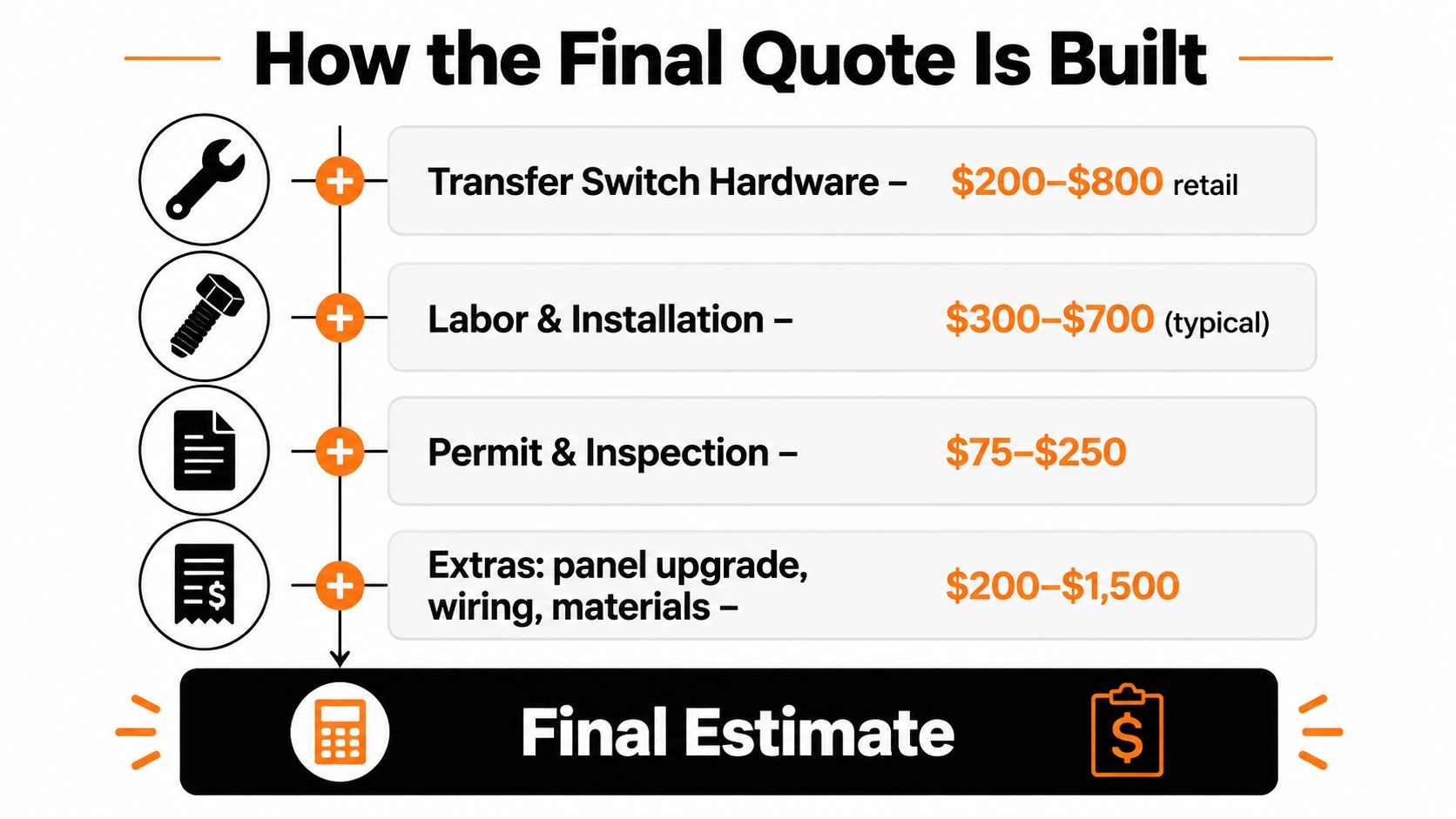
A reliable estimate separates four cost buckets: hardware, labor, materials, and permits. Hardware is easiest to identify. Labor changes with site conditions, materials follow the physical route, and permits depend on local rules. Those four lines explain why the installed price can reach twice the switch price or more.
Hardware and labor
Hardware: The switch itself usually falls between $200 and $800, depending on circuit capacity, amperage rating, brand, and configuration. Ask for the exact model. A vague “transfer switch” allowance makes comparison difficult because capacity and circuit count can change the equipment price.
Labor: A simple installation may fall in the lower labor range, while panel access, circuit quantity, wiring, and inspection requirements can push the charge much higher. The electrician is pricing the work required to trace circuits, make terminations, mount equipment, and test the setup, not just the time spent handling the switch. A low labor allowance deserves questions if the panel is enclosed or poorly labeled.
Materials: Conduit, wire, breakers, an exterior inlet box, mounting hardware, fittings, and labels are separate from the switch. A short, accessible route keeps this line controlled. Longer wiring runs, difficult surfaces, or added circuit work increase it quickly.
Permits and inspections: Permit fees can change the total before panel work begins. Residential generator permits are cited at $50 to $300, electrical permits at $50 to $200, and local examples range from about $50 to $354, according to generator permit cost guidance. Confirm whether the quote includes permit filing, inspection coordination, and any correction visit.
A quote that adds up
Suppose a contractor quotes a $1,600 project. A sensible written breakdown could show $450 for hardware, $650 for labor, $175 for materials, and $325 for permit and inspection costs. These figures illustrate how the total is assembled, not a universal price.
Use this transfer switch installation guide to clarify the work before comparing bids. Require the electrician to name the switch model, circuit count, inlet location, wiring route, and every fee excluded from base labor. That is how you separate a low quote from an incomplete one.
This video can also help you visualize how the equipment connects to the home's electrical system:
Why Labor Costs Vary So Widely
A homeowner can buy the same transfer switch for two houses and receive very different installation quotes. Labor covers far more than mounting the switch. The electrician must reach the panel, identify circuits, route and secure wiring, install the inlet, complete terminations, test the system, and prepare it for inspection. Those tasks explain why the installed price can widen far beyond the hardware price.
Panel accessibility sets the starting point
An exposed panel in a garage with clear working space is a straightforward job. A flush-mounted panel in a finished basement closet requires more care. The electrician may need to trace poorly labeled circuits, work around finished walls, add mounting support, or route cable through restricted spaces.
That difference can move labor from a simpler $200 to $500 range toward $300 to $1,500 when access and routing become more involved, according to the installation complexity breakdown. The switch has not changed. The property has.
Ask whether the quote includes wall access, cable routing, patching, and difficult panel work. These items often explain a major gap between bids.
Circuit count adds repetitive work
Each selected circuit must be identified, connected or moved correctly, labeled, and tested. Six circuits require less coordination than fourteen, especially inside a crowded panel or one with incomplete labeling.
Circuit count also determines the equipment configuration. A small essential-load setup may cover only a few appliances, while refrigerators, pumps, heating equipment, lighting, and selected receptacles require broader coverage. A contractor calling a circuit-heavy scope “basic” is understating the labor.
Permits can add time beyond the panel
Permit and inspection requirements affect the schedule as well as the fee. The electrician may prepare documentation, arrange the inspection, return for corrections, or coordinate separate review stages. Cited local examples place permit charges between $50 and $354, according to permit fee guidance for generator work.
Two homes with the same switch and circuit count can still produce very different labor lines. An accessible panel may allow a short, predictable visit. A buried panel can require substantially more work, and labor may effectively double without any equipment change. Treat phone estimates as preliminary until the electrician sees the panel, wiring route, and selected circuits.
Manual Transfer Switch vs Interlock Kit
An interlock kit can lower the hardware cost, but it only works when the panel and generator setup support it. A dedicated manual transfer switch assigns a defined group of backed-up circuits. An interlock mechanically prevents the utility main breaker and generator breaker from operating together, while the homeowner manages the selected circuits at the main panel.
The installed-price gap is often smaller than the product-price gap. A manual transfer switch commonly falls around $500 to $1,500 installed in some markets. Interlock work may cost less for a straightforward setup, but panel compatibility, wiring, permits, and the number of circuits can erase that difference. Hardware prices alone do not make a reliable comparison.
| Factor | Manual Transfer Switch | Interlock Kit |
|---|---|---|
| Cost structure | Separate switch, inlet, wiring, labor, and permits | Kit plus compatible breaker work, inlet, wiring, labor, and permits |
| Load selection | Clearly defined circuits | Managed through the main panel |
| Operation | Centralized circuit switching | Main breaker and individual generator circuits |
| Panel requirements | May need space for transfer equipment | Must be listed for the specific panel and fit correctly |
| Best fit | Essential circuits with clear separation | Modern panel with suitable space and a simpler portable-generator setup |
| Main drawback | More equipment and wiring | More hands-on load management and panel-specific compatibility |
An interlock must be listed for the exact panel and installed according to its instructions. The kit is not automatically acceptable because it fits physically. Equipment listing, panel design, breaker compatibility, and local inspection requirements all matter. Ask the electrician or local authority before buying; a low-priced kit that cannot be approved is wasted money.
Choose an interlock for a modern panel with available breaker space, a portable generator, and a clear plan for limiting loads. It is a practical choice when everyone using the system understands which breakers can run during an outage.
Choose a dedicated manual transfer switch when you want centralized control and clearly separated circuits. It costs more in equipment and installation, but operation is easier to explain to another household member. The switch also reduces the chance that someone energizes too many loads by turning on breakers without checking generator capacity.
What to Check at Your Home Before You Quote
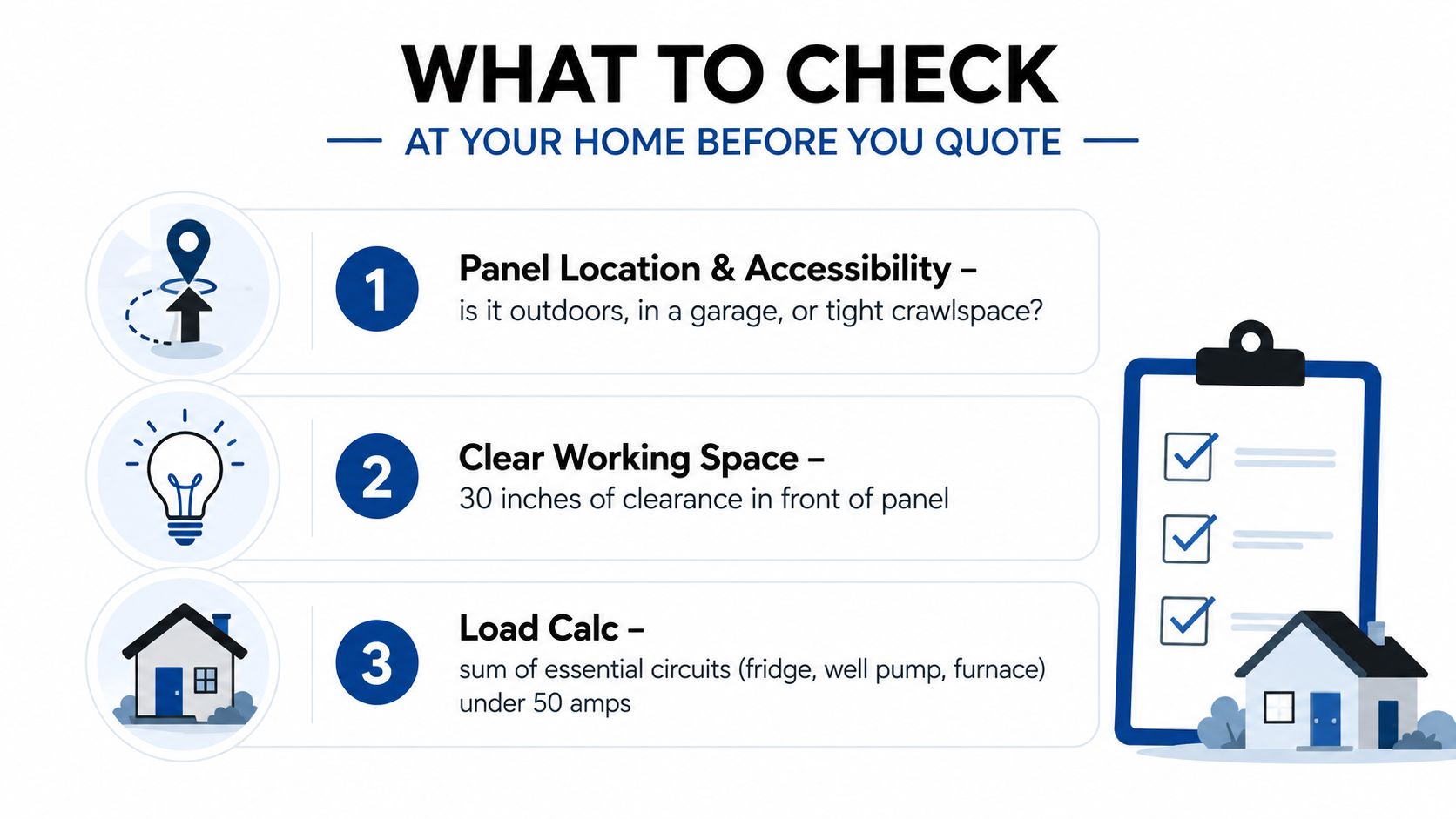
A few observations before the electrician arrives can make the quote far more accurate. They do not replace an on-site assessment, but they reveal the four cost drivers that widen the hardware price into the installed price: labor, permits, panel access, and circuit count.
Start with the panel location
Record whether the panel is an outdoor meter-main combination, an indoor garage panel, a flush-mounted closet panel, or a panel beside a basement stairwell. Check the likely route from the panel to the generator inlet. A short, open path is straightforward to price. Finished walls, tight spaces, and obstructions add labor, conduit, wire, and sometimes patching.
Clear the area before the appointment. The electrician needs safe access, room to inspect the panel, and a suitable mounting location. The most convenient spot shown in an online product photo may not work at your house.
Confirm service amperage
Read the service rating on the panel or main disconnect. A 100-amp panel may require a different configuration, such as a subpanel or supply-side work. A 200-amp panel often gives the electrician more workable options, but it does not set the final price. The rating identifies constraints that need review, especially when the panel has limited space or older equipment.
Build a real circuit list
Write down the loads you want available during an outage:
- Food protection: Refrigerator and freezer circuits.
- Water management: Well pump or sump pump.
- Heating: Gas furnace blower or other heating controls.
- Connectivity: Internet equipment and selected lighting.
- Health and work: Medical equipment or a dedicated home-office circuit.
Count breakers, not appliances. Multiple devices can share one circuit, while a single large load may need its own circuit. Circuit count directly affects transfer-switch capacity, wiring, labor, and the permit scope.
Bring the list, panel photos, service rating, and approximate inlet location to the appointment. Also show the gas meter and proposed generator location, even if the transfer-switch electrician does not perform fuel work. Distance, wall construction, and access help the contractor write a real scope instead of carrying a vague allowance.
Reading a Quote Without Getting Burned
A fair quote lets you rebuild the job line by line. If it only says “manual transfer switch installation” with one round number, you cannot tell whether the contractor included the inlet, permit, circuit connections, testing, or panel corrections. That missing detail is where a cheap quote turns expensive.
Check for these items in writing:
- Hardware identity: Brand, model, amperage, circuit capacity, and a separate equipment price.
- Labor scope: Hours, crew assumptions, or a clearly defined flat labor charge.
- Permit handling: Permit and inspection fees, plus who applies and schedules.
- Physical materials: Conduit, wire, breakers, inlet box, fittings, and mounting hardware.
- Panel work: Breaker-space changes, knockouts, supply-side tap, or subpanel allowance.
- Warranty coverage: Separate equipment and labor terms, including what happens if a connection fails.
A missing permit line does not prove poor workmanship, but it requires a direct question. Transfer-switch work may require electrical permitting, so the quote should state whether the contractor handles the application, inspection scheduling, and related fees. If the answer is vague, treat that as an incomplete scope.
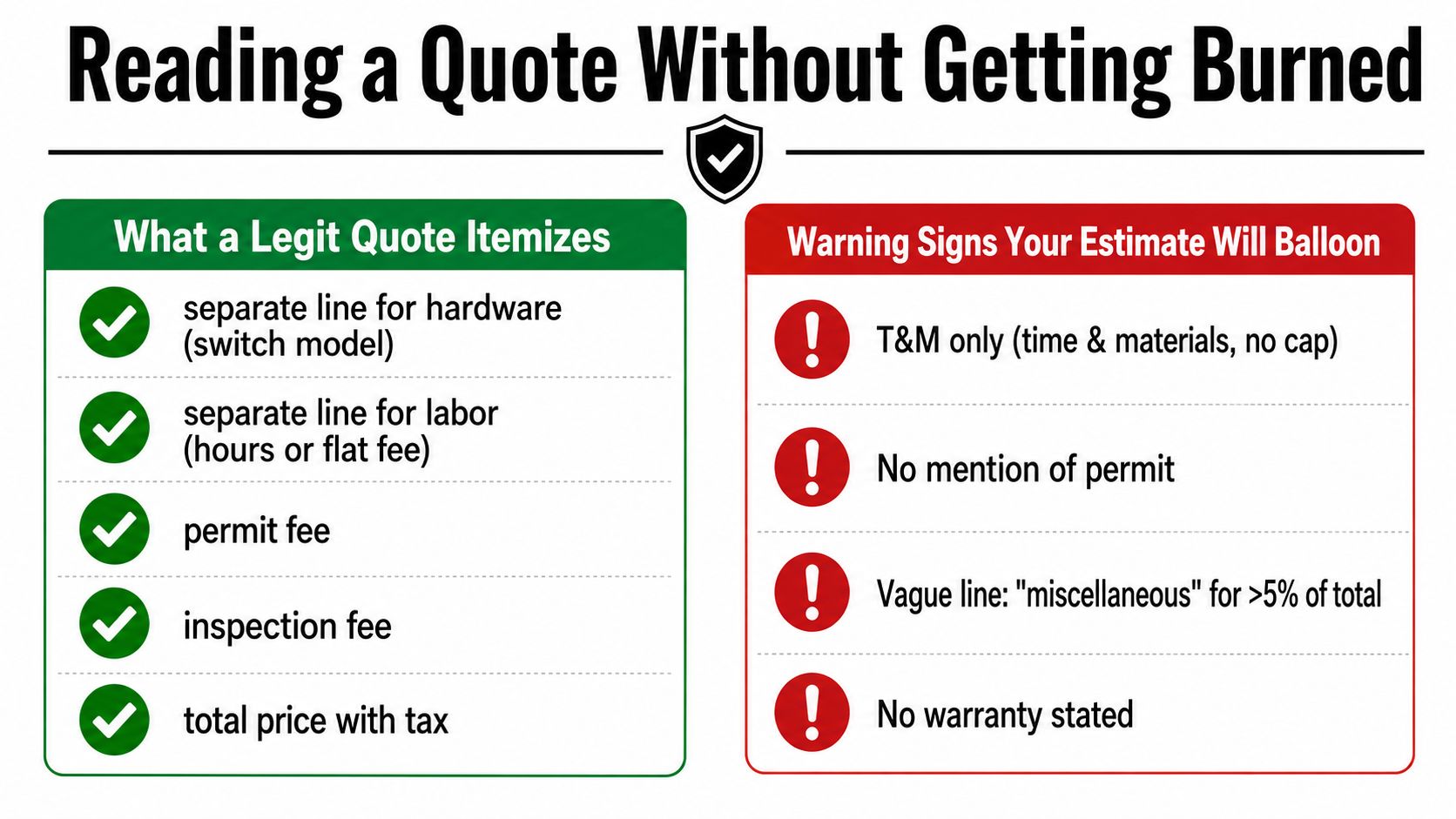
Be cautious with “transfer switch” as the only equipment line, unexplained labor, panel work buried under “miscellaneous,” or permits omitted from a job that plainly needs one. Before signing, use these questions to ask a generator installer and request the same written scope from at least two bidders.
A $900 quote and a $2,100 quote may describe different jobs, not different levels of honesty. Compare circuit count, wiring route, permit responsibility, equipment model, testing, and warranty before choosing the lower number. The installed price is controlled by those line items, not the switch alone.
Getting Comparable Quotes in Your Area
Start with licensed electricians who regularly perform generator and transfer-switch work, not just the first general electrical contractor who appears in an advertisement. Ask whether they pull permits themselves, whether they carry general liability insurance, and how often they install manual switches for portable generators.
Give every bidder the same one-page scope. Include the panel service rating, panel location, desired circuits, proposed inlet location, generator type, and any known access problem. A site visit is preferable to a phone estimate because the panel, wiring path, and working space determine the labor.
Use the same questions for every bidder
- Scope: Which circuits will the switch serve, and how will they be labeled?
- Equipment: What brand, model, amperage, and circuit capacity are included?
- Permits: Who pulls the permit, pays the fee, and arranges inspection?
- Materials: Is the inlet, conduit, wire, breaker work, and mounting hardware included?
- Testing: Will the electrician test the generator connection and each selected circuit?
- Warranty: What coverage applies to the switch, workmanship, and callbacks?
A directory can shorten the initial search, but it isn't a substitute for checking credentials directly. Use listings to build a shortlist, then verify the state license, insurance, service area, generator experience, and permit process with each company.
The strongest comparison is an itemized side-by-side sheet. Put hardware, labor, materials, permits, panel work, testing, and warranty in separate rows. If one electrician refuses to define the scope, that bid isn't comparable, regardless of how attractive the headline price looks.
Before you schedule work, confirm the final price, the equipment model, the circuits covered, and the permit plan in writing. Then arrange installation before the next outage, not while a storm is already approaching.
If you need to compare local generator installers for a manual transfer switch project, GeneratorInstallerList helps you find generator-focused companies by location and review their visible service signals. Use it to build a shortlist, then contact the installers directly to verify licensing, permits, insurance, scope, and warranty terms.
- manual transfer switch cost
- transfer switch installation
- generator transfer switch
- electrical permit fees
- standby generator budget
Ready to find who to call?
Open your state page or search by ZIP for a distance-sorted list.