Propane Generator Installation Cost: A Full 2026 Guide
Learn the propane generator installation cost in 2026, including labor, permits, and materials. Get accurate estimates before you buy.
Propane generator installation cost in the United States typically ranges from about $6,000 to $23,000 installed for a whole-house standby system, and the generator unit itself often represents only about half of that total. A compact project can stay in the low thousands, while tank work, long fuel runs, electrical upgrades, and local approvals can push a complete installation into five figures.
You usually discover the difference when the contractor arrives during a renovation and the quote lists more than the generator shown in the brochure. The automatic transfer switch, propane storage, gas piping, trenching, panel connections, permits, inspection, and startup can all sit outside the equipment price.
That's why comparing generator stickers is the wrong way to budget. A useful benchmark places whole-house generator projects at about $6,000 to $11,000, while more involved full installations can reach $8,000 to $23,000, depending on size, fuel type, labor, permits, and site preparation, according to Modernize's generator cost guidance. Another national benchmark puts installed whole-house projects at roughly $1,516 to $8,810, with a midpoint near $5,160, while propane standby units alone can range from about $2,000 to $21,000 depending on configuration, as reported by HomeAdvisor's generator installation cost guide.
Table of Contents
- What Propane Generator Installation Cost Really Means
- The Main Pieces of an Installed Propane System
- Propane Tank Choices and Their Price Impact
- Gas Line Routing and Site Work
- Regional Pricing Factors That Change Your Quote
- Two Realistic Installation Scenarios Compared
- Your Pre-Quote Checklist for Accurate Budgeting
What Propane Generator Installation Cost Really Means
A homeowner can choose the generator, approve the model, and still underestimate the project. The quote may add a transfer switch, propane connection, conduit, pad, permits, inspection coordination, and commissioning. The machine is only one line in the final invoice.
For a whole-house propane standby system in the United States, plan around $6,000 to $23,000 installed. That range covers the working system, not an equipment purchase left for you to connect. Use this whole-house generator cost guide to separate equipment allowances from installation work before requesting bids.
Installed cost means the contractor has made the system operational and code-compliant. A complete proposal should account for:
- Generator unit: The standby machine, sized for the electrical demand you selected.
- Automatic transfer switch: The equipment that moves selected or whole-home loads from utility power to generator power safely.
- Electrical work: Conductors, conduit, breakers, grounding, panel connections, and any load-management equipment.
- Propane infrastructure: Tank ownership or rental arrangements, regulator, piping, shutoffs, and the generator connection.
- Site work: A suitable pad, access preparation, trenching, and required physical protection.
- Permits and inspections: Local approvals for the electrical and fuel portions of the job.
- Startup and commissioning: Pressure testing, programming, transfer testing, and confirmation that the generator carries its intended load.
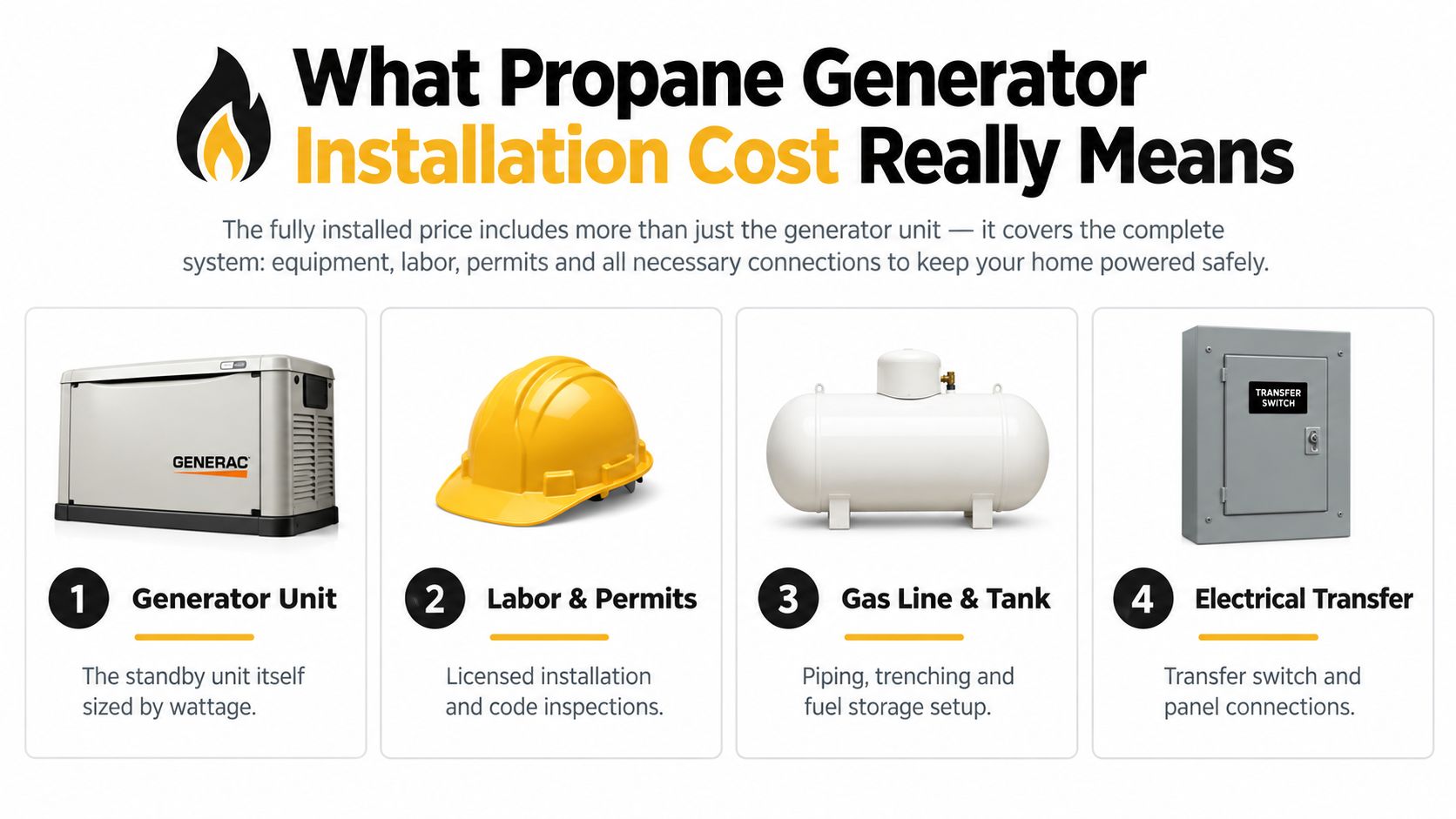
The generator often represents only about half of the final invoice. The remaining work determines whether a quote stays controlled or rises sharply. A tank across the property can require longer piping or trenching. An older panel may need electrical changes, and local rules may require separate gas and electrical reviews.
Inspection requirements can swing a quote by thousands. Ask whether the contractor has included both permit fees and the labor needed to satisfy each reviewing department.
Installer's rule: A quote with one equipment price and one total, but no scope sheet, is not ready for comparison.
Request the complete installed figure. Then require the contractor to list every allowance, exclusion, and condition that could change it before work begins. That exposes hidden propane generator installation costs while revisions are still manageable.
The Main Pieces of an Installed Propane System
A propane generator quote is complete only when it accounts for both routes: electricity from the generator to the house and fuel from the tank to the engine. A missing route usually becomes a change order after installation starts.
Equipment and transfer controls
The generator unit must match the circuits you plan to run and the starting demand of air-conditioning compressors, pumps, and well equipment. The automatic transfer switch matters just as much. It disconnects the home from utility power before the generator supplies electricity, preventing dangerous backfeed.
Your electrical setup may require a service-rated transfer switch, a load center, managed-load controls, or a subpanel separating essential circuits from optional ones. The proposal should state the switch rating and the circuits it will control. “ATS included” is not enough.
Electrical and fuel connection
Electrical labor can cover conduit, conductors, grounding and bonding, breakers, panel modifications, and the final generator connection. An outdated or crowded panel can add work. So can a long route between the generator and service equipment.
The propane side needs correctly sized piping, regulators, shutoff valves, and pressure testing. Simpler tank, regulator, and supply-line work can contribute about $500 to $1,000. Longer trenching and larger tank arrangements raise the total, as described in this standby generator cost breakdown.
Startup and overlooked accessories
Startup requires more than pressing a button. The technician should verify fuel pressure, test transfer operation, check voltage and frequency, inspect connections, and document commissioning. The written scope should also identify the pad, risers, battery, remote monitoring module, first fuel fill, utility locating, and warranty registration.
| Component | Typical Cost Range |
|---|---|
| Generator and automatic transfer switch | Varies by capacity and configuration |
| Electrical connection and panel work | Varies with distance, panel condition, and load controls |
| Propane piping, regulator, and tank connection | About $500 to $1,000 for simpler work, with more for complex routing |
| Tank installation | About $1,000 to $2,500 for a 500 to 1,000 gallon system (Modernize) |
| Permits and inspections | About $350 to $700 typically, with complex jobs reaching $800 to $1,800 (Sundry Know) |
| Startup and commissioning | Must be identified in the written scope |
Use these figures to compare proposals, not to replace a site-specific bid. Require line-item pricing, stated allowances, exclusions, and conditions. Two contractors should be quoting the same work before their totals are compared.
Propane Tank Choices and Their Price Impact
The tank can change the project total more than the generator's equipment price suggests. Ownership, placement, capacity, delivery access, and local setbacks all affect the installation invoice. Decide these items before comparing quotes.
Ownership versus leasing
An owned tank gives you control over the propane supplier and tank location, but you pay for the equipment, setup, inspections, and future maintenance. A leased tank can reduce the upfront equipment purchase. The supplier may require a fuel contract, delivery terms, approved placement, or setup charges. Read that agreement before accepting a low installation quote.
For a 500 to 1,000 gallon system, common installed tank estimates run about $1,000 to $2,500. A new storage arrangement can cost substantially more, with some new tank projects reaching $5,000 to $8,000, particularly when the work includes more than connecting to an existing compliant tank. Treat these figures as budgeting guidance, not a guaranteed bid.
Above-ground versus underground placement
Above-ground tanks generally cost less to install because the crew can inspect, service, and replace them without excavation. Underground placement preserves yard space and reduces visibility, but it adds digging, corrosion protection, access requirements, and surface restoration. Choose burial only after the installer gives you the complete installed price and states who handles future tank maintenance.
Tank capacity must match the generator's fuel demand, expected outage duration, delivery schedule, and local placement rules. A smaller tank may suit limited backup use. A whole-home system requires a fuel plan that supports rated load and allows deliveries during extended outages. Have the propane supplier and generator installer confirm both storage capacity and gas flow before work begins.
| Tank Option | Added Cost vs. Base Install |
|---|---|
| Existing compliant tank nearby | Usually the lowest added cost |
| New owned tank | Can add substantial equipment and setup cost, with some new installations reaching $5,000 to $8,000 |
| Leased tank | Lower upfront equipment cost may be offset by supplier terms and setup charges |
| 500 to 1,000 gallon installed system | About $1,000 to $2,500 for tank installation in common estimates |
| Underground placement | Higher site-work and protection cost than a simple above-ground arrangement |
Compare propane storage with other fuel options in this guide to natural gas versus propane generators, especially if the property already has a natural gas connection. The existing utility setup may change the equipment and site-work decision.
Setbacks from windows, doors, property lines, and ignition sources can determine where the tank may go. Delivery trucks also need a practical route from the road. A tank that looks inexpensive on paper can become a major added cost when the crew must excavate, restore landscaping, or route piping around buildings, driveways, retaining walls, or utility corridors. Get the proposed location and every allowance in writing before approving the installation.
Gas Line Routing and Site Work
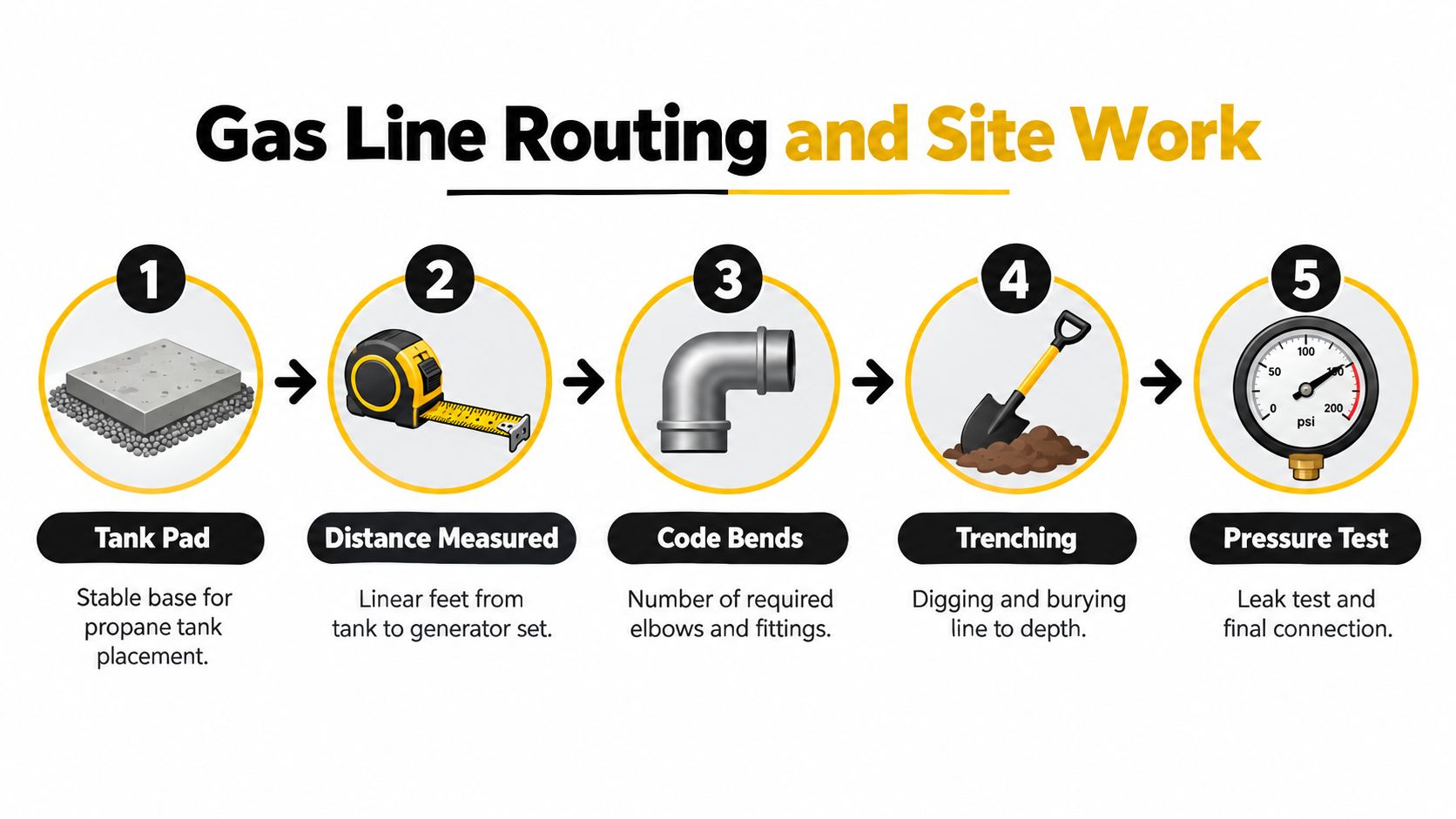
The gas line often turns a straightforward propane project into a major site-work job. The installer must map the route, size the pipe and regulator, protect crossings, meet burial requirements, and test the completed system. Price the full route, not just the generator connection.
Measure the route before pricing
Distance matters, but bends, elevation changes, crossings, and regulator placement can add work quickly. A line across soft soil is simpler than one beneath a concrete driveway, through dense plantings, or around a retaining wall.
Trenching and piping can add meaningful labor and material costs, while short runs may still carry a minimum service charge. A concrete or composite generator pad adds another line item. Ask the contractor to show each allowance in writing rather than accepting one blended site-work figure.
Practical rule: Have the contractor mark the proposed tank-to-generator route on the site plan. A straight line on paper is not enough if it crosses a driveway, retaining wall, drainage path, or utility corridor.
Regulator sizing prevents false savings
The engine needs adequate gas flow under load. A regulator or pipe sized for a small appliance may fail to maintain pressure when a standby generator starts while household equipment is running. Long runs can require larger piping, additional regulation, or a different tank location.
Require the proposal to state the pipe material, nominal size, regulator arrangement, burial method, and pressure-test procedure. Do not accept “connect to existing propane line” without those details. Existing piping may be too small, poorly routed, or unsuitable for the generator's demand.
Site access can change the quote as much as pipe length. Crews may use trenching equipment where the ground allows it, while rocky soil, concrete, narrow side yards, or protected landscaping require slower methods. Confirm whether restoration is included. Concrete repair, soil replacement, and disturbed planting beds can become separate charges after the installation.
Clearance, inspection, and fuel-routing rules vary by jurisdiction. Review this guide to generator permits and codes before approving the layout, then ask the installer to identify any local requirement that affects the route or pad.
Regional Pricing Factors That Change Your Quote
Two homes can use the same generator and transfer switch yet receive sharply different proposals. Labor rates matter, but jurisdiction, site access, required approvals, and regional construction rules often move the total further.
Permits and inspections
Electrical and propane work may follow separate inspection paths. The automatic transfer switch and fuel piping can require different code reviews, and some jurisdictions require a separate propane tank permit. Standard jobs usually carry a moderate permit and inspection allowance, while complex approvals can cost substantially more, as outlined in the recent permit and inspection guidance.
A failed inspection creates more than paperwork. It can mean return-trip labor, correction work, delayed commissioning, and another inspection fee. Ask who pulls each permit, which approvals are included, and whether retesting is covered in the proposal.
Labor and site conditions
Metro labor markets generally cost more than rural markets, but the hourly rate is only part of the quote. Urban properties may require hand excavation, traffic protection, limited staging, or special delivery planning. Rural sites often provide easier equipment access but may need longer fuel or electrical runs.
Regional construction rules can change the installation itself. Seismic, high-wind, flood, and wildfire requirements may affect equipment mounting, clearances, shutoff valves, bollards, and placement. Soil conditions, frost depth, drainage, and property setbacks can add work even when the generator model remains unchanged.
| Regional Factor | Cost Impact |
|---|---|
| Standard permit and inspection process | Moderate administrative cost |
| Complex permit and inspection process | Substantially higher administrative cost |
| Separate tank approval | Added cost beyond ordinary electrical review |
| Difficult excavation | Higher labor and restoration cost |
| Long tank or electrical route | More trenching, pipe, conduit, and testing |
| Special hazard-zone requirements | Possible upgraded mounting, barriers, or shutoffs |
Compare proposals line by line before choosing the lower bid. Both contractors should identify the same tank arrangement, line route, transfer switch, panel work, permits, inspections, and commissioning. A low quote that omits local approval work is not a bargain. It is an incomplete project price, and the missing requirement may appear later as a change order.
Two Realistic Installation Scenarios Compared
The generator sticker price tells only part of the story. A rural property with an owned tank and a short trench can produce a very different propane generator installation cost from an urban project with leased fuel storage, concrete work, added safety equipment, and stricter inspection requirements. These examples use the assumptions supplied for this comparison, so use them to position contractor quotes, not as universal bids.
Scenario A in a low-cost rural county
The first home is single-story and uses a 22-kilowatt air-cooled standby unit. Its owned 500-gallon tank sits 20 feet from the generator. Soft soil permits a direct trench, and minimal permitting keeps administrative work controlled. The stated labor rate is $85 per hour.
The project totals about $9,500 to $11,000. The breakdown assigns roughly $5,500 to the generator and transfer switch, $1,800 to the owned tank, $1,200 to the line, pad, and electrical work, and $500 to permits and startup.
Scenario B in a complex coastal urban setting
The second home uses a 26-kilowatt liquid-cooled unit. Its 1,000-gallon tank is leased, and the 60-foot gas route crosses a concrete driveway. Seismic-rated mounting, a secondary regulator, bollards, and added inspection requirements increase the scope. The stated labor rate is $140 per hour.
The project reaches about $20,000 to $23,000, including $650 in permit fees. The equipment class, restricted access, driveway crossing, tank arrangement, and local approval process all affect the total. A gap this large does not automatically indicate contractor overcharging. It usually reflects a larger project, not just a more expensive machine.
| Cost Component | Rural Scenario A | Urban Scenario B |
|---|---|---|
| Generator and transfer switch | About $5,500 | Higher due to liquid-cooled equipment class |
| Propane tank | About $1,800 owned tank | 1,000-gallon leased tank |
| Gas route and site work | About $1,200 for line, pad, and electrical | Higher due to 60-foot route and driveway crossing |
| Permit and startup portion | About $500 | Permit fees of $650, plus added inspection requirements |
| Labor assumption | $85 per hour | $140 per hour |
| Total project | About $9,500 to $11,000 | About $20,000 to $23,000 |
Use the comparison to test the scope of each quote. The rural bid covers a short route, accessible soil, an owned tank, and limited approval work. The urban bid includes a larger tank arrangement, a longer gas route, concrete restoration, equipment protection, and more inspection exposure.
The practical lesson is simple. Price the tank, trench, regulators, electrical work, permits, inspections, and startup with the generator. A short rural installation deserves a different budget from a large unit beside a constrained urban home. Compare included work, not just the final number.
Your Pre-Quote Checklist for Accurate Budgeting
A reliable quote starts with facts about your property, not a generator model. Give each contractor the same site information so bids use the same assumptions and expose the full propane generator installation cost.
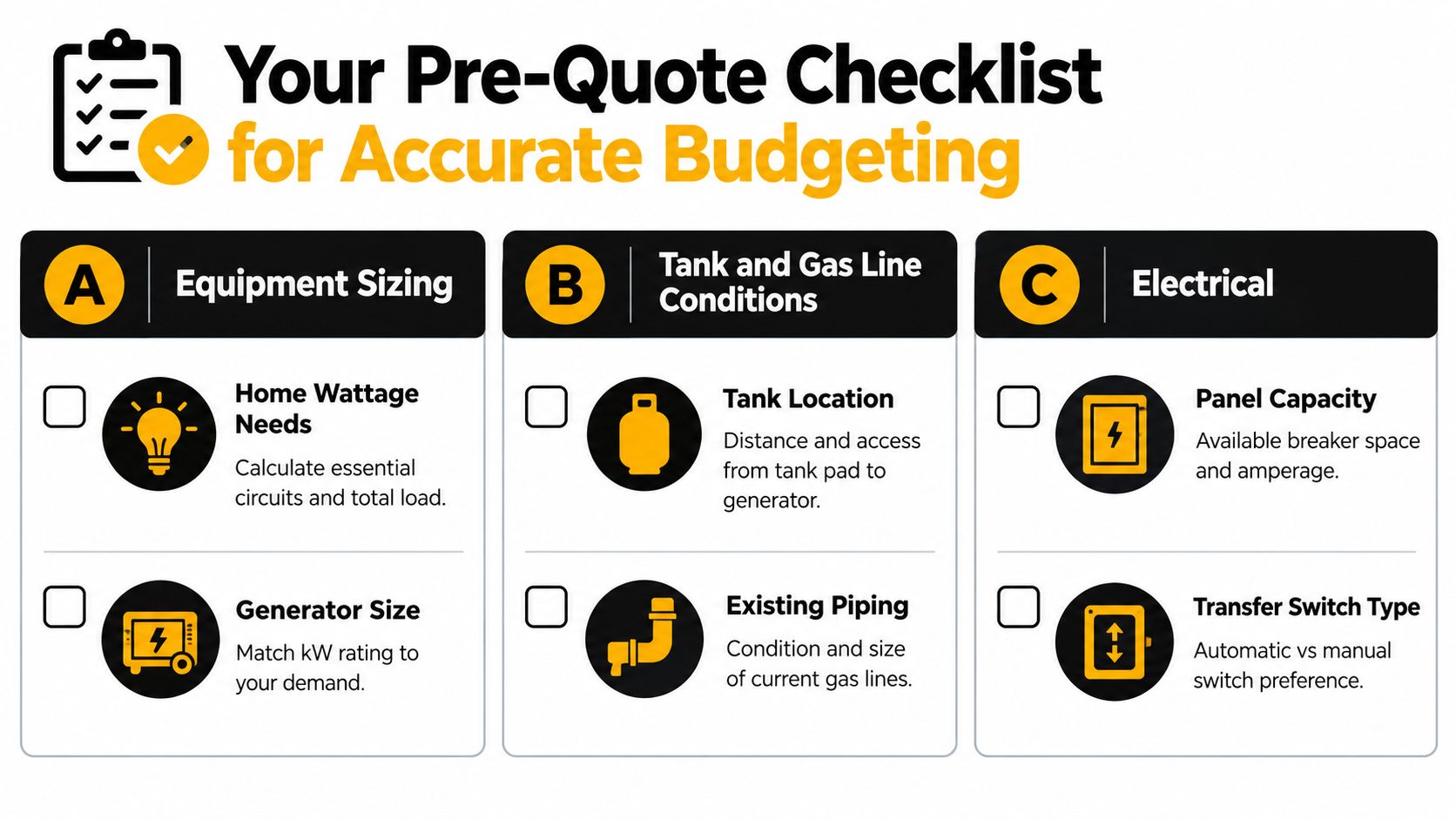
Equipment sizing
- Define the backup goal: State whether you want whole-home operation or only selected essential circuits.
- List major starting loads: Include air-conditioning equipment, well pumps, sump pumps, electric water heating, and other motor-driven systems.
- Confirm transfer equipment: Require the proposal to name the automatic transfer switch rating and identify any load-management equipment.
- Check panel capacity: Record the panel location, visible breaker space, service size, and signs of outdated equipment.
Tank and gas route
- Document the fuel source: State whether you own a tank, lease one, or need a new tank installation.
- Measure the route: Estimate the distance from the tank to the generator and mark every driveway or walkway crossing.
- Inspect access: Note narrow gates, steep grades, landscaping, retaining walls, and paved areas that could complicate delivery or trenching.
- Put gas details in writing: Require pipe sizing, regulator arrangement, shutoff location, and pressure testing to appear in the proposal.
Approvals and contract scope
- Identify every permit: Ask whether electrical, gas, mechanical, zoning, and tank approvals are separate requirements in your jurisdiction.
- Clarify site work: Confirm the pad, trenching, surface restoration, bollards, risers, utility locates, and drainage treatment.
- Define completion: Verify that startup, transfer testing, programming, warranty registration, and inspection closeout are included.
- Separate service plans: Ask whether monitoring, maintenance, battery replacement, and first-year service are included or billed separately.
Permitting deserves its own line in the budget. Typical work may carry $350 to $700 in permit costs, while complex jobs can reach $800 to $1,800. If the contractor excludes permits or inspections, the initial quote can leave a substantial unpaid balance.
Ask every bidder: “What can increase this price after you open the trench or submit the permit?”
Request written scope sheets from at least three contractors. Each sheet should identify the propane tank size and ownership, gas-line material, route, transfer-switch amperage, panel work, permit responsibility, startup procedure, inspection closeout, and restoration. Without those details, the bids are not directly comparable.
GeneratorInstallerList provides a ZIP-based directory of standby and whole-house installers across all 50 states, with filters for generator installation, service, maintenance, and major brands. Use it to identify local companies, then verify licenses, insurance, tank terms, and the written scope directly with each contractor.
Visit GeneratorInstallerList to find nearby installers with standby generator experience before requesting quotes. Ask every company to price the tank, fuel route, permits, electrical work, commissioning, and restoration as separate parts of the complete project.
- propane generator installation cost
- standby generator pricing
- propane tank cost
- generator installation guide
- whole-house generator budget
Ready to find who to call?
Open your state page or search by ZIP for a distance-sorted list.