Standby Generator Financing Options You Should Compare
Compare standby generator financing options, dealer plans, personal loans, HELOCs, and PACE to find the right payment structure for your home or business.
A storm is on the forecast, your electrical panel is already crowded, and the installer says the generator package can be scheduled if you approve the quote now. The price includes far more than the generator itself, but the dealer's payment plan makes the project look manageable. At the same time, your bank offers a lower rate, though the money may not arrive before the next outage.
That's the standby generator financing decision. You're not choosing the lowest APR. You're balancing time to power, total repayment cost, collateral, approval risk, and the chance that a promotional deadline arrives before the system is installed and inspected.
Table of Contents
- Why Standby Generator Financing Is a Different Decision
- How Standby Generator Financing Actually Works
- The Five Main Ways to Finance a Standby Generator
- Sample Payment Scenarios With Real Numbers
- Questions to Ask Before Signing Any Financing Agreement
- Comparing Two or Three Offers Side by Side
- Choosing the Right Path for Your Situation
Why Standby Generator Financing Is a Different Decision
A homeowner facing hurricane season may have three choices: pay cash, borrow through a bank, or accept the installer's financing offer. A small-business owner who already lost power for nine days may reach the same decision with higher stakes, because every delay can threaten refrigeration, electronic systems, customer access, or normal operations.
The cheapest-looking loan can fail if it funds too slowly. A lower-rate home-equity product doesn't help much if appraisal and closing delays push installation beyond the period when reliable power matters most. A dealer promotion can also become expensive if the balance isn't cleared before its deadline.
Practical rule: Choose the financing path that gets the right system installed on time at a total cost you can actually manage.
Standby systems create this problem because installation is a small infrastructure project, not a simple appliance purchase. The financed package may include the generator, automatic transfer switch, gas-line work, concrete pad, permits, electrical labor, inspection coordination, and startup service. The equipment sticker shows only one part of the amount you're borrowing.
Time-to-power changes the calculation
A dealer plan may move quickly because the installer already works with the lender and can coordinate financing with the project contract. An unsecured personal loan may also close relatively quickly, while a HELOC can involve more documentation and property-related steps. PACE financing depends on local availability and eligibility.
The question to ask isn't only, “What rate did I get?” Ask, “When can the installer receive the funds, complete the work, pass inspection, and place the system into service?”
Promotional deadlines create a second risk
Published Generac disclosures illustrate how complicated these offers can be. One widely disclosed U.S. option lists 9.99% APR with fixed monthly payments over 132 months, plus a $29 account activation fee, while another offers 0% interest if paid in full within 18 months (Generac's standby generator financing details). The long plan stretches repayment beyond 11 years, while the shorter promotion demands disciplined payoff planning.
A promotion that ends before your cash flow improves isn't cheap financing. It's a deadline attached to a major home project.
How Standby Generator Financing Actually Works
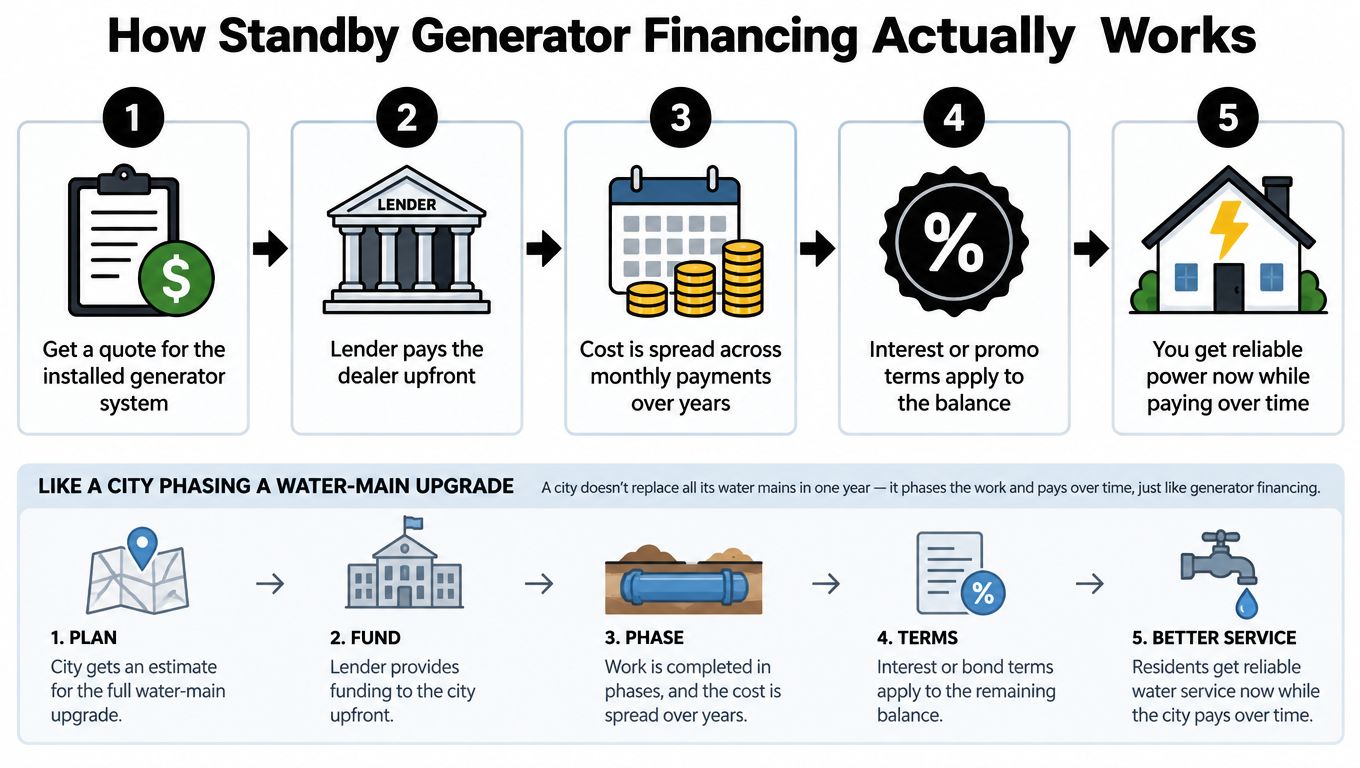
Think of standby generator financing like phasing a city water-main upgrade. The city gets useful infrastructure now, then spreads the project cost across future budgets. You receive an installed backup-power system now, then repay the project through scheduled installments.
That comparison matters because the lender isn't necessarily financing a boxed generator sitting in a warehouse. The application may cover a complete operating system, including equipment, transfer equipment, site preparation, fuel connections, permits, labor, and commissioning.
Where the money comes from
The most common structures fall into several categories:
- Dealer-arranged plans: The installer submits your application through a financing partner and may package approval, contract signing, and scheduling into one process.
- Third-party specialty loans: A lender focuses on home-energy or equipment projects, sometimes paying the contractor directly after approval and completion milestones.
- Unsecured personal loans: A bank or credit union lends against your credit profile rather than taking a lien on the generator or property.
- Secured borrowing: A lender may use home equity or another asset as collateral, which can reduce the rate while increasing the consequences of default.
Payment schedules often begin after installation, funding, or inspection milestones, but the contract controls the actual trigger. Don't assume that signing the quote means the first payment starts later. Ask for the exact date, event, or funding condition that activates repayment.
Why the approved amount exceeds the equipment price
A manufacturer's MSRP doesn't include every site cost. A difficult gas route, panel modification, trenching, permit work, inspection corrections, or a required transfer-switch upgrade can increase the installed total. Financing approval therefore may reflect the complete quote, not just the generator model.
Before you accept the amount, require a written breakdown separating equipment, labor, permits, taxes, fees, and optional service coverage. That document gives you something concrete to compare across lenders and installers.
The Five Main Ways to Finance a Standby Generator
The right option depends on urgency, equity, credit strength, and whether you can pay ahead. These paths don't behave alike, even when they finance the same installed system.
| Option | Typical Term | Collateral | Speed to Fund | Best Fit |
|---|---|---|---|---|
| Dealer payment plan | Short promotional window or extended installment schedule | Often tied to the financed project or account terms | Usually fast when arranged through the installer | Buyers who value one streamlined process |
| Personal unsecured loan | Short to medium fixed term | No home lien in a typical unsecured structure | Often faster than home-equity closing | Buyers with sufficient credit and limited equity |
| HELOC | Flexible, longer repayment horizon | Home equity | Can be slower because of property and underwriting steps | Owners with substantial equity who want rate flexibility |
| PACE financing | Long property-linked repayment structure | Repaid through the property-tax mechanism | Depends on local program and eligibility | Owners in participating jurisdictions who accept property-linked debt |
| Specialty equipment lender | Varies by lender and project | May be unsecured or equipment-secured | Middle ground, depending on documentation | Homeowners and businesses seeking a tailored project loan |
Dealer payment plans
Dealer financing wins on convenience and often on speed. The installer can present the project, financing application, and scheduling process together. The weakness is complexity. A low payment can come from a long term, while a promotional rate may carry deferred-interest conditions or fees.
Published disclosures show this structure clearly. One 132-month offer uses a monthly payment set at 1.25% of the highest promotional balance, while a separate 18-month offer uses 2.5% of the highest balance (Generac's financing disclosures). Read the payoff language, not just the payment box.
Personal unsecured loans
A personal loan keeps your home out of the collateral arrangement and may offer a fixed payment. Credit unions can be especially useful because they may provide a competing quote without tying you to the installing dealer. Approval still depends on your credit profile, income, debt load, and requested amount.
For small businesses, an equipment-financing overview such as Business Loan Warrior's equipment financing guide can help frame the difference between business borrowing, asset-backed structures, and general-purpose credit.
HELOCs and PACE
A HELOC can be attractive when you have strong equity and want a flexible borrowing line, but it uses the home as collateral and may carry variable-rate exposure. PACE financing is tied to the property-tax system and isn't available everywhere. It can fit a property owner who understands the repayment mechanism, but it deserves careful review before signing.
Specialty lenders
Specialty lenders sit between dealer convenience and traditional bank borrowing. They may understand installation projects better than a general lender, though their fees, collateral rules, and contractor requirements vary. Treat every lender as a separate offer. Familiarity with generators doesn't guarantee the lowest total cost.
Sample Payment Scenarios With Real Numbers
A homeowner facing an outage may value speed more than a small APR difference. A dealer plan can put an installation in motion quickly, while a bank or credit-union loan may reduce borrowing costs but add processing time. Compare the cost of waiting, especially if a financing promotion expires before your project is funded.
Published terms are more useful than invented “typical” examples. The dealer options described earlier include 9.99% APR with fixed payments over 132 months, a $29 account activation fee, and 0% interest if the balance is paid in full within 18 months. The long term lowers the immediate payment but leaves the account open for more than 11 years. The promotional option can cost less when you clear the balance before the deadline, so confirm the payoff conditions before relying on it.
| Financing Option | Term | APR | Monthly Payment | Total Interest | Total Paid | Promo or Prepayment Risk | Time to Funding |
|---|---|---|---|---|---|---|---|
| Dealer installment plan | 132 months | 9.99% | Contract-specific fixed payment | Depends on financed balance | Depends on financed balance and fees | Long repayment period, activation fee, possible contract conditions | Often fastest through the installer |
| Promotional dealer plan | 18 months | 0% if paid in full within the stated window | Contract-specific payment based on promotional balance | Depends on payoff compliance and disclosure | Lowest only if the balance is cleared as required | Deferred-interest or deadline risk must be checked | Often fast through the dealer |
| Credit-union generator loan example | 36 months | 7.30% APR (BankFive generator loan information) | $162.79 per month on a $5,000 loan (BankFive generator loan information) | Contract-specific | Contract-specific | Check eligibility and lender terms | Depends on lender processing |
| Regional generator loan example | Up to 60 months | 8.550% APR (BankFive generator loan information) | About $20.54 per $1,000 borrowed (BankFive generator loan information) | Contract-specific | Contract-specific | Confirm fees and no-prepayment terms in writing | Depends on lender processing |
The regional product lists a $5,000 minimum and $15,000 maximum, while the credit-union example uses a $5,000 loan. These figures illustrate payment structure, not a quote for your installation. A faster approval may justify a higher total cost when an outage risk is immediate or a promotional deadline is close.
Review this whole-house generator cost guide before comparing offers. Ask every dealer for the total of payments and the same-day payoff amount. A lower monthly figure is useful only when the full cost and the time to power both work for your budget.
Questions to Ask Before Signing Any Financing Agreement
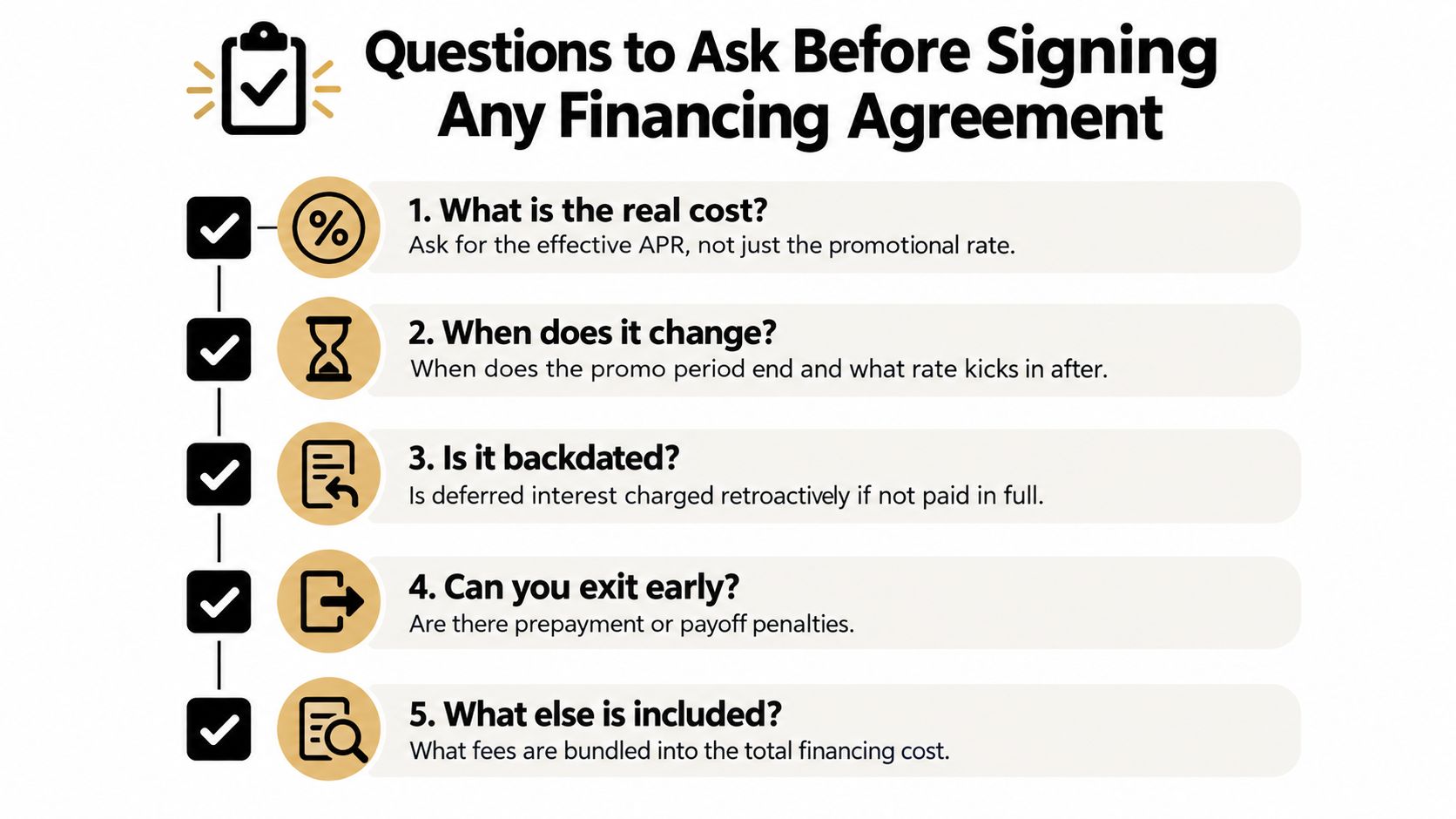
Don't sign from a payment screenshot or a verbal promise. Ask the dealer or lender to answer each question in writing, then compare the response with the formal disclosure.
“Please show me the effective APR, total of payments, all fees, and the exact payoff amount if I close the account early.”
Ask these questions directly
- What is the effective APR? Request the rate that applies after any introductory period, not merely the promotional rate.
- Is interest waived or deferred? Waived interest generally differs from interest that accrues and may be charged later if conditions aren't met.
- What event starts the payment period? Confirm whether the clock begins at signing, installation, inspection, funding, or another milestone.
- What happens if I miss a payment? Ask whether one late payment ends the promotion or changes the account terms.
- Are there prepayment penalties? Get a clear answer about early payoff, partial prepayment, and account-closure fees.
- Will you run a hard or soft credit pull? This affects how you shop for competing offers.
- Which contractor fees are financed? Require separate lines for labor, permits, fuel work, electrical work, taxes, and service plans.
- Is there a lien? Find out whether the lender claims the equipment, the property, or neither.
- Who is responsible for installation quality? The installer and finance company may be separate businesses, so identify each party's obligation.
- Can I receive the Truth in Lending disclosure now? Don't wait until the signing appointment.
Use the contract to verify the answer, especially for deferred-interest language. This guide to the deferred-interest trap is useful preparation, but your signed disclosure controls.
Also verify that the installer is properly licensed for the work required in your jurisdiction. Financing approval doesn't prove licensing, fuel-system competence, electrical capability, or inspection readiness.
Comparing Two or Three Offers Side by Side
Put every offer on one worksheet. Don't compare a dealer's 132-month payment with a bank's shorter-term payment and declare a winner based on the smaller monthly number. First normalize the project price, scope, funding date, and repayment assumptions.
| Line Item | Offer A Dealer Plan | Offer B Personal Loan | Offer C HELOC or PACE |
|---|---|---|---|
| Installed project price | |||
| Headline APR | |||
| Effective APR including fees | |||
| Term length | |||
| Monthly payment | |||
| Total of payments | |||
| Promotional deadline | |||
| Prepayment terms | |||
| Collateral requirement | |||
| Funding timeline | |||
| Warranty or service inclusions | |||
| Payment start trigger |
Normalize the quote before judging it
Ask each provider to price the same generator capacity, transfer switch, fuel connection, pad, permit handling, electrical scope, startup, and warranty. Then request the same starting date assumption. A dealer may appear cheaper because a permit, trench, service visit, or maintenance package sits outside the financed amount.
Check for distortions that make a payment look better than it is:
- Long-term payment framing: A low monthly figure may stretch repayment far into the future.
- Promotional-rate framing: "0%" may apply only if you meet the payoff condition.
- Fee omission: An activation or origination charge increases the actual cost.
- Service bundling: Maintenance may be useful, but it shouldn't hide the financing price.
- Different funding assumptions: A fast dealer approval and a slower bank approval aren't equivalent if storm timing matters.
Score the offer for your actual priority
Give each offer a simple rating for speed to funding, total cost, deadline risk, collateral exposure, and payment stability. Weight speed more heavily if an outage threatens a business or a storm is approaching. Weight total cost more heavily if you can wait and have enough liquidity to choose a longer underwriting process.
The best offer is the one that survives this comparison without relying on an attractive headline.
Choosing the Right Path for Your Situation
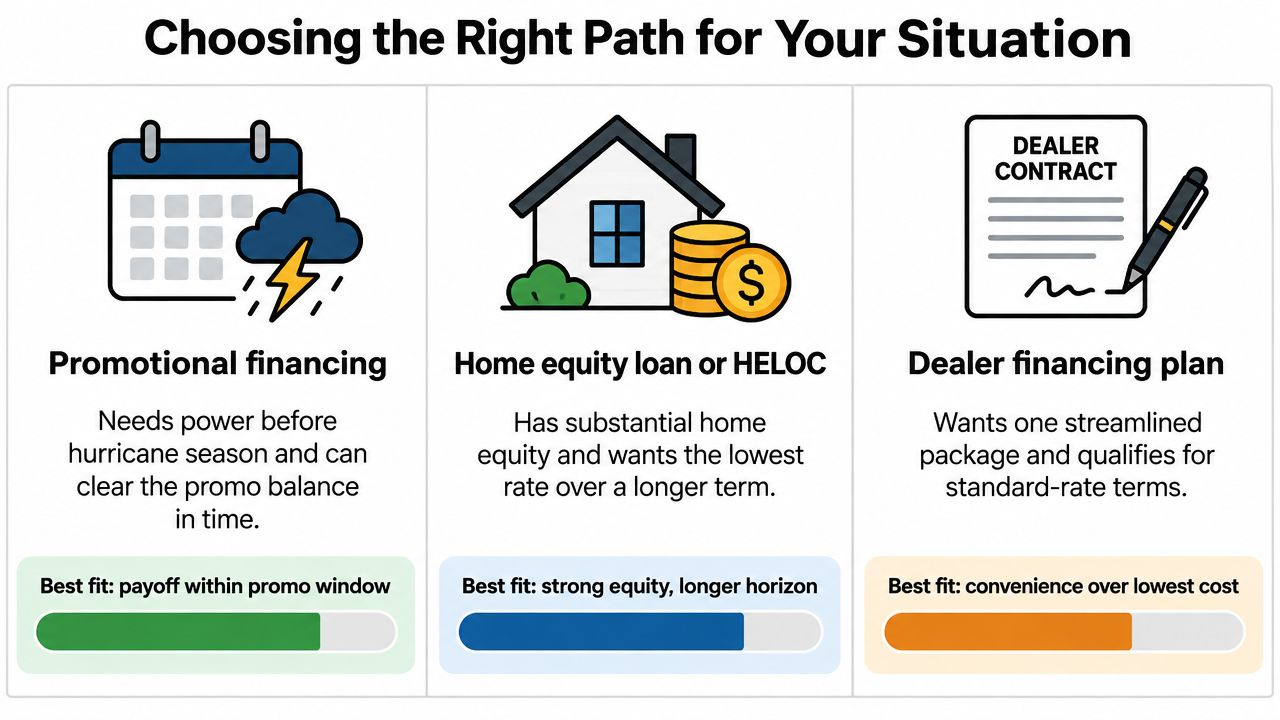
A homeowner who needs power before hurricane season and can confidently clear a promotional balance may reasonably choose dealer financing. The condition is strict: the payoff plan must be realistic, and the installation schedule must leave enough time before the promotional window closes.
A homeowner with substantial equity and a longer planning horizon may prefer a home-equity loan or HELOC. The lower potential rate can help, but the borrower must accept property collateral and possible rate movement. A buyer with limited equity may have no practical reason to pursue a secured option and may need an unsecured personal loan instead.
A contractor or property owner considering PACE should first confirm that the jurisdiction participates and that the property-linked repayment structure fits the ownership and tax situation. Small businesses should also separate household borrowing from business equipment financing, because accounting, tax, and cash-flow needs differ. For a broader look at financing used for urgent repairs and property systems, emergency service financing information can provide useful context, though it isn't a substitute for comparing generator-specific disclosures.
Use this decision sequence:
- Set the installation deadline. Decide when the system must be operational, not merely ordered.
- Calculate your safe monthly payment. Leave room for fuel, maintenance, and ordinary household or business expenses.
- Check your collateral tolerance. Decide whether a home lien is acceptable.
- Demand the full cost. Compare total payments, fees, and payoff rules.
- Choose the funding path that fits the deadline.
If you're still deciding whether a standby system is appropriate for your property, compare the trade-offs in this guide to standby, portable, and battery generators before borrowing.
GeneratorInstallerList helps homeowners and small-business owners find standby and whole-house generator installers by location, service signal, and brand preference. Use the GeneratorInstallerList directory to build a short installer list, request comparable installed quotes, and evaluate financing terms before storm-season urgency limits your choices.
- standby generator financing
- generator payment plans
- whole house generator loan
- home equity for generator
- PACE financing standby
Ready to find who to call?
Open your state page or search by ZIP for a distance-sorted list.