Standby Generator Installation Cost: A 2026 Guide
Standby generator installation cost explained for 2026. See real price ranges by size, fuel, and region, plus tips to compare installer bids.
A typical whole-house standby generator installation costs $8,000 to $16,000 in 2026, while broader projects can reach $8,000 to $23,000 when the generator is larger or the site needs substantial electrical, fuel, or excavation work.
You're probably reading this after an outage made the risk feel more expensive than the equipment. A storm knocked out power, the refrigerator contents spoiled, the sump pump stopped, and a hotel bill or basement cleanup turned a temporary inconvenience into a serious household expense. The right question isn't just, “What does the generator cost?” It's, “What will I pay to insure my home against the next outage, and what exactly is included in that insurance?”
Table of Contents
- What a Standby Generator Install Really Costs in 2026
- Breaking Down the Installed Package Line by Line
- How Size and Cooling Type Change the Equipment Number
- Site Conditions That Quietly Drive Labor Up
- Regional Pricing and How Permits Shift the Total
- What a Sample Installer Quote Should Look Like
- The Lifecycle View Most Buyers Skip
- Your Quote Comparison Checklist
What a Standby Generator Install Really Costs in 2026
For a 2,000-square-foot home in a storm-prone region, the current benchmark for a standard whole-house standby installation is $8,000 to $16,000, including the generator, system equipment, materials, and installation, according to Generac's 2026 installation cost guidance. Larger liquid-cooled systems and difficult properties can push the project toward the broader $8,000 to $23,000 range cited in the same market discussion.
That range is useful only if you understand what “installed” means. A legitimate turnkey price should account for:
- Generator equipment, including the engine, enclosure, controls, and factory accessories.
- Automatic transfer switch, which safely moves the home between utility and generator power.
- Electrical work, including conductors, conduit, grounding, breakers, and service connections.
- Fuel connection, such as natural-gas piping, regulator work, or propane infrastructure.
- Pad and site preparation, including mounting, clearances, access, and drainage.
- Permits, inspections, startup, and commissioning, not just delivery of the machine.
A manufacturer's equipment price is not your project price. The unit may be sitting beside the house, but it still has to communicate with the electrical service, receive enough fuel under load, comply with clearance rules, pass inspection, and start safely when the grid fails. Two nearby homes can need the same generator model and receive very different bids because one has a 200-amp service and a short gas route, while the other needs panel work and trenching.
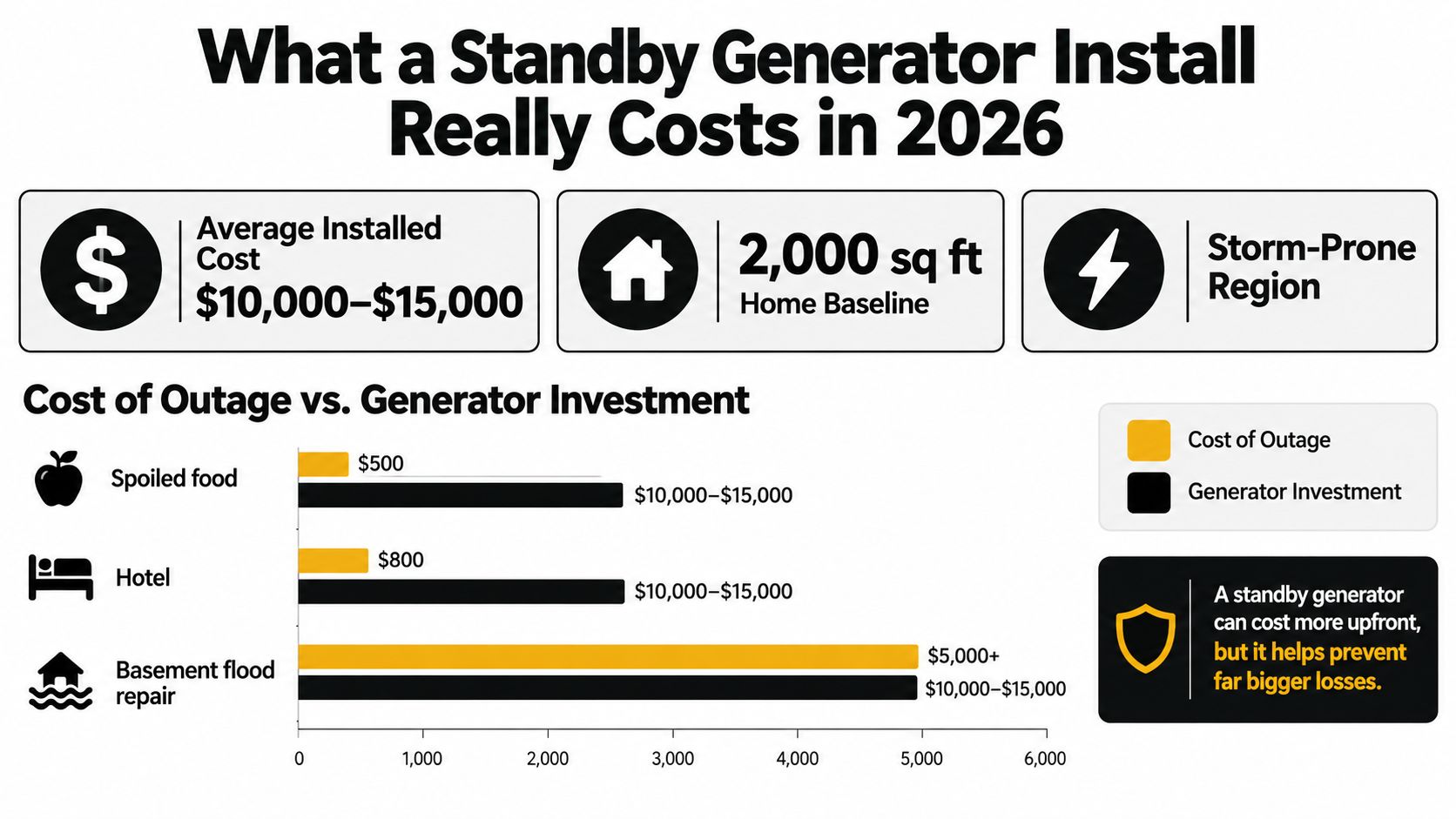
My buying rule: Compare complete installed packages, not generator stickers. If a quote omits the transfer switch, fuel work, permits, or startup, it isn't a lower price. It's an incomplete price.
Historical pricing shows why older online averages can mislead. CostHelper's standby generator data places smaller air-cooled installations at about $2,500 to $4,500, mid-size systems at $4,000 to $10,000, and large liquid-cooled systems at roughly $9,000 to $15,000 or more. Those figures help show the long-standing spread, but current whole-house bids often include broader electrical scope, code work, monitoring, and site constraints. Use the whole-house generator cost guide to compare the equipment decision with the installed project rather than treating the machine as a standalone appliance.
Breaking Down the Installed Package Line by Line
A generator quote should read like an outage-insurance plan, not an appliance receipt. Every line should show what keeps your home powered, code-compliant, and ready to start when the grid fails.
| Line Item | Typical 2026 Range | What to verify on the quote |
|---|---|---|
| Generator and standard equipment | Varies by size and cooling type | Exact model, rated output, enclosure, accessories, and warranty |
| Transfer switch and integration | Included in installed package | Service amperage, switch model, supported circuits, and load-management controls |
| Electrical labor and setup | About $3,000 to $5,000 | Pad placement, conduit, wiring, grounding, startup, and commissioning |
| Complex electrical scope | $5,000 to $12,000 or more | Panel work, long wire runs, trenching, and systems above 20 kW |
| Panel upgrade | About $1,300 to $2,500 | Whether the quote covers the 100-amp to 200-amp service change, breakers, and inspection |
| Permits | About $50 to $450 | Electrical, gas, building, and inspection fees included in the total |
| Fuel infrastructure | Several hundred to several thousand dollars, with propane tank work potentially higher | Meter capacity, regulator, route, pressure test, connection, tank placement, and restoration |
The equipment line should list the exact model, rated output, enclosure type, and included accessories. “20 kW generator” is not enough. Models in the same nominal class can have different transfer-switch requirements, fuel consumption, monitoring options, and warranty terms.
Give the transfer switch its own line. It must match the service arrangement and the circuits the generator will support. Whole-house coverage may require main-service integration, while managed-load systems use controls that prevent large appliances from starting together. A quote that says “switchgear” without amperage and model needs correction.
Electrical work is where cheap bids usually break
Professional setup commonly adds $3,000 to $5,000 for labor and installation. Long runs, trenching, panel upgrades, or systems above 20 kW can push the electrical portion to $5,000 to $12,000 or more, according to HomeGuide's generator cost breakdown. That guide also places a 100-amp to 200-amp panel upgrade at $1,300 to $2,500.
Fuel work covers meter-capacity checks, regulators, gas-line routing, pressure testing, and the generator connection. A short natural-gas route is far simpler than a buried line crossing finished landscaping. Propane may require tank placement and added infrastructure, with some installations adding $5,000 to $8,000 for tank work, as described in the industry cost reference from Off Grid Compare.
Separate required work from options. Wi-Fi monitoring, cold-weather equipment, load-shedding modules, upgraded enclosures, and service contracts should not hide inside a vague package price. Confirm that labor includes the pad, conduit, wiring, grounding, fuel connection, startup, and commissioning. The generator installation process guide helps you check the sequence from site evaluation through final commissioning.
How Size and Cooling Type Change the Equipment Number
The first equipment decision is air-cooled versus liquid-cooled. Air-cooled units suit many average homes and generally occupy the lower equipment tiers. Liquid-cooled units use radiator-style systems designed for heavier sustained loads, so they belong in a different price and installation category.
| kW Range | Cooling Type | Equipment Cost | Typical Home |
|---|---|---|---|
| 14 to 16 kW | Air-cooled | $4,000 to $6,000 | Average home with essential loads or managed whole-home coverage |
| 20 to 26 kW | Air-cooled | $6,500 to $9,500 | Larger home or home with heavier starting loads |
| 30 to 48 kW | Liquid-cooled | $11,000 to more than $20,000 | Large home, high demand, or sustained commercial-style load |
Those equipment figures are not installed prices. They exclude the transfer switch, electrical work, fuel connection, permits, pad, startup, and site preparation. The distinction matters because a buyer who finds a lower-priced 20 kW unit online may still receive a higher final quote if the property requires panel work or a long route from the service entrance.
Choose output from the load, not the floor plan
Square footage is a weak sizing shortcut. The installer should examine the starting demand of motors and compressors, the capacity of the electrical service, and the loads you intend to power during an outage. A refrigerator, sump pump, well pump, heating system, internet equipment, lighting, and air-conditioning system create a different starting profile from a home that can leave large electric heating or cooking loads offline.
Air-cooled is usually the sensible choice when the home has moderate demand and the load calculation supports it. Liquid-cooled becomes more defensible when the house has substantial motor loads, high service demand, or a need for sustained operation under heavier conditions. Paying for a large engine without a load calculation is wasted money. Undersizing without a load-management plan is worse, because nuisance shutdowns defeat the reason you bought the system.
Site Conditions That Quietly Drive Labor Up
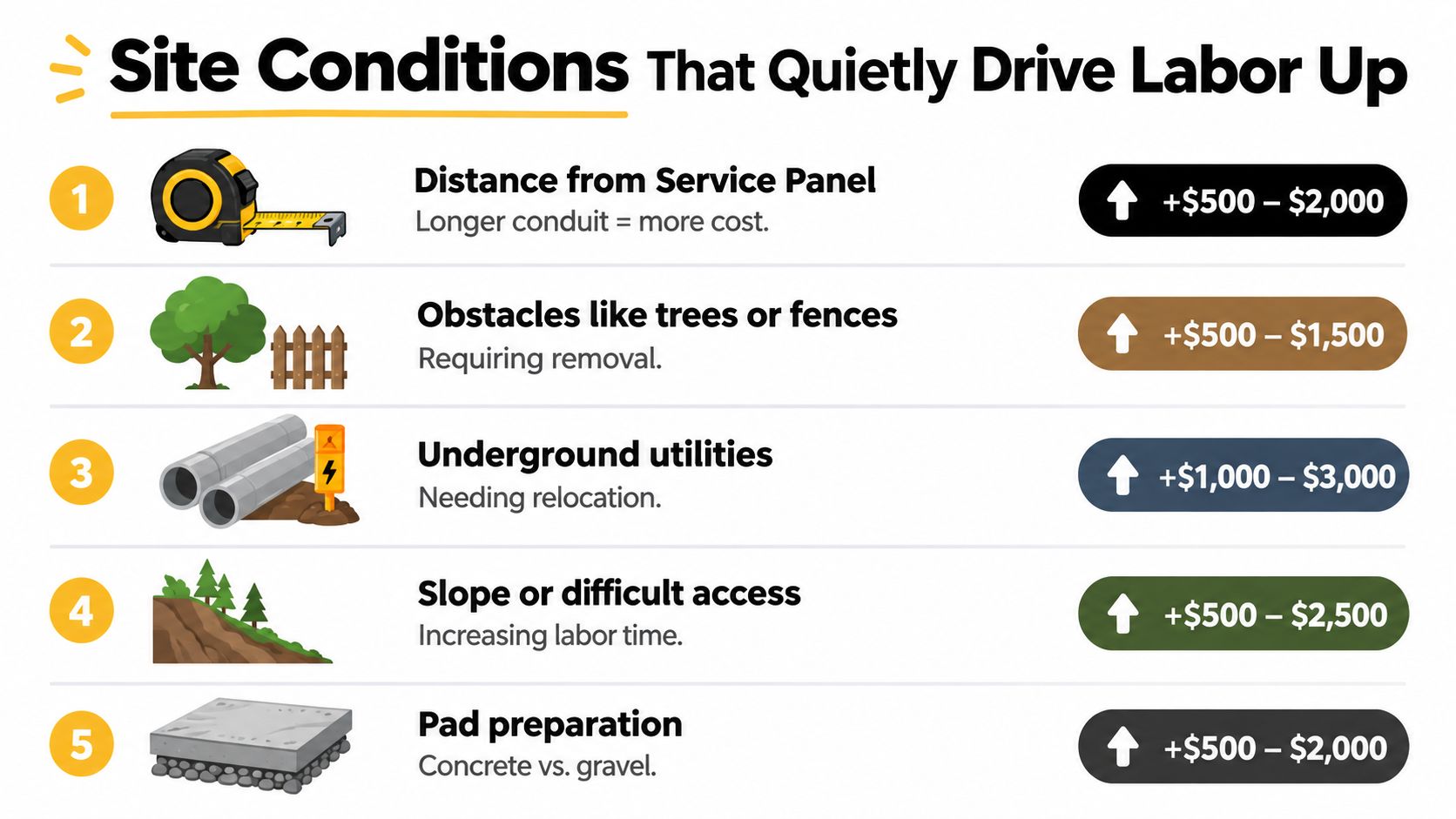
The generator's distance from the electrical service is one of the most overlooked cost drivers. Every additional section of conduit, conductor, grounding material, and gas piping adds labor, and difficult routing can require trenching, restoration, or work around finished surfaces.
A panel upgrade can change the project completely. If the existing service lacks capacity or the transfer-switch arrangement doesn't fit the current equipment, the installer may need to add a subpanel or replace the main panel. That's why the panel should be opened and documented during the site visit, not estimated from a property listing.
Fuel routing creates a second chain of costs. A short propane connection may be relatively straightforward, while a natural-gas line that crosses a driveway, patio, retaining wall, or planted yard can require excavation and restoration. The installer also needs to verify regulator capacity and pressure under demand. A line that serves the furnace may not automatically support the generator and other gas appliances together.
The property, not the model, explains the gap
Sloped access, fences, trees, underground utilities, snow conditions, and hardscape all affect the crew's time. Code-required clearances may force the pad farther from the service entrance, which lengthens both electrical and fuel routes. Tight lots may also need a sound-rated enclosure or a more carefully engineered placement.
A generator pad isn't just a rectangle of concrete. The base must support the equipment, preserve required clearances, handle drainage, and remain accessible for service. Snow-belt properties may need mounting and placement decisions that keep snow accumulation from obstructing airflow or service panels.
Quote test: If two identical 20 kW systems have materially different prices, ask the installers to mark the conduit route, gas route, panel work, pad, and restoration area on a site sketch. The difference should be visible, not hidden inside “miscellaneous labor.”
See the site conditions visually before accepting a bid:
Regional Pricing and How Permits Shift the Total
A generator quote can rise sharply across state lines even when the equipment stays the same. Local authorities may require separate electrical, gas, mechanical, zoning, noise, or right-of-way approvals. Permit fees often fall within the $50 to $450 range, but several applications, inspections, and correction visits can increase the administrative total.
Regional conditions also change the installed package. Midwest properties often offer simpler access, existing gas service, and straightforward electrical inspections. Northeast coastal homes may require tighter placement, difficult excavation, corrosion-rated equipment, or more labor. Gulf Coast installations may need mounting and fuel-system decisions that address severe weather. Compare the work, not just the generator model.
| Region | Equipment | Labor and Materials | Permits and Fees | Typical Installed Range |
|---|---|---|---|---|
| Midwest | Similar model cost, with fewer cold-weather accessories often required | Access and routing are commonly simpler when utility service is nearby | Electrical and gas approvals may apply | Lower end when service and fuel are ready |
| Northeast coastal | Corrosion-rated enclosures or hardware may add to the equipment line | Excavation, setbacks, restoration, and labor can increase the scope | Multiple inspections or local approvals may apply | Middle to upper end |
| Gulf Coast | Mounting and fuel-system specifications may add equipment cost | Weather-related mounting, fuel work, and code requirements can expand labor | Electrical, gas, zoning, or storm-related requirements may apply | Middle to upper end |
Reject a percentage surcharge without a written explanation. Ask whether it covers engineering, upgraded mounting, a gas-meter change, union labor, inspection coordination, or surface restoration. A credible installer should connect every regional premium to a specific requirement and line item.
Permit sequencing can delay the useful part of the project
Permits affect the schedule as well as the price. Electrical and fuel inspections may follow a required order, and commissioning can wait until the authority having jurisdiction approves the work. Ask who pulls each permit, who schedules inspections, and who handles corrections when an inspector rejects part of the installation.
Review this generator permits and codes guide before comparing bids, then confirm requirements with your local authority. Your quote should name the jurisdiction, list every included permit, and state whether fees are allowances or fixed charges. That detail protects the outage insurance you are buying from turning into an unfinished project when the power fails.
What a Sample Installer Quote Should Look Like
A good quote lets you compare scope without guessing. It names the generator model, transfer-switch amperage, breaker arrangement, fuel route, panel work, permits, startup procedure, and warranty registration. A vague lump sum may be legitimate, but it gives you no practical way to determine whether one installer omitted work that another included.
| Line Item | Description | Typical Range |
|---|---|---|
| Generator unit | Exact manufacturer model and output | Varies by size and cooling type |
| Transfer switch | Model, amperage, service configuration | Included in installed package |
| Pad or mounting base | Concrete, composite, or approved foundation | Site-dependent |
| Gas connection | Line sizing, regulator, pressure test, and route | Several hundred to several thousand dollars |
| Electrical conduit and wire | Route, conductor size, grounding, and disconnects | Site-dependent |
| Panel work | Breaker changes, subpanel, or service upgrade | Panel upgrade may be $1,300 to $2,500 |
| Permits and inspections | Electrical, gas, mechanical, or local approvals | Permit fees often $50 to $450 |
| Startup and commissioning | Test run, transfer test, load verification, owner handoff | Should be included |
| Warranty registration | Manufacturer registration and documentation | Should be included |
Read the exclusions before the total
The most frequently padded or underexplained lines are gas-line footage, trench restoration, old-equipment disposal, and miscellaneous materials. Ask for the assumed route length, restoration standard, disposal method, and a definition of miscellaneous materials. “Allowance” should identify what happens if the actual cost exceeds the allowance.
Check for missing accessories. Wi-Fi monitoring, cold-weather kits, load-shedding modules, upgraded pads, and service contracts can sit outside the headline price. If you want them, put them in the base comparison or list them separately on every bid.
The quote should also state whether the installer will perform a load test and demonstrate automatic transfer. Startup isn't the same as delivery. The equipment needs to start, transfer the home safely, carry the intended loads, return to utility power, and complete the handoff with documentation.
Red flag: A bid that names only a brand and “whole-house generator installation” is not detailed enough for a serious comparison. Ask for the exact model and every connection between the utility, fuel supply, transfer switch, and house panel.
The Lifecycle View Most Buyers Skip
A standby generator is outage insurance, not a decorative appliance. The upfront price buys capability, but the ownership decision depends on maintenance, fuel, inspections, battery replacement, and the losses you're trying to avoid.
The available lifecycle example for a 20 kW natural-gas installation uses $11,500 upfront, about $220 per year for maintenance contracts, $400 to $900 per year in fuel depending on run hours, and $300 to $600 every three years for battery replacement and load testing. Those figures come from the supplied cost brief and should be treated as a planning example, not a universal invoice.
| Install Type | Upfront Cost | 10-Year Maintenance and Fuel | Typical Outage Exposure per Year | 10-Year Total |
|---|---|---|---|---|
| Basic standby package | Site-dependent | Maintenance and fuel vary | Short or infrequent outages | Requires local calculation |
| 20 kW natural-gas example | $11,500 | Annual maintenance, fuel, plus periodic battery and load testing | Depends on run hours | Requires local calculation |
| Larger or complex standby package | Higher site-dependent total | Higher fuel and service exposure is possible | Longer or heavier-load outages | Requires local calculation |
The loss side can be just as important. The supplied planning scenarios use $180 for a 24-hour refrigerator or freezer loss, $1,500 or more for a multi-day sump-pump failure in a finished basement, and $4,000 to $10,000 for small-business income exposure. These aren't universal damages. They're prompts for calculating what an outage costs your household or business.
Calculate your outage-insurance rate
Add the installation, maintenance, expected fuel, battery work, and inspection costs over the period you care about. Then divide that total by the outage hours you realistically expect the system to cover. Compare the resulting per-hour insurance rate with your actual exposure.
The cheapest equipment bid often becomes expensive when it omits the work that makes the system reliable. An undersized gas line, inadequate transfer-switch arrangement, skipped load testing, or unsuitable enclosure can leave you paying twice. The right comparison is not the lowest machine price. It's the lowest credible cost for dependable coverage.
Your Quote Comparison Checklist
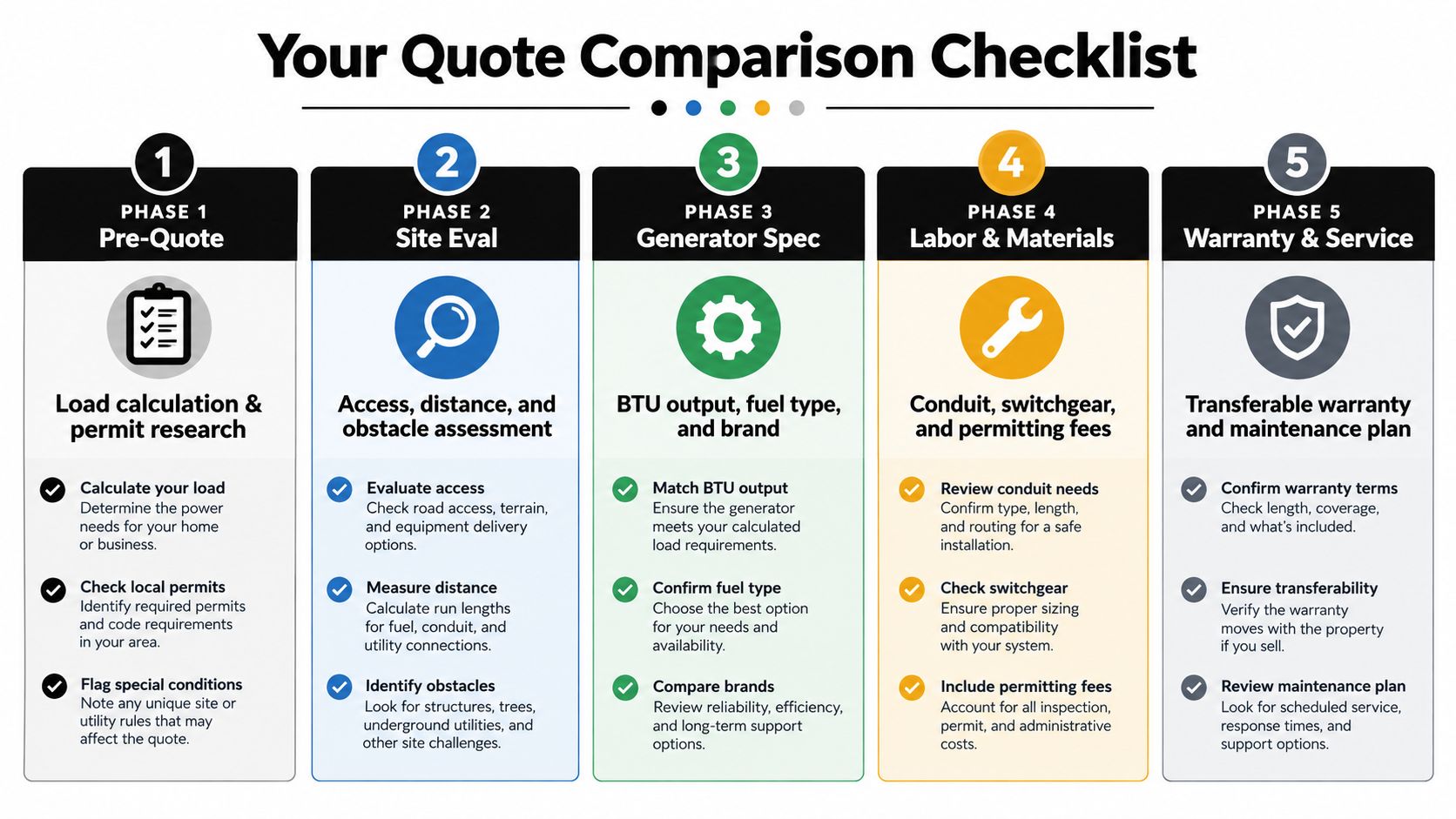
Collect bids using the same scope. If one installer prices a full-service whole-house setup and another prices a generator beside the panel with fuel work excluded, the spreadsheet will create a false winner.
Start before the installer arrives
Write down the service-panel amperage, generator location, approximate distance to the panel, fuel type, major motor loads, and the circuits you refuse to lose. Ask the installer to explain the load-calculation method, not just recommend a size from square footage.
Bring these questions to the site visit:
- Load calculation: Which starting loads are included, and which loads will be managed or excluded?
- Electrical service: Does the existing panel support the proposed transfer-switch configuration?
- Fuel capacity: Has the installer verified gas pressure and meter capacity under combined demand?
- Routing: What conduit and gas-line distances are included?
- Permits: Which permits will the installer pull, and who schedules inspections?
Make every bidder price the same package
Request at least three bids using one written scope. Each bid should identify the exact generator and transfer-switch models, pad type, wire and conduit route, fuel-line assumptions, panel work, permits, startup, warranty registration, monitoring, and maintenance options.
Match part numbers, not just model families. A “20 kW” label doesn't prove that two quotes specify the same controller, switch, enclosure, or accessories. Confirm whether the transfer-switch amperage matches your service and whether the quoted breaker arrangement supports the loads you listed.
Reject vague allowances
Be suspicious of open-ended allowances for gas work, trenching, restoration, and miscellaneous materials. Ask what triggers a change order and whether the installer will provide photos or measurements before charging for additional work.
Also avoid comparing cash discounts without reviewing payment protections. Tie payments to tangible milestones, such as equipment delivery, completed installation, passed inspection, and successful commissioning. Confirm that the service contract rate is clear for the first year and that warranty registration paperwork is included.
Three questions that expose a weak site visit: “What is the measured distance from the service equipment to the proposed pad?” “What gas pressure and meter capacity did you verify?” “Which exact panel and transfer-switch configuration are you pricing?”
Use GeneratorInstallerList as one way to find directory listings with visible standby or whole-house generator signals, then verify licensing, insurance, manufacturer authorization, references, and local permit experience directly with each company. Don't treat a directory listing as an endorsement or a substitute for credential checks.
The best bid isn't automatically the highest or lowest. Choose the installer who documents the load calculation, prices the complete installed package, explains the site risks, pulls the required permits, and stands behind startup and service. Visit GeneratorInstallerList to find generator-focused installers in your area, then send each qualified candidate the same quote checklist so their prices are comparable.
- standby generator installation cost
- whole house generator
- generator pricing
- transfer switch
- installer quotes
Ready to find who to call?
Open your state page or search by ZIP for a distance-sorted list.