Whole House Generator Cost with Installation in 2026
Whole house generator cost with installation explained for 2026. See equipment, labor, permits, and add-on costs with realistic total-price scenarios.
Most whole-house generator projects in 2026 land between $10,000 and $18,000 installed, with typical projects clustering around $12,000 for a standard 20–22 kW system including equipment, transfer switch, pad, gas, electrical labor, and permits. Larger or more complicated properties can reach $23,000 or more, while a national cost benchmark places the broader installed range between $1,516 and $8,810 because it combines simpler generator projects with full standby installations.
That gap is the point. The generator itself isn't the whole project, and treating its shelf price as the budget creates bad decisions. Transfer-switch architecture, electrical work, fuel connections, site preparation, and local permitting often determine the final bill more than the engine housing in the driveway. The right way to evaluate whole house generator cost with installation is to read the quote as a construction scope, not as a product invoice.
Table of Contents
- What Whole House Generator Cost With Installation Means
- The Main Components That Drive the Price Tag
- Generator Size and Switch Type Compared
- On-Site Variables That Move Labor Up or Down
- Three Sample Homes and Their Installed Totals
- Where Quotes Get Inflated and How to Push Back
- Financing, Dealer Plans, and the True All-In Cost
- Your Pre-Quote Checklist Before You Sign Anything
What Whole House Generator Cost With Installation Means
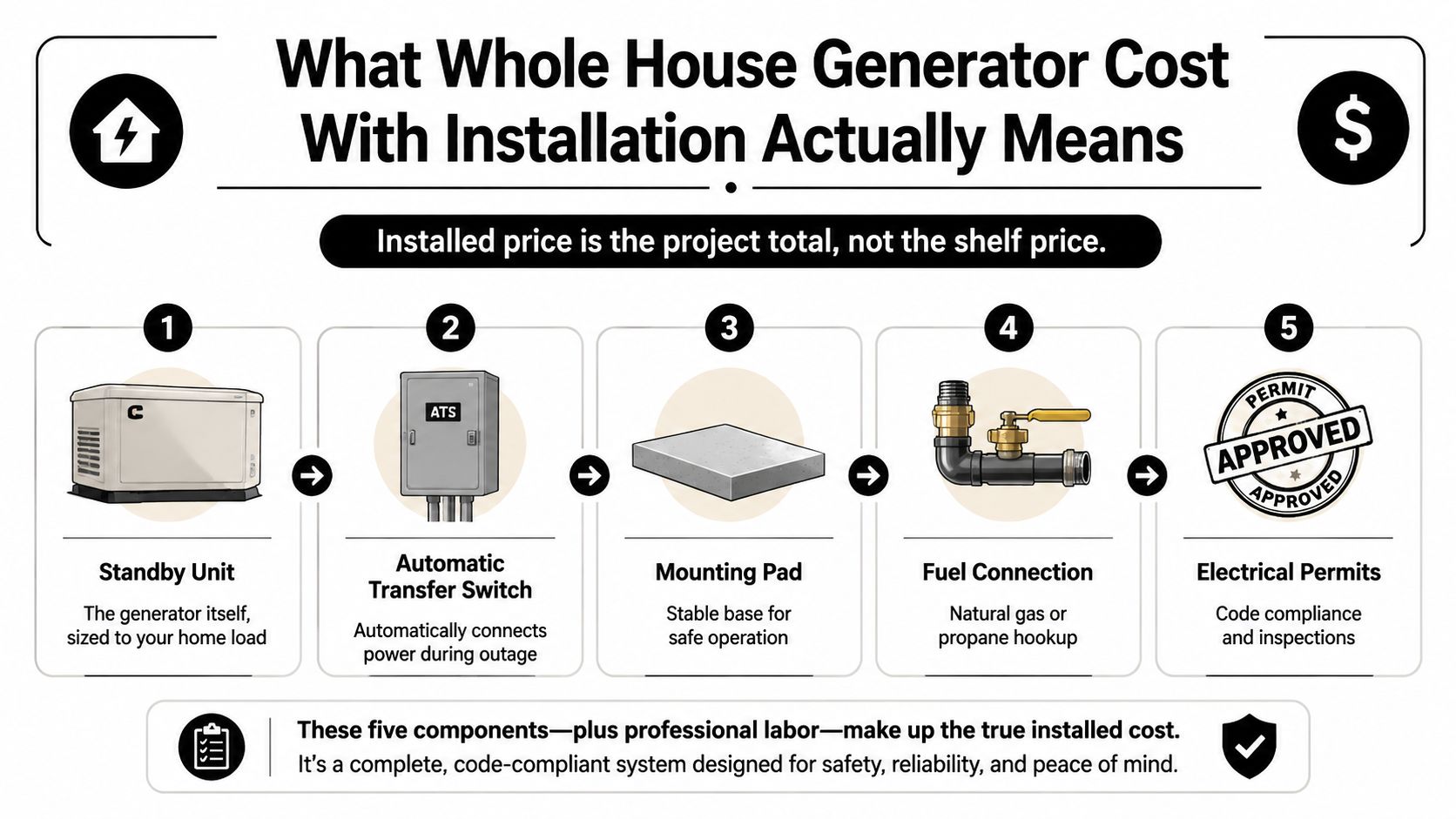
An installed price should cover a generator system ready to operate automatically during an outage. That scope includes the standby unit, automatic transfer switch, mounting pad, fuel connection, electrical labor, permits, startup, and applicable taxes. The $10,000 to $18,000 typical range for many standard projects, including a common 20–22 kW system near $12,000, comes from generator-specific 2026 installed-cost guidance.
A quote below that range usually covers the equipment only and leaves out trenching, gas-line upgrades, utility coordination, inspection fees, battery installation, or startup. A higher quote can reflect a larger liquid-cooled system, long utility runs, difficult access, service-panel changes, or a site that cannot meet required clearances without relocation. Installation complexity, transfer-switch architecture, and site work can add as much as the equipment itself.
Read the total as a scope of work
Ask the contractor to separate these items:
- Generator equipment: The model, fuel type, output, battery, and included monitoring hardware.
- Transfer switch: The amperage, service rating, whole-home or managed-load design, and load-management modules.
- Site work: The pad, leveling, excavation, trenching, drainage, and disposal.
- Fuel connection: Natural gas or propane piping, regulators, meter coordination, and pressure testing.
- Electrical installation: Conduit, conductors, disconnects, grounding, panel connections, and controls.
- Compliance and completion: Permits, inspections, startup, testing, programming, walkthrough, and warranty terms.
Practical rule: If the proposal does not identify the transfer-switch model and fuel-line assumptions, you are not comparing installed prices yet.
The system must match the home's actual peak demand. HVAC compressors, well pumps, electric ranges, heat pumps, and other motors create starting loads that square footage alone cannot reveal. Ask for a load calculation, then confirm whether the proposed system backs up the entire panel or selected circuits. A generator delivered without the pad, wiring, permits, and commissioning is equipment waiting for a project, not an installed system.
The Main Components That Drive the Price Tag
The equipment line gets the most attention because it's easy to recognize. The labor and materials deserve equal scrutiny. A typical 20–22 kW standby system may sit within an overall installed project range of $10,000 to $18,000, while the exact split depends on the transfer switch, fuel distance, panel arrangement, and site conditions, as described in current generator installation cost guidance.
A useful bid should show where each part of that total goes.
| Project component | Typical cost range |
|---|---|
| 20–22 kW standby equipment | $4,000–$7,000 |
| Automatic transfer switch | $900–$3,000 |
| Straightforward electrical work | $1,500–$4,000 |
| Fuel connection and piping | $1,000–$3,000 |
| Pad, mounting, permits, inspection, and startup | $500–$1,500 |
| Labor and materials beyond a straightforward installation | Varies by site |
The ranges above are planning figures from the provided project guidance, not guaranteed line-item prices. Contractors may bundle labor and materials differently, so don't add every maximum together and treat the result as a standard quote.
The transfer switch deserves special attention
A whole-home automatic transfer switch can add about $2,000, while a load-managed switch is around $1,400 and an essential-circuits switch about $900, according to the same standby installation cost benchmark. Those choices can change the total even when the generator engine remains the same.
Electrical work includes more than connecting two wires. The installer may need conduit, conductors, a disconnect, grounding, control wiring, service-rated equipment, and panel modifications. Fuel work can stay modest when the generator sits close to an adequate gas service, but it rises when the contractor must extend or resize piping.
Demand an itemized proposal
A vague “installation package” prevents a fair comparison. Request the generator model, transfer-switch model, wire and pipe assumptions, pad type, permit responsibility, startup details, battery status, warranty coverage, and maintenance inclusions. If a contractor refuses to separate equipment from labor, treat that as a warning, not a convenience.
Generator Size and Switch Type Compared
The cheapest system isn't automatically the right system, and the largest one usually isn't either. A smaller generator paired with managed loads can protect the circuits that matter without carrying every appliance at once. A whole-home switch offers broader coverage but requires equipment and wiring capable of serving the home's full electrical service.
The practical comparison looks like this:
| System choice | Common installed-price range | Best fit |
|---|---|---|
| Air-cooled, 18–22 kW, short gas and electrical runs | $8,000–$13,000 | Average homes with straightforward access |
| 24–26 kW system | Higher than a standard air-cooled project | Larger loads confirmed by a load calculation |
| Liquid-cooled, 30–48 kW | $15,000–$25,000 and potentially higher | Large homes with substantial HVAC or property loads |
| Essential-circuits transfer switch | Lower-cost architecture | Owners prioritizing refrigeration, heating, pumps, and selected circuits |
| Managed-load transfer switch | Mid-range architecture | Homes that need broader coverage while accepting automatic load shedding |
| Whole-home transfer switch | Higher equipment and installation cost | Homes seeking full compatible-panel coverage |
The ranges for air-cooled and liquid-cooled systems come from the supplied 2026 generator sizing guidance at this generator sizing resource. They should be treated as comparison bands, not promises from any manufacturer or installer.
Air-cooled versus liquid-cooled
Air-cooled units generally suit ordinary residential backup needs. They can be a sensible choice when the load calculation supports the output and the property has short, accessible utility runs. A liquid-cooled unit makes more sense when the home has larger HVAC demand or other loads that exceed the practical range of a typical air-cooled system.
Don't select capacity from square footage alone. Calculate running demand, account for motor starting requirements, and identify which loads can be managed. An oversized unit increases equipment and installation demands without necessarily improving the outage experience.
Whole-home versus managed loads
A whole-home switch carries the service and allows compatible circuits to operate together. A managed-load design uses controls to prioritize equipment, such as HVAC, refrigerators, or pumps, while temporarily shedding lower-priority loads. That can make a smaller generator workable, but the homeowner must accept that some equipment won't run simultaneously.
The right pairing meets the home's actual peak demand with usable headroom. It isn't simply the proposal with the biggest kW number.
On-Site Variables That Move Labor Up or Down
Two homes can use the same generator and receive very different labor quotes. The difference usually comes from the path between the generator, gas source, transfer switch, and main panel. Generator installation process guidance is useful for understanding why each connection and inspection step appears in a legitimate scope.
Distance creates work
A short gas run beside an existing meter keeps piping, trenching, and labor under control. A distant pad can require excavation, additional pipe, wall penetrations, pressure testing, and restoration. The same principle applies to electrical conduit. Every extra run between the generator and panel adds material, routing time, and possible access work.
The panel location matters just as much as the meter. A main panel on the opposite side of the house may require longer conduit or a different transfer-switch arrangement. Older or crowded electrical equipment can trigger upgrades that weren't visible in a basic equipment quote.
Clearance rules can relocate the project
The generator needs a compliant location with safe separation from the structure and openings. If the obvious spot fails local or manufacturer clearance requirements, the contractor may have to move the pad, extend both utility connections, remove landscaping, or build around an obstruction. HOA review and municipal approval can also delay the work and create return trips.
| Site variable | Low impact | High impact | Typical add to labor |
|---|---|---|---|
| Gas-line distance | Short, exposed connection | Long run requiring trenching or resizing | $2,000–$5,000 |
| Panel location | Nearby service equipment | Distant panel, wall penetrations, or sub-panel work | $2,000–$5,000 |
| Pad preparation | Level, accessible ground | Clay, roots, slopes, retaining work, or relocation | $2,000–$5,000 |
| Access and restoration | Clear path for crew and materials | Tight access, removal, grading, or surface repair | $2,000–$5,000 |
| Permits and coordination | Straightforward approval | HOA review, utility coordination, or reinspection | Qualitative, quote-specific |
The $2,000 to $5,000 labor impact is the supplied planning range for an otherwise similar installation with materially different site complexity. Ask the contractor to state the assumed gas distance, conduit route, pad location, and restoration responsibility before signing.
Three Sample Homes and Their Installed Totals
The following examples are planning scenarios, not reported customer case studies. They show how the same general product category can produce different whole house generator cost with installation because the coverage goal and property layout change.
Home A, essential-circuits coverage
This 1,600-square-foot ranch uses a 14 kW air-cooled unit and a 10-circuit managed transfer switch. The existing panel sits near the proposed pad, and the gas run is short.
| Line item | Home A |
|---|---|
| Generator unit | $6,200 |
| Managed transfer switch | $1,400 |
| Gas work | $700 |
| Electrical labor | $1,300 |
| Pad and mounting | $400 |
| Permits, startup, and inspection | $400 |
| Total | $10,400 |
This profile suits a homeowner who wants refrigeration, heating, lighting, communications, and selected outlets rather than every circuit. The managed switch controls the budget, but the homeowner must accept that some loads won't operate during peak demand.
Home B, standard whole-home coverage
This 2,800-square-foot two-story home uses a 22 kW air-cooled unit with a 200-amp service-rated transfer switch. The project includes a 30-foot gas-line trench, a poured pad, permit handling, and inspection.
| Line item | Home B |
|---|---|
| Generator unit | $6,600 |
| Whole-home transfer switch | $2,000 |
| Gas work and trenching | $1,400 |
| Electrical labor | $2,700 |
| Poured pad | $700 |
| Permits, startup, and inspection | $1,200 |
| Total | $14,600 |
This is the closest match for many buyers asking about a conventional whole-house system. The transfer-switch architecture and trenching explain why the total is materially above an essentials-only installation.
Home C, large-property coverage
This 4,500-square-foot estate has large HVAC and pool loads. It uses a 38 kW liquid-cooled generator, a whole-home switch, a long gas run, a setback-driven relocation, and upgraded electrical equipment.
| Line item | Home C |
|---|---|
| Generator unit | $15,000 |
| Whole-home transfer switch | $2,500 |
| Gas work and long run | $2,500 |
| Electrical labor and upgrades | $4,500 |
| Relocated pad and site work | $1,000 |
| Permits, startup, and inspection | $1,000 |
| Total | $26,500 |
| Line item | Home A: Essentials, 14 kW | Home B: Whole-Home, 22 kW | Home C: Large Estate, 38 kW |
|---|---|---|---|
| Generator unit | $6,200 | $6,600 | $15,000 |
| Transfer switch | $1,400 | $2,000 | $2,500 |
| Gas work | $700 | $1,400 | $2,500 |
| Electrical labor | $1,300 | $2,700 | $4,500 |
| Pad and site work | $400 | $700 | $1,000 |
| Permits, startup, and inspection | $400 | $1,200 | $1,000 |
| Total | $10,400 | $14,600 | $26,500 |
Home A matches an essentials-focused buyer. Home B matches the typical whole-home buyer. Home C matches a high-load property, and a larger liquid-cooled unit, longer utility run, or service upgrade can push a project into that next tier.
Where Quotes Get Inflated and How to Push Back
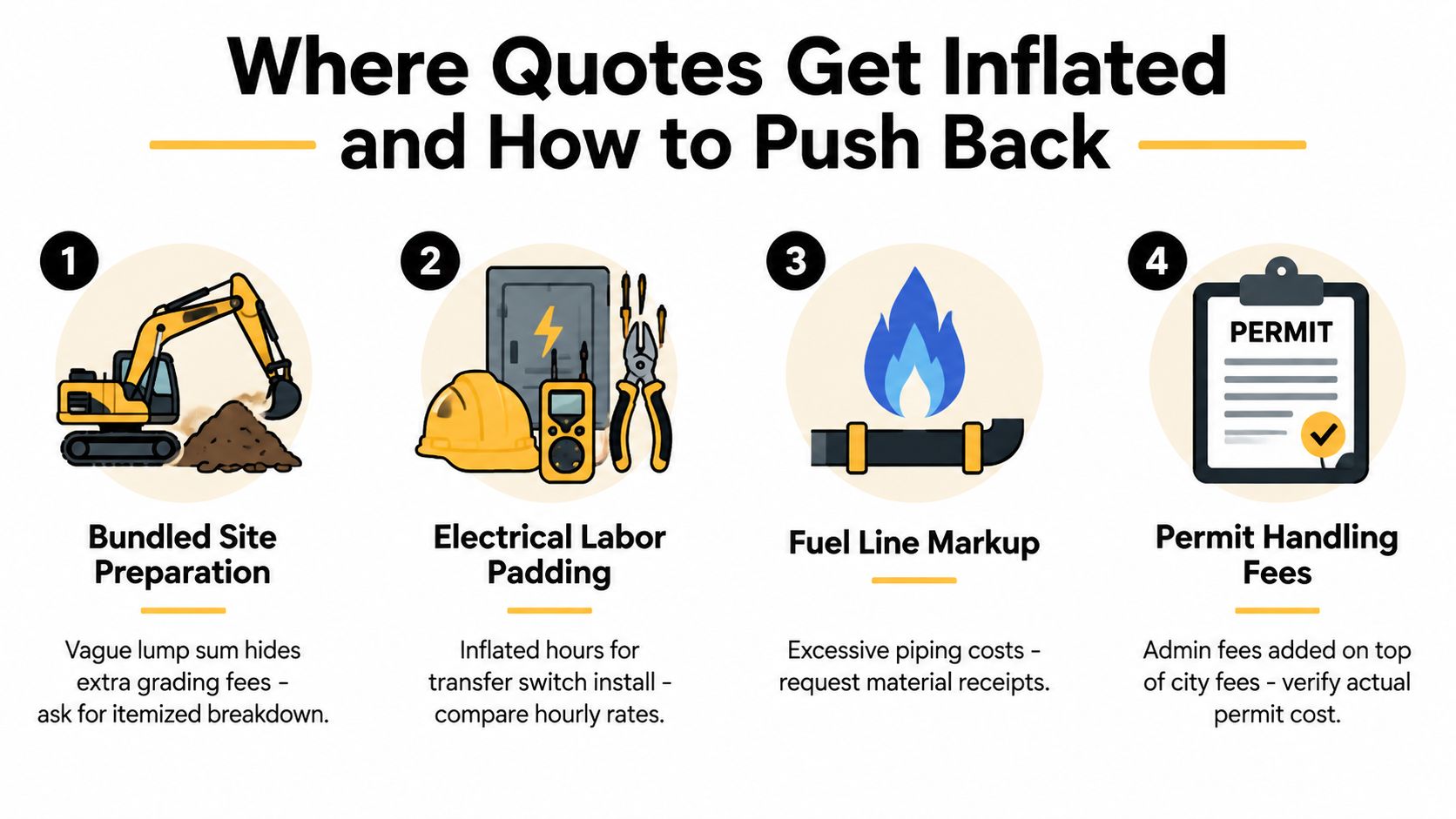
Contractors don't always inflate the generator price. More often, they hide margin inside vague installation categories that homeowners can't compare. A bundled “site preparation” line may combine concrete, grading, disposal, and crew time without showing what each task costs.
Test the vague lines
Ask direct questions before you negotiate the total:
- Site preparation: What pad type, dimensions, excavation, grading, and restoration are included?
- Electrical compatibility: Is the proposed panel equipment required by the load calculation or bundled as a kit?
- Transfer-switch work: Which circuits need rewiring, and why can't managed loads avoid unnecessary changes?
- Fuel piping: What pipe length, diameter, fittings, trenching, and pressure work does the price assume?
- Permit handling: Which fees are municipal charges, and which are contractor administration fees?
- Warranty and maintenance: Are extended coverage and service visits optional, or buried in the financed balance?
The supplied project guidance indicates that the generator can represent roughly 45% to 55% of the project, but that ratio is a planning rule rather than a universal benchmark. If a proposal makes the unit appear to be 70% or more of the total, ask what installation work has been omitted or compressed into later change orders.
Don't negotiate a lump sum you can't audit. Negotiate the scope first, then the price.
Get competing bids based on the same kW rating, transfer-switch class, fuel distance, pad type, and permit responsibility. Off-season scheduling may improve availability, but it shouldn't justify skipping inspections or reducing the electrical scope. If you finance the project, refuse to finance unexplained markup. A lower sticker price with missing site work isn't a lower installed cost.
Financing, Dealer Plans, and the True All-In Cost
A financing offer changes the project math. Compare the cash contract total with the amount you'll pay if the promotional terms expire, a payment is missed, or fees are added. A “0%” offer may include deferred interest that applies the standard rate to the original balance if the balance remains when the promotion ends.
Ask for two written figures:
- Installed cash price: Equipment, transfer switch, fuel work, electrical labor, pad, permits, startup, tax, and included service.
- Financed total: Principal, interest, processing fees, credit-card surcharge, maintenance plan, and any warranty add-on.
| Payment method | Typical APR / term | Hidden cost risk | Best for |
|---|---|---|---|
| Cash | No financing term | Less flexibility for household reserves | Buyers who can pay without weakening emergency savings |
| Dealer promotion | Promotional period varies by contract | Deferred interest, missed-payment penalties, restricted installer choice | Buyers who can clear the balance under the written terms |
| Home-equity borrowing | Rate and term depend on lender | Interest, closing costs, and secured debt | Owners comparing a longer repayment schedule |
| Credit card | Card agreement applies | Interest and processing surcharge | Short-term payment only when repayment is certain |
Review the agreement rather than relying on a salesperson's summary. Confirm whether the permit fee, first maintenance visit, startup, battery, monitoring, and warranty labor are included. The GeneratorInstallerList financing guide can help you build a question list before you compare dealer plans.
Your Pre-Quote Checklist Before You Sign Anything
A good quote starts before the contractor arrives. Gather the documents that reveal the home's real electrical and fuel conditions, then require every bidder to price the same system scope.
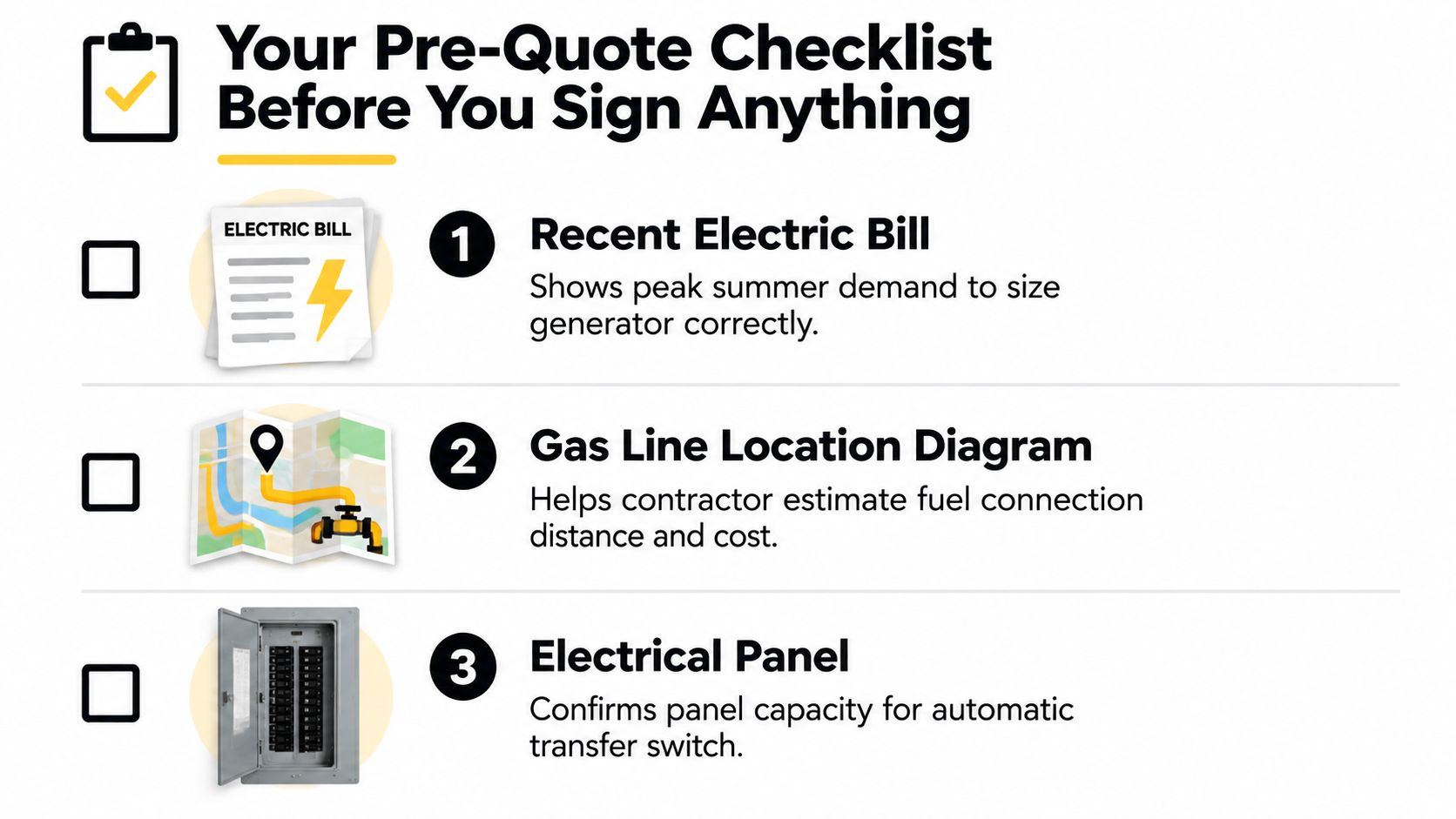
Bring three useful documents
- Recent electric bill: It gives the contractor a starting point for understanding demand, especially during heavy cooling or heating periods.
- Gas-line location diagram: A utility markout or clear site sketch helps establish the likely fuel-connection path.
- Electrical panel photo and rating: The panel configuration, service rating, and available space affect transfer-switch planning.
Then verify the proposed pad location against municipal and manufacturer clearance rules. A location that looks convenient from the driveway may force relocation once doors, windows, vents, property lines, and access routes are considered.
Make competing bids comparable
Give each contractor the same generator output, transfer-switch architecture, fuel-line distance assumption, and desired backup scope. Require separate lines for the unit, switch, pad, gas work, electrical labor, permits, inspection, startup, tax, warranty, and maintenance.
The two decisions with the greatest influence are accurate sizing and transfer-switch architecture. Get those right before discussing brand upgrades, monitoring features, or financing. A smaller system with managed loads may be the correct design, while a whole-home system may be justified when the calculated peak demand and outage priorities require it.
GeneratorInstallerList provides a ZIP-based directory of generator-focused installers, with filters for standby or whole-house signals, service and maintenance language, and several major brands. Use GeneratorInstallerList to identify potential contractors, then confirm licensing, insurance, permits, references, and the written scope directly with each company.
Visit GeneratorInstallerList to find installers whose websites show standby or whole-house generator experience in your area. Compare several companies using the same load calculation, transfer-switch design, fuel-run assumptions, and itemized scope before you pay a deposit.
- whole house generator
- generator installation cost
- standby generator
- home backup power
- generator pricing
Ready to find who to call?
Open your state page or search by ZIP for a distance-sorted list.