Whole House Generator How Many Watts: A Real Sizing Guide
Whole House Generator How Many Watts. Learn how many watts a whole house generator really needs. Step-by-step sizing, starting vs running watts, transfer-switch
Most homes that want broad backup land somewhere in the 15 kW to 26 kW range, but the right answer comes from your total running watts plus the largest motor starting surge, not from square footage alone. If you only want essentials, some homes fit much lower, while larger all-electric homes can need far more.
That's usually the point where homeowners get frustrated. They've already searched whole house generator how many watts, seen a clean answer like “20kW is enough,” and now they're trying to figure out why one installer says 14kW, another says 20kW, and a third wants to quote something much larger. In the field, that spread usually means nobody is talking about the same load list.
A good sizing conversation isn't about house size first. It's about what you expect to stay on during an outage, which loads start with a surge, whether your house is gas-heavy or electric-heavy, and whether you're willing to use load management. That last part matters more now because modern standby installs increasingly rely on smart control instead of brute-force oversizing.
Table of Contents
- Why a Single Wattage Number Won't Fit Your Home
- Building Your Home Load Inventory
- Starting Watts vs Running Watts Explained
- Running the Sizing Calculation
- Choosing Between Whole House and Managed Power
- Transfer Switches and Panel Compatibility
- Sizing Recap and What to Do Next
Why a Single Wattage Number Won't Fit Your Home
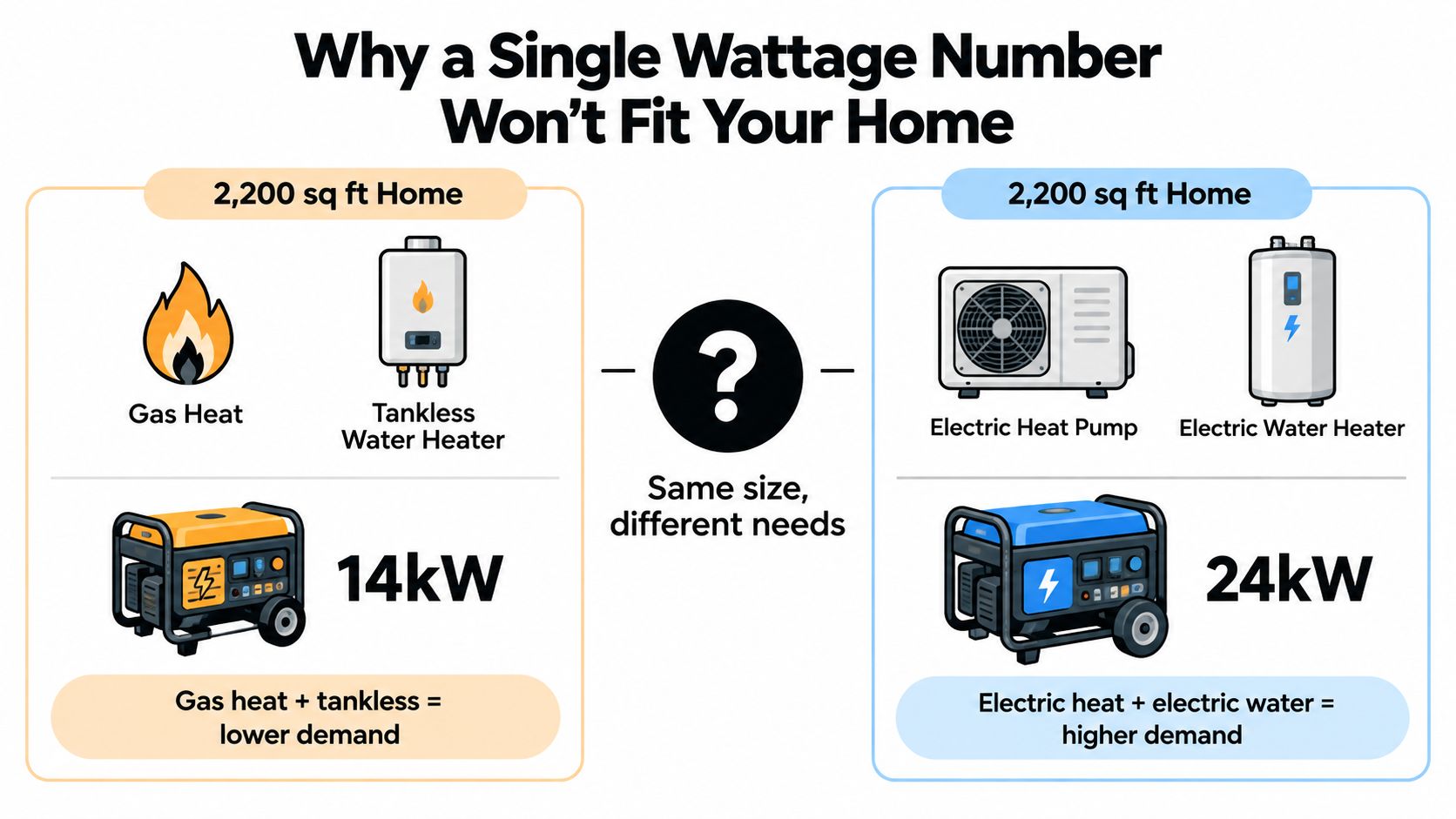
Two homes can look nearly identical from the street and need completely different generators.
I've seen the same basic story over and over. One homeowner has a mid-size house with gas heat, gas cooking, and a tankless water heater. The other has a similar-size house with electric water heating, central air, and heavier electric loads. On paper, the square footage matches. In practice, the generator size doesn't.
What actually drives the number
The common starting range for a whole-house standby unit is 15,000 to 20,000 watts for many homes, but that's only a starting point, not a rule. The load has to be built from what will run at the same time, and the surge from motors has to be handled without the unit falling on its face. That's why sizing guidance focuses on totaling running watts and then adding the biggest startup surge instead of using square footage alone, as outlined in Angi's whole-house generator sizing guide.
Another practical benchmark puts whole-home backup in the 20 to 26+ kW range when the goal is to carry most or all of the home, including HVAC and heavier kitchen or water-heating loads, while lighter backup tiers can fall below that depending on what you exclude, according to Valley Service's generator sizing guide.
A “whole house” label on the brochure doesn't tell you what the generator can actually start at the same moment.
Where buyers get misled
The trap is the quick chart that asks for bedrooms or square footage and spits out one neat number. Those charts can be fine for a first pass, but they routinely miss the loads that blow up a real standby design.
A few examples matter more than floor area:
- Well pumps: A home on a well can size very differently from a similar home on city water.
- Electric heat or water heating: These loads can move a house out of the small standby class fast.
- Multiple condensers or larger HVAC: Two cooling systems change the conversation immediately.
- Lifestyle loads: Hot tubs, shop tools, and pool equipment often don't show up on generic dealer forms.
The only sizing method that holds up
Start with your house, not somebody else's average.
If you're asking whole house generator how many watts, the useful answer comes from a personal load audit. List what you want energized during an outage. Separate what must run from what would be nice to run. Identify the largest motors. Then decide whether you want true whole-house coverage or managed power that temporarily drops noncritical loads.
That's how you avoid buying a generator by slogan.
Building Your Home Load Inventory
A usable load inventory doesn't need to be fancy. A clipboard works. A spreadsheet works better. What matters is that you walk the house and write down the loads you care about.
Use three buckets
Break the house into these groups so you don't miss something important:
Always-on essentials
Refrigerator, freezer, internet equipment, lighting circuits, garage door opener, medical devices, sump pump.HVAC and water
Furnace blower, air conditioner, heat pump, boiler controls, well pump, water heater.Discretionary heavy loads
Electric range, dryer, hot tub, shop equipment, EV charging, pool equipment.
That structure keeps the audit honest. Homeowners often remember the refrigerator and forget the well pump, or they remember the lights and forget that a gas furnace still needs blower power and controls.
What to record for each item
For each appliance or circuit, write down:
- Appliance name
- Running watts
- Starting watts if it has a motor or compressor
- Fuel type
- Circuit location in the panel
- Whether it's must-have or optional
The panel location matters later when the transfer switch or backed-up subpanel is laid out. A clean load list saves time during the install because the electrician can match the circuits you care about to the actual panel spaces.
Practical rule: If it has a compressor, pump, or blower motor, don't stop at the running wattage.
Sample Home Load Inventory
Below is a simple example format. The values shown are illustrative appliance examples often seen in homes, but your nameplates and manuals should control the final list.
| Appliance | Running Watts | Starting Watts | Notes |
|---|---|---|---|
| Refrigerator | 150W | Record from nameplate/manual | Essential kitchen load |
| Microwave | 1,000W | N/A or manufacturer spec | Resistive/electronic load |
| Gas furnace blower | 600W | Record from equipment data | Heating system still needs electricity |
| Central AC | 1,200W | Record compressor start data | Motor-driven, often largest surge |
| Electric water heater | 4,500W | N/A or manufacturer spec | Heavy resistive load |
| Internet router/modem | Record from label | N/A | Usually small but important |
| Well pump | Record from nameplate | Record from pump data | Frequently missed in DIY estimates |
How to walk the house without missing circuits
Don't try to do it from memory.
Open the panel directory and compare it to what's in the home. Then go appliance by appliance and read the data plate. If the label gives amps and volts instead of watts, note those values so your installer can convert them. For HVAC, well pumps, and larger motors, the equipment tag and model data are more useful than guessing from a generic chart.
One more thing. Mark future loads separately. If you're planning to add a heat pump, workshop equipment, or an electric water heater later, that belongs in the conversation now. It may not change today's choice, but it can affect whether the installer recommends extra load-management capability or a larger transfer switch setup.
Starting Watts vs Running Watts Explained
A generator that carries your house comfortably at dinner time can still stumble the moment the well pump or AC compressor starts. That is the part many online wattage charts miss.
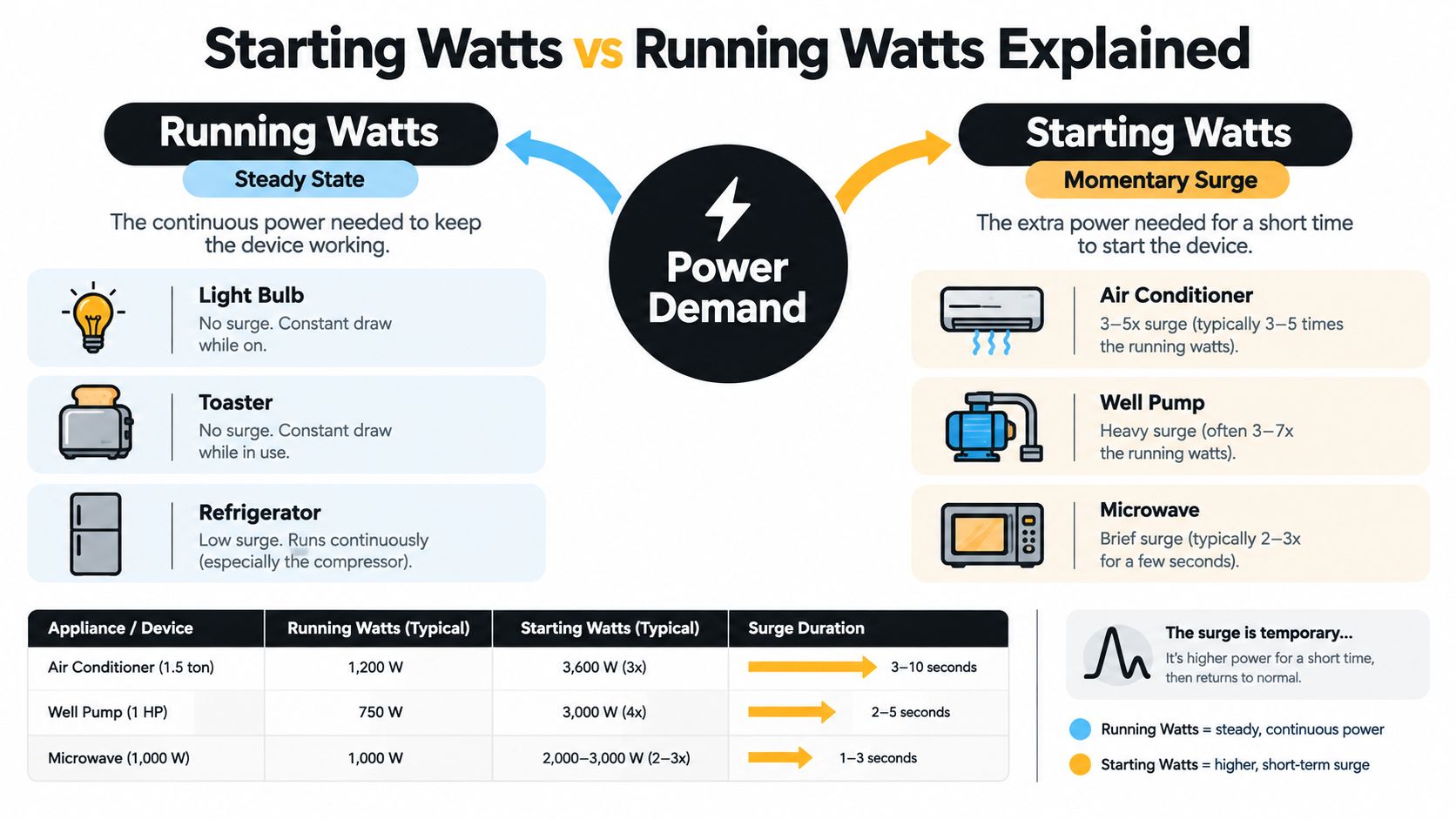
Running watts are the power a load uses once it is operating normally. Starting watts are the short burst needed to start a motor. For lighting, electronics, and heating elements, those two numbers are often close enough that sizing is straightforward. For motor loads, they are not.
The surge is what separates a clean install from a problem install
Refrigerators, sump pumps, well pumps, air conditioners, and furnace blowers can pull far more current for a moment at startup than they do while running. Technical guidance from Voltage Lab's generator sizing calculator guide explains that motor startup can reach several times running load, and the generator still has to hold voltage high enough during that event for equipment to stay online.
That is why two houses with the same square footage can need different generator sizes. One may have gas heat, no well pump, and a smaller single-stage AC. The other may have a deep well pump, a large compressor, and a basement sump that kicks on during storms. The steady load may look similar on paper. The startup behavior does not.
I see this mistake often. A homeowner adds up appliance wattages, lands on a number that looks safe, and buys too close to the edge. Then the first hot outage hits, the compressor starts, lights dip, and the generator sounds loaded even though the running total looked fine.
How to count startup load without oversizing the generator
The practical method is simple. Add the running watts of the loads you expect to operate at the same time, then account for the largest motor surge likely to hit during that period.
Do not add every motor surge in the house as if all of them start together. That pushes people into larger units than they need. Do not ignore startup load either. That is how a "whole house" unit turns into a nuisance call.
A real example helps. If a home is steadily using around 8,000 watts and the air conditioner compressor is the biggest motor in the mix, the sizing question is not just whether the generator can carry 8,000 watts. It is whether it can carry that base load and absorb the compressor start without an ugly voltage drop or an overload fault.
Here's a visual explanation of how that relationship works in a house backup setup.
Why the answer changed in 2026
Load management changes the math. So do soft-start kits on some HVAC systems.
If the transfer equipment can delay one large load for a minute while another motor starts, the generator does not have to brute-force every heavy demand at once. That often lets a homeowner buy a smaller standby unit without giving up the loads that matter. If the goal is true no-compromise backup, the size goes up fast. If the goal is keep the house comfortable, cold food safe, water running, and internet on, managed power can get there with less generator.
That is also where marketing gets slippery. "Whole house" can mean every branch circuit is connected, or it can mean the system powers the whole home with load shedding in the background. Those are different designs, and the wattage requirement is different too.
Running the Sizing Calculation
A sizing worksheet gets clearer once you run real numbers against real habits.
I've seen two 2,500 square foot homes land in different generator classes because one has a well pump, two HVAC systems, and an electric water heater, while the other has city water, gas heat, and stricter load control. Square footage is a weak shortcut. The load list decides the generator.
The basic formula
Use this framework:
Generator size target = total running watts of simultaneous loads + largest starting surge + safety margin
The order matters. Add the loads that are realistically on at the same time during an outage. Then account for the single biggest startup event, which is often an AC compressor, heat pump, or well pump. After that, add headroom so the unit is not working at its limit every time a major load kicks on.
A good cross-check is the utility-demand method in Fall River Electric's standby generator guide. It recommends looking at peak kW demand over about a month, sizing above that peak, and making sure the reading reflects normal occupancy and the heavier seasonal load.
Sample Home Sizing Calculation
Here's a sample layout for the math. The exact values should come from your own load inventory and equipment labels.
| Load Category | Running Watts | Starting Watts | Counted in Total |
|---|---|---|---|
| Refrigerator | 150W | From appliance data | Running total, plus surge only if largest |
| Microwave | 1,000W | N/A or spec sheet | Running total |
| Gas furnace blower | 600W | From equipment data | Running total, plus surge only if largest |
| Central AC | 1,200W | From compressor data | Running total and often largest surge |
| Electric water heater | 4,500W | N/A or spec sheet | Running total if allowed to run during outage |
| Well pump | From pump data | From pump data | Running total, plus surge only if largest |
| Lighting and small receptacles | From audit | N/A | Running total |
Here is what that looks like in practice.
Say the homeowner wants the refrigerator, furnace blower, lights, microwave, well pump, and water heater available during an outage. Add the running watts for the loads expected to overlap. Then identify the biggest motor start among those loads. If the well pump has the largest surge, count that one surge on top of the running total instead of stacking every motor start as if they all hit at once. Then add a margin before choosing the next generator size up.
That last step is where undersizing usually happens. Sales quotes often look clean on paper because they assume perfect load timing. Houses do not behave that neatly during an outage.
Where homeowners usually go wrong
The first mistake is adding every startup watt at once. That inflates the target and can push a buyer into a larger unit than the home needs.
The second mistake is worse. Ignoring startup loads produces a generator that carries the house fine until the compressor or pump tries to start, then trips, bogs down, or throws a fault.
A better field method is straightforward:
- Add realistic simultaneous running loads. Base this on outage behavior, not everything in the panel.
- Identify the largest single surge. Usually that is a compressor or pump.
- Decide which high-watt loads are allowed to overlap. Water heaters, dryers, ovens, and EV charging often change the answer fast.
- Add margin and round up. A standby unit should have breathing room.
One more practical check helps. If the number only works when nobody cooks, the AC never restarts under load, and the water heater stays off, the generator is sized too tightly for the way the house is used.
The cleanest quote is the one where the load list, surge plan, and switching strategy all match.
Choosing Between Whole House and Managed Power
Most buyers aren't really choosing a wattage first. They're choosing a coverage style.
Three ways to build the system
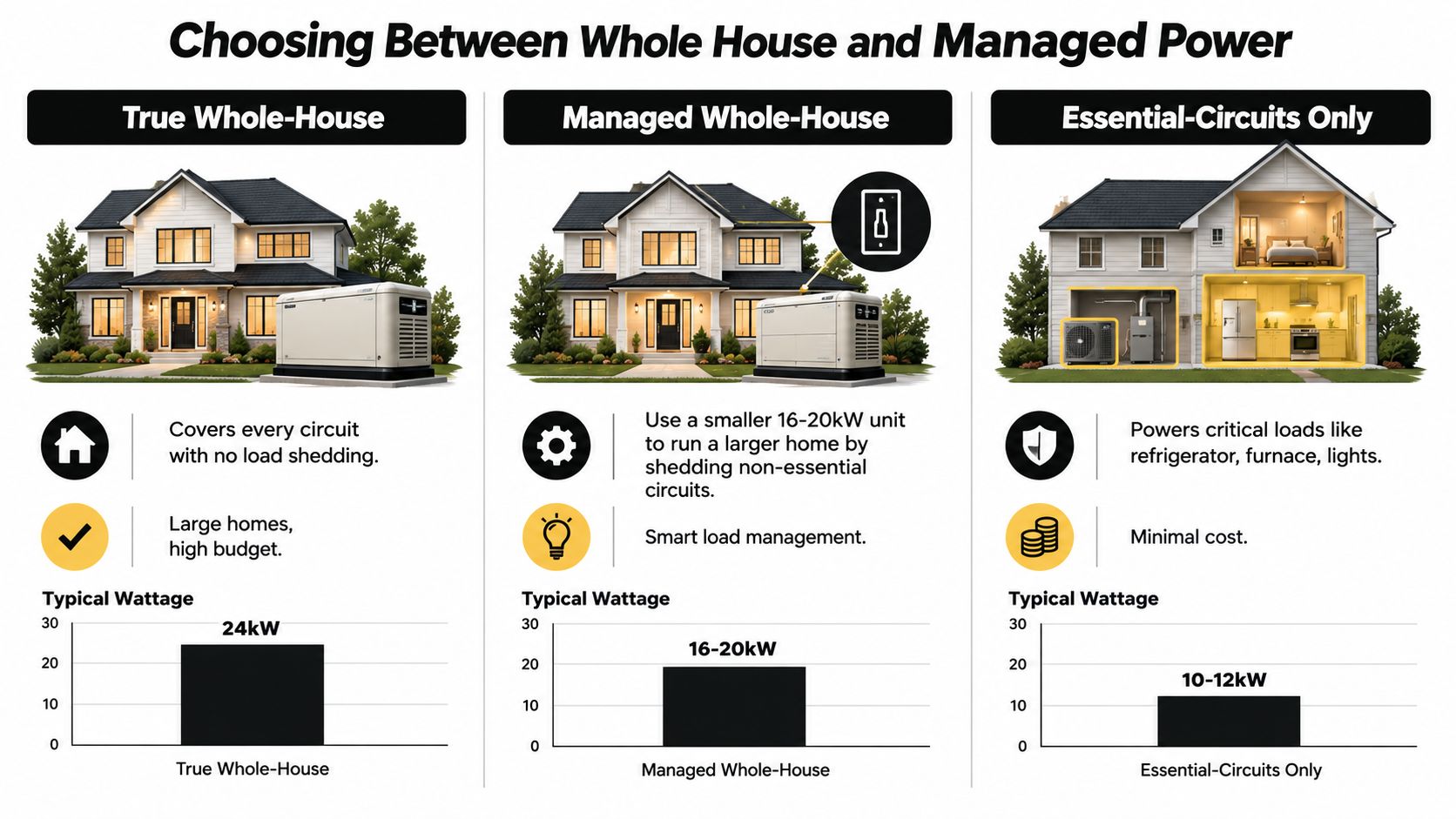
True whole-house coverage means every circuit is available without planned load shedding. This is the most straightforward user experience. It's also the option that tends to push homes into the larger standby classes, especially if the house has central air, electric cooking, or heavier water-heating loads.
Managed whole-house is where the math gets smarter. Recent guidance increasingly separates essential circuits, most-of-home coverage, and full whole-home backup because the wattage jump between those goals can be significant, and soft-start or load-shedding strategy can materially reduce the needed generator size for the same house, as discussed in this standby versus portable versus battery guide. In plain terms, the system can pause a water heater or dryer while the AC starts, then bring that load back later.
Essential-circuits only is the most selective approach. It focuses on keeping food cold, internet up, basic lighting on, and heating or cooling support available. It's the right answer for some homes, especially when outage comfort matters more than running every appliance.
What usually makes sense
If you want the house to feel almost normal during an outage, managed whole-house is often the sweet spot. It avoids the common mistake of buying a larger generator just to cover a few loads that don't need to run at the same second.
If you run a home business, have medical equipment, or don't want to think about what's on, true whole-house coverage may be worth the extra equipment and fuel use.
Buyers often pay for generator capacity when what they really needed was better load control.
One caution. Load management isn't universal across every setup. It depends on the transfer switch, the controls, and whether the brand and installer support the scheme they're proposing. If someone promises a smaller generator through “smart management,” ask which loads will be shed, in what order, and what hardware handles that logic.
Transfer Switches and Panel Compatibility
Generator size gets most of the attention, but the transfer switch and panel arrangement often decide whether the install goes smoothly.
The switch has to match the service
A standby generator doesn't operate in isolation. It has to tie into the home through a transfer switch that matches the service setup and the intended coverage plan. Some homes use a whole-house service-rated switch. Others use a backed-up subpanel that carries only selected loads.
For homeowners comparing proposals, it helps to understand the difference between a whole-house switch and a selective-load approach. A clear overview of that hardware decision is laid out in this guide to transfer switch installation.
Common compatibility problems
These are the issues that slow jobs down or change the quote after site visit:
- Older equipment: Some older fuse panels or obsolete load centers aren't good candidates for a simple generator tie-in.
- Limited panel space: Even when the service is adequate, the physical layout can complicate breaker moves and backed-up circuit selection.
- Busbar and listing constraints: Not every panel allows the same connection method.
- Service configuration: Some homes need a different switch arrangement than the homeowner expected.
A good installer checks the meter location, service entry, grounding and bonding details, and whether the proposed switch location works with code clearance and equipment listings.
The schedule is often longer than the install
Homeowners usually focus on pad, gas, and generator lead time. Utility coordination and permitting can take longer than expected. Some projects move quickly. Others get delayed by service work, panel upgrades, or local interpretation on how the connection has to be made.
There's also a practical code layer. The install may require additional disconnecting means, and local inspectors may have strong preferences about equipment placement and labeling. That's why two quotes can differ even when the generator brand and size are the same.
Ask each bidder to put the switch type, switch amperage, panel strategy, and any assumed upgrade work in writing. If that part of the quote is vague, the generator size alone won't tell you much.
Sizing Recap and What to Do Next
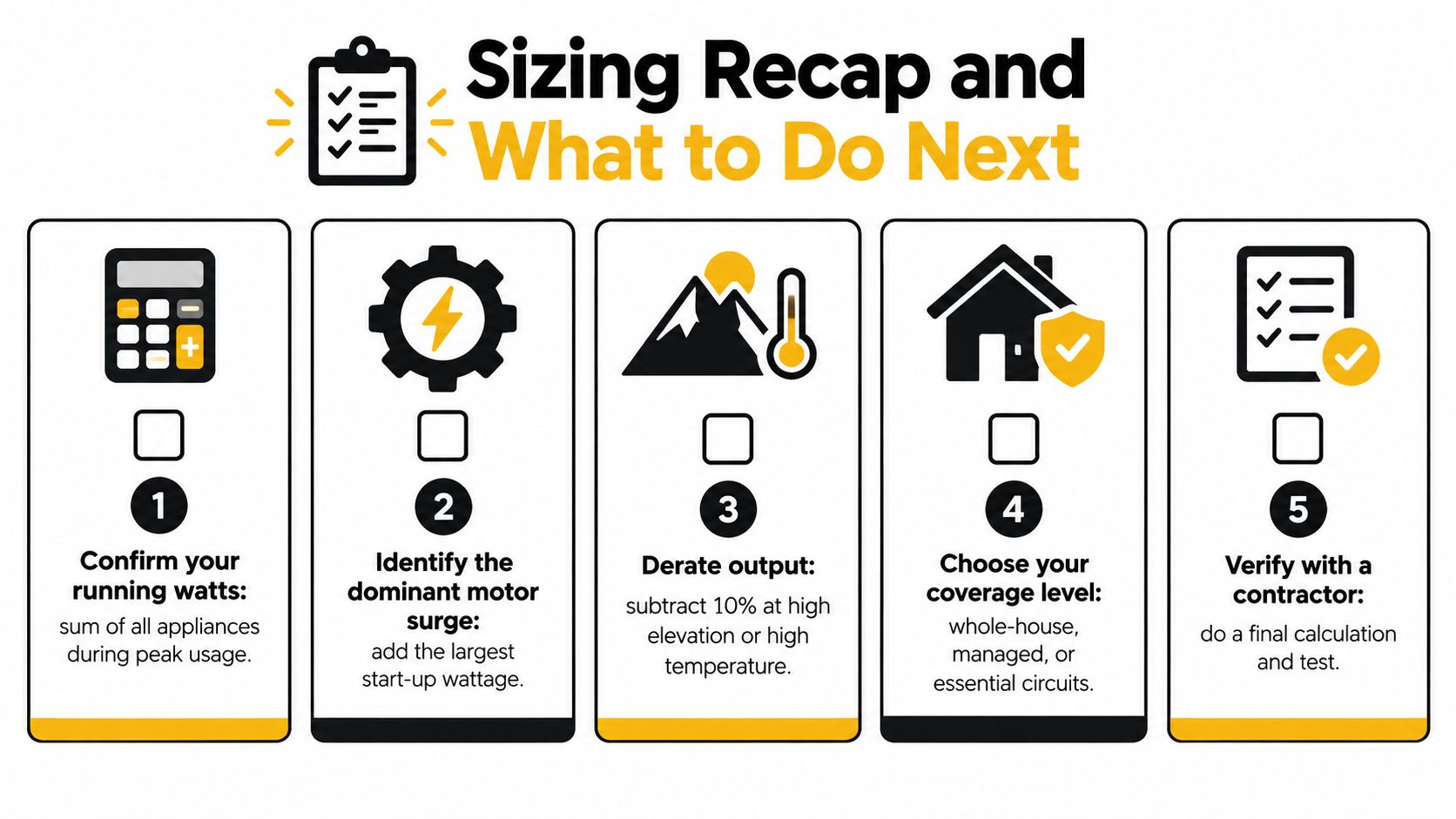
The right answer to whole house generator how many watts usually comes down to five checks, not one marketing number.
The practical checklist
- Confirm the running load: Build the list from real appliances and real simultaneous use.
- Find the dominant surge: The largest motor startup changes the answer more than most homeowners expect.
- Check site derating: Heat and elevation matter if the unit is already close to the line.
- Pick the coverage tier: Essential circuits, managed whole-house, and true whole-house are different projects.
- Match the switch and panel plan: The generator, switch, and service equipment have to work as one system.
How to compare quotes without getting lost
Get three written load audits. Ask each installer to show the same backed-up load list, not just a generator model number. If one bidder includes the water heater, well pump, and AC startup, and another doesn't, those are not comparable quotes.
Also compare the control strategy. A larger unit isn't automatically the better proposal. Sometimes the better design is a smaller generator with clear load management, cleaner panel work, and a more realistic outage plan.
If you're still collecting bids, a buyer directory such as this whole-house generator cost guide from GeneratorInstallerList can help you frame the questions to ask each contractor about equipment, labor, and scope.
What to do in the next 30 days
Start by finishing your appliance and circuit inventory. Then schedule site visits and hand the same load list to each installer. Ask them to mark which loads are always supported, which are managed, and which are excluded.
The mistake I'd avoid is buying extra generator size before you've priced load management properly. In many homes, smarter control solves the problem better than jumping to a much larger unit.
GeneratorInstallerList helps homeowners cut through noisy search results by organizing researched standby and whole-house generator installers across the U.S. If you're trying to match the load audit in this guide to actual local companies, visit GeneratorInstallerList to find installers, compare generator-focused signals, and keep your quote process grounded in scope instead of guesswork.
- whole house generator
- generator sizing
- running watts
- transfer switch
- load management
Ready to find who to call?
Open your state page or search by ZIP for a distance-sorted list.