Whole House Generator Inverter Explained Simply
Confused about whole house generator inverter tech? Learn how inverter systems work, when they matter, and how to size for real home loads.
A storm has just taken out your power. The refrigerator is quiet, the Wi-Fi router is dark, and the heating or cooling system won't restart. You search for a whole house generator inverter and quickly find conflicting advice. One page says inverter technology is essential for protecting electronics. Another recommends a conventional standby generator for dependable whole-home operation. Both can be right, depending on what you're trying to power and how the system is installed.
The confusion comes from treating “inverter” as a universal quality label. Inverter technology can provide clean, stable electricity and efficient operation at changing loads. Yet a permanently installed standby system also depends on generator capacity, starting current, transfer equipment, permitting, and automatic load management.
This guide starts with the electrical basics, then compares inverter and conventional designs before focusing on the decisions that determine real outage performance. By the end, the useful question won't be “Which generator has an inverter?” It'll be “What does my home need to stay powered safely and reliably?”
Table of Contents
- Introduction When the Lights Go Out and Choices Get Confusing
- How Inverter Technology Creates Cleaner Power for Your Home
- Inverter Versus Conventional Whole House Systems Compared
- Sizing and Load Management That Determine Real Whole House Performance
- Common Misconceptions About Inverter Labels in Standby Power
- Real World Use Cases Where Inverter Whole House Power Makes Sense
- Choosing the Right Setup and Finding Qualified Installers
Introduction When the Lights Go Out and Choices Get Confusing
A storm knocks out power just as the refrigerator, internet router, and heating or cooling system are running. You search for a whole house generator inverter, then encounter product pages using “whole house,” “pure sine wave,” “standby,” and “inverter” as if they meant the same thing. They do not.
The first distinction is the generator's role. A portable inverter generator is commonly valued for refined power, quieter operation at lighter loads, and engine speed that adjusts with demand. It may suit selected appliances, electronics, or temporary power. A stationary standby generator faces a broader test: it must start automatically, connect through approved transfer equipment, supply household circuits, and cope with the high starting demand of motors and compressors.
The practical question: Judge the complete electrical system, not the generator label alone.
The market helps explain why inverter products attract attention. The global inverter generator market was valued at $5.2 billion in 2024 and is projected to reach $8.8 billion by 2035, with a projected 5.0% compound annual growth rate from 2025 to 2035, according to OMR Global's inverter generator market summary. North America is also a major demand center. Its inverter generator market was estimated at $1.56 billion in 2024 and is forecast to reach $2.77 billion by 2035, at a projected 5.5% CAGR, as reported in OMR Global's North American market analysis.
Those figures describe a growing product category, not a reason to select an inverter-based standby system automatically. A home office with sensitive electronics may place greater value on waveform quality. A property with a heat pump, well pump, or electric vehicle charger may first need accurate sizing, transfer-switch design, and load sequencing. Another home may perform well with a conventional standby generator when its capacity and load management are correctly configured.
Start by identifying the circuits that must remain powered, their running demand, and the loads that start hardest. Then ask what the inverter contributes to that complete setup.
How Inverter Technology Creates Cleaner Power for Your Home
Think of electricity from an engine-driven generator as water coming from a rough underground pump. The pump may provide pressure, but the flow can fluctuate. Sensitive equipment works better when that flow passes through a treatment process before reaching the pipes in your house.
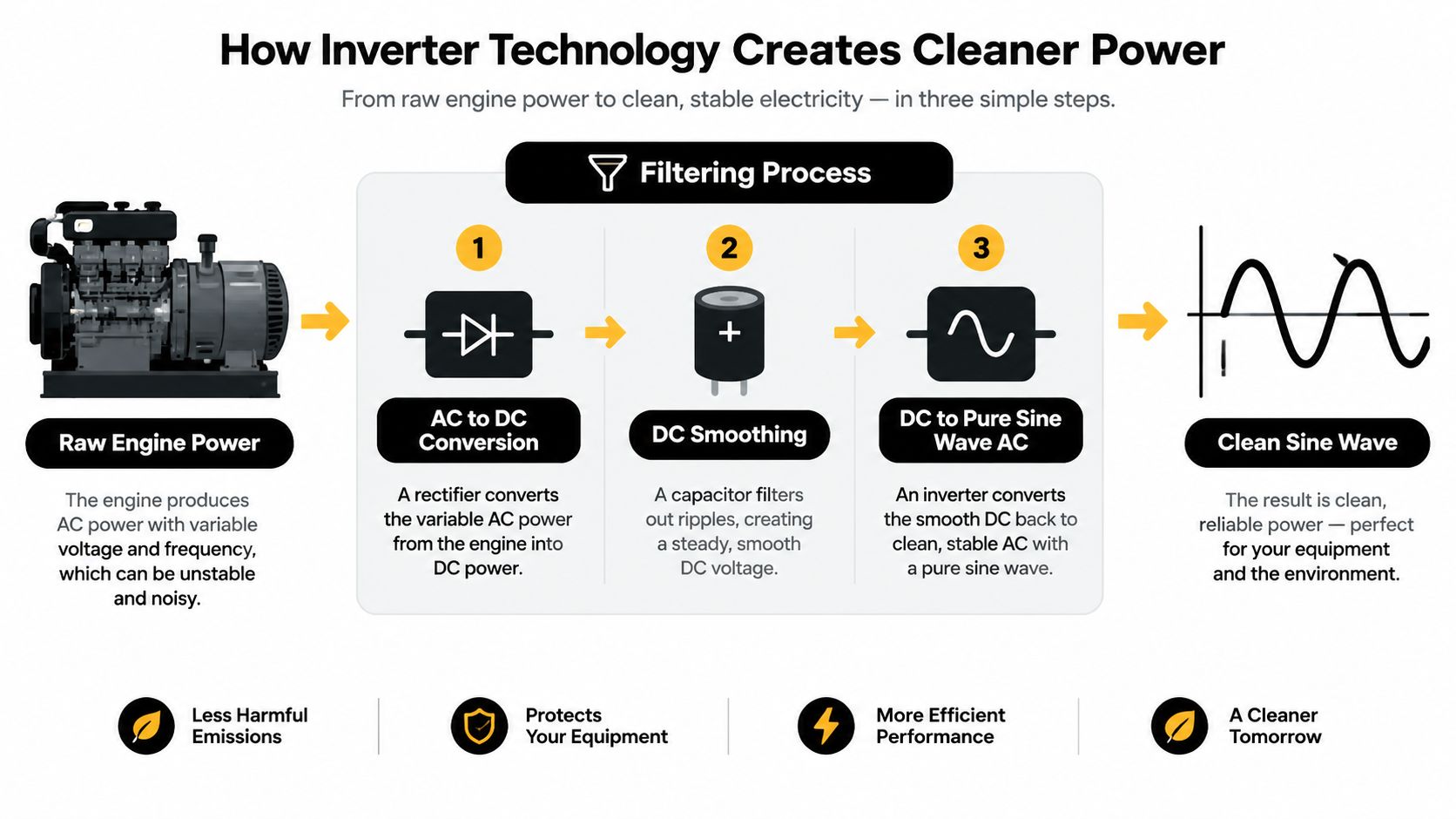
An inverter generator uses electronics to refine the electricity in stages. The engine first produces alternating current, or AC. The system converts that AC into direct current, or DC, smooths the DC supply, and then converts it back into carefully controlled AC for the home.
The three stages behind the output
AC to DC conversion: A rectifier changes the generator's initial AC output into DC. This separates the engine's raw electrical production from the final waveform supplied to appliances.
DC smoothing: Capacitors and related electronics reduce fluctuations in the DC supply. The smoother intermediate signal gives the control system a more stable foundation.
DC to pure sine wave AC: The inverter electronics build a new AC waveform from the controlled DC supply. The result is typically described as pure sine wave output, a shape that closely matches utility power.
Pure sine wave power is not magic. It's a rebuilt electrical signal, shaped and regulated before it reaches your equipment.
That refinement matters because computers, chargers, medical devices, audio equipment, and modern appliance controls contain electronic power supplies. They generally tolerate low-distortion electricity better than irregular output. Cleaner power can also reduce unwanted buzzing, erratic behavior, and compatibility problems in equipment with sensitive controls.
Why split-phase power changes the conversation
A whole-home system has larger demands than a small portable unit. North American homes commonly use split-phase service, with 120/240V operation allowing the generator to supply ordinary 120V circuits alongside larger 240V loads.
A published whole-home inverter system example demonstrates this scale with 7,200W of continuous power, 14,400W of peak power, 60Hz output, and 240V split-phase operation, as listed by Nature's Generator's Powerhouse whole-home generator specifications. The example shows that inverter architecture isn't limited to phones, laptops, or camping appliances. It can be built into systems intended to support heavier household loads while maintaining a controlled waveform.
The important distinction is that clean output and adequate capacity are separate requirements. A perfectly shaped waveform won't run an oversized air conditioner if the system can't handle its starting demand. Conversely, a large generator still needs suitable power-quality characteristics and controls for the equipment connected to it.
Inverter Versus Conventional Whole House Systems Compared
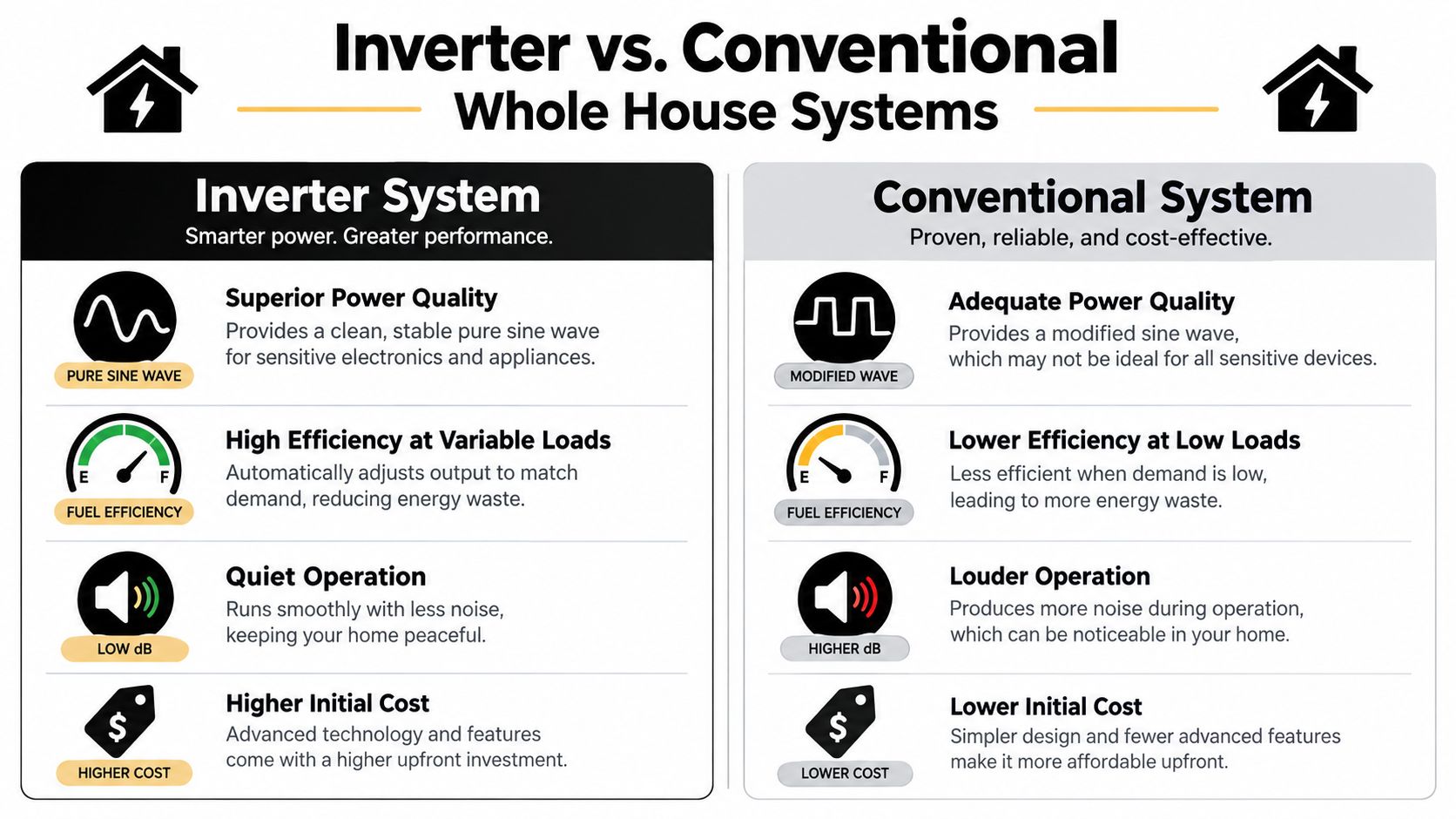
An inverter system and a conventional standby system can both provide useful backup power, but they solve the problem differently. Inverter designs generate and electronically reconstruct the output. Conventional systems generally produce AC directly from an engine-driven alternator and rely on regulation and control systems to maintain usable voltage and frequency.
For portable or partial-home backup, an inverter's strengths are easy to appreciate. The engine can slow down when demand falls, the enclosed design can reduce operating noise, and the output is well suited to electronic devices. A stationary standby system, however, usually emphasizes automatic starting, high output, serviceability, and the ability to support large household circuits.
| Feature | Inverter Whole House System | Conventional Standby System |
|---|---|---|
| Power quality | Often designed around pure sine wave output and electronic regulation | Can provide suitable household power when properly designed and regulated |
| Variable-load operation | Can adjust engine operation to changing demand | Often maintains a more constant engine operating condition |
| Noise profile | Enclosed architecture and variable engine speed can support quieter operation | Engine and cooling components may be more noticeable, especially under sustained load |
| Initial cost | More electronics can increase purchase complexity and cost | Simpler architecture may offer a lower entry point in some product categories |
| Whole-home readiness | Must be matched to transfer equipment, split-phase needs, and load controls | Commonly designed as an automatic standby package |
| Main buying priority | Power refinement, flexible operation, and reduced output at changing loads | Capacity, automatic operation, service support, and load acceptance |
The table highlights a key distinction. “Inverter” describes an electrical architecture, not the entire installation. A buyer still has to confirm that the unit supports the home's voltage arrangement, transfer equipment, fuel system, outdoor location, and priority loads.
For a broader explanation of how portable, battery, and standby systems differ, see this standby, portable, and battery generator guide.
Where each design makes the most sense
An inverter approach is attractive when a homeowner values quiet operation, sensitive electronics protection, and efficient response to changing demand. It can be especially appealing when the system serves selected circuits rather than every major load simultaneously.
A conventional standby system may be the more practical value when automatic whole-home operation and high motor-starting capability matter most. Its suitability depends on the quality of the installation, not on a simplistic assumption that conventional output is automatically unsafe.
Power quality deserves attention, but it shouldn't distract from the more consequential question: can the system start and manage the loads your home uses?
Sizing and Load Management That Determine Real Whole House Performance
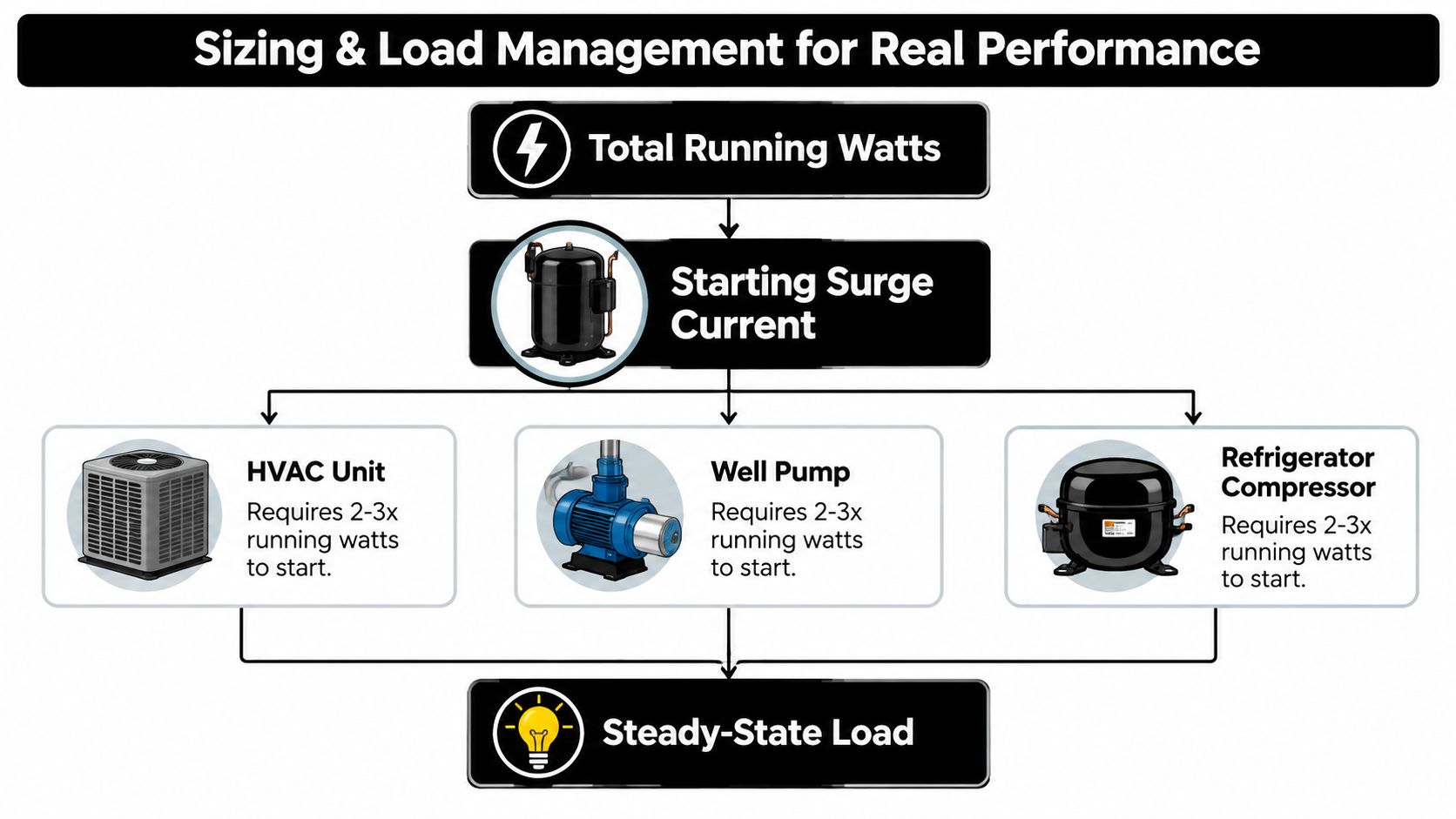
A generator can have enough running watts on paper and still struggle when a major appliance starts. Motors in air conditioners, heat pumps, well pumps, refrigerators, and compressors draw a temporary surge above their normal operating demand. That starting event can pull voltage down, challenge the engine, or trip the generator before the steady load settles.
The issue is similar to opening a large valve suddenly in a household water system. The pipes may support the normal flow, but the abrupt pressure change can expose weaknesses. Generator sizing must account for both the electricity a device uses while running and the extra power required to start it.
Running demand is only the first layer
An installer's load calculation should identify the home's steady-state requirements, then examine the largest starting events. A central air conditioner may be comfortable after it starts but demanding at the moment its compressor engages. A well pump can create a similar challenge, particularly if other household loads are already active.
Industry standby guidance highlights the need for load acceptance and, in some systems, V/Hz recovery features. These controls help the engine recover when large inductive loads start, a concern for central air conditioners, pumps, and compressors, as described in EcoFlow's whole-home generator guidance.
Ask an installer to show how the proposed system handles:
- Continuous loads: The appliances and circuits likely to operate together during an outage.
- Starting loads: Motors and compressors that briefly demand more power than their running rating.
- Priority order: Which equipment starts first and which circuits wait.
- Transfer behavior: How the transfer switch moves the home from utility power to generator power.
- Load shedding: Which nonessential circuits disconnect automatically when demand approaches the generator's limit.
Managed loads can beat brute force
“Whole house” doesn't always mean every circuit can run at maximum demand at the same moment. If generator capacity is below the home's full service size, permitting authorities may require load calculations, wiring diagrams, transfer-switch documentation, and automatic load-shedding or energy-management controls. A published generator permitting document illustrates how code-driven design can make managed loads central to a whole-home installation.
That arrangement can be more sensible than buying a much larger generator to cover rare combinations of simultaneous demand. For example, an energy-management system may allow the HVAC system to run while delaying an electric vehicle charger or temporarily disconnecting a secondary water heater. The home still receives useful backup power, but the system avoids asking the generator to start every large load at once.
For a more detailed starting point, use this generator sizing and load calculation guide. When comparing quotes, don't accept a single wattage number without asking how the installer calculated starting current and what happens when the home exceeds the available output.
Common Misconceptions About Inverter Labels in Standby Power
The word “inverter” often sounds like a complete answer. It isn't.
In portable power, inverter technology can deliver a clear advantage because the unit may serve laptops, chargers, televisions, and other electronics while operating at changing loads. In a permanently installed standby system, the inverter label usually deserves less attention than the generator's actual waveform specification, transfer equipment, capacity, and control strategy.
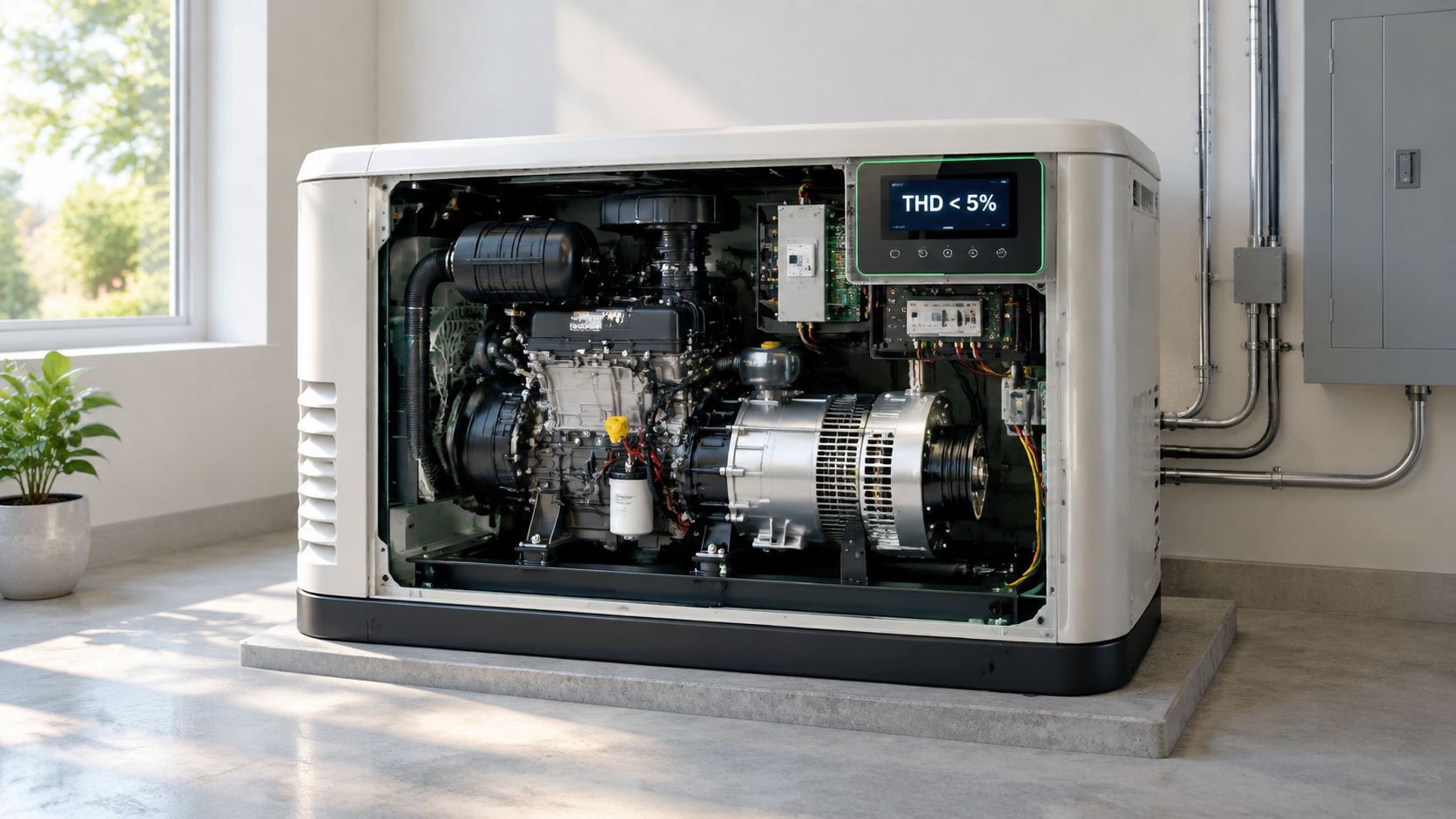
Clean power isn't exclusive to inverter systems
One generator dealer FAQ states that standby units typically deliver under 5% total harmonic distortion, a level described as comparable to grid power in the dealer's standby generator FAQ. That doesn't mean every conventional unit has identical performance, or that buyers can ignore the manufacturer's specifications. It does mean a stationary standby generator shouldn't be dismissed just because its product name doesn't include “inverter.”
The correct comparison is based on measured electrical output and the equipment manufacturer's compatibility requirements. Ask for the total harmonic distortion specification, voltage regulation information, frequency control details, and the conditions under which those values apply.
A homeowner can also overpay for inverter architecture while overlooking a poor load design. A pure sine wave output won't compensate for an undersized transfer switch, an incomplete load calculation, or an installation that fails to account for a heat pump's starting current.
The image above shows how a whole-home generator might appear in a residential setting, but appearance doesn't reveal whether the equipment is suitable for a particular service entrance or load profile. The installation documents matter more than the marketing photograph.
Permits can expose weak planning
Many jurisdictions require load calculations, wiring diagrams, and transfer-switch documentation for whole-house generator installations. Those requirements push the project toward electrical design rather than branding. The authority reviewing the work wants to know how the generator connects, what it will power, and how the system prevents unsafe overloads or backfeed.
This video offers another visual reference for homeowners comparing generator arrangements:
The balanced conclusion is simple. Inverter technology can be valuable, especially for portable, quiet, variable-load applications. For stationary standby power, treat it as one specification among several, not as a substitute for correct sizing and professional installation.
Real World Use Cases Where Inverter Whole House Power Makes Sense
A homeowner working remotely during frequent outages may depend on computers, monitors, networking equipment, and storage devices. Clean, stable power protects that setup, while automatic transfer restores the selected circuits without requiring someone to reconnect equipment. The generator must also handle nearby HVAC or refrigerator starting demands.
A household using sensitive medical equipment needs a more careful review. Start with the equipment manufacturer's power requirements and the backup system's waveform specifications. An inverter design may fit, but the installer must also verify runtime, transfer behavior, grounding, and whether the device needs a separate battery or uninterrupted power supply.
Small businesses face a different combination of loads. A shop, studio, or office may need refrigeration, point-of-sale equipment, internet service, security systems, and lighting at the same time. Inverter technology can suit sites that place a high value on power quality and efficient operation under changing loads. Managed circuits can keep large intermittent equipment from interrupting those services.
Larger electrical loads change the priority
Homes with heat pumps, well pumps, or electric vehicle chargers need a deliberate electrical design. These devices may draw substantial current when starting or operating, so load sequencing can matter more than the inverter label. Disconnecting a charger while a heat pump starts may produce steadier operation than using a larger unmanaged generator that repeatedly approaches its limit.
Market interest shows that homeowners and businesses are considering inverter generators for several applications. That interest does not make one architecture appropriate for every whole-house installation. For permanent standby power, the transfer switch, load calculation, and control strategy often determine the result more directly than the inverter designation.
Use daily priorities to compare the options:
- Sensitive electronics first: Confirm waveform quality and equipment compatibility.
- Large motors first: Check starting current, load acceptance, and recovery.
- Quiet neighborhood operation: Compare enclosure design and variable-speed behavior.
- Long outages: Review fuel supply, service access, and which circuits can be shed.
- Automatic restoration: Examine transfer-switch operation and standby controls.
A strong whole-house arrangement may combine clean power, automatic transfer, and intelligent load management. Inverter technology can be especially useful for portable systems and changing loads, while permanent standby systems still depend on correct sizing and coordinated controls. No single label guarantees all three.
Choosing the Right Setup and Finding Qualified Installers
Start with the home's electrical profile, not the product category. List the circuits you want during an outage, identify motor-driven equipment, and ask for a documented load calculation that includes starting demand. Then confirm whether the proposed system will power every circuit continuously or use automatic load shedding.
An inverter whole-house setup deserves serious consideration when you value refined waveform quality, quieter variable-load operation, and flexible power management. A conventional standby system may be the smarter value when automatic operation, reliable motor starting, local service, and a well-designed transfer system outweigh the advantages of inverter architecture.
Before accepting a quote, ask the installer to provide:
- Load documentation: Running loads, starting loads, and the assumptions used.
- Transfer details: The transfer-switch type, service arrangement, and wiring scope.
- Management plan: Which loads shed, in what order, and when they reconnect.
- Permit scope: Required drawings, inspections, and utility coordination.
- Maintenance support: Service intervals, emergency response, and warranty handling.
- Site requirements: Clearance, ventilation, fuel connection, noise considerations, and weather exposure.
Use this questions to ask a generator installer checklist while comparing proposals. Look for answers that describe the electrical design in concrete terms, rather than relying on “whole house” or “inverter” as a promise.
GeneratorInstallerList can also help you locate contractors whose websites show standby or whole-house generator work, with ZIP-based searching and optional filters for service language or major brands. It's a directory and research starting point, not a licensing verification service or endorsement, so confirm credentials and project scope directly with each installer.
GeneratorInstallerList helps homeowners compare standby and whole-house generator installers by location, visible generator service signals, and optional brand preferences. Visit GeneratorInstallerList to narrow your search, then use the resulting list to request quotes that clearly address sizing, transfer equipment, and load management.
- whole house generator inverter
- inverter generator guide
- standby generator sizing
- home backup power
- generator load management
Ready to find who to call?
Open your state page or search by ZIP for a distance-sorted list.