Whole House Generator Maintenance Made Simple
Learn whole house generator maintenance schedules, DIY checks, technician service needs, runtime triggers, and realistic maintenance costs.
An ice storm is moving in, the utility has already warned of possible outages, and the standby generator outside your home has been quiet for months. You remember that it worked during the last outage, but you don't know whether the battery is healthy, whether the fuel system is clean, or whether the automatic transfer switch will respond when the lights go out.
That uncertainty is exactly why whole house generator maintenance can't be reduced to an annual appointment. A reliable plan combines calendar dates, exercise cycles, accumulated operating hours, and the runtime from the last serious outage. Homeowners can safely handle several observations, while fuel, electrical, engine, and transfer-switch work should remain with a qualified technician.
Table of Contents
- Why Standby Generator Maintenance Matters
- Build a Weekly and Quarterly Maintenance Routine
- Separate DIY Checks From Technician Service
- Plan Service by Time and Operating Hours
- Respond to Outages and Troubleshoot Warning Signs
- Estimate Maintenance Time and Cost
- Create a Reliable Annual Maintenance Plan
Why Standby Generator Maintenance Matters
A standby generator can appear ready while it sits unused. A weak battery, stale fuel, corroded terminals, blocked intake, coolant loss, or controller fault may remain hidden until utility power fails. At that moment, the unit must start automatically, transfer household circuits, and continue running under load without anyone beside it.
During an ice storm, a household may rely on the generator for heat, refrigeration, a sump pump, internet access, or medically important equipment. A failed start can lead to cold rooms, spoiled food, water damage, or an unsafe attempt to restore power. The risk is greater when an outage lasts for hours rather than minutes.
Practical rule: A generator that starts during a short exercise cycle has proven only that it can start under those conditions. It has not proven that it can carry your home through a prolonged outage.
Regular operation helps expose problems that develop during idle periods. NFPA 110 calls for regular exercise of emergency power equipment, including weekly no-load operation for Level 1 systems, with the applicable duration and testing requirements determined by the adopted edition and installation context. The maintenance guidance summarized by Oxmaint's generator maintenance schedule also describes a common pattern of weekly exercise, periodic inspection, and annual professional service.
Calendar dates are only one trigger. Track operating hours and the runtime from each significant outage as well. A lightly used unit still needs scheduled attention because oil, batteries, filters, and fuel systems age while sitting. A generator that carried the home through an extended outage may need service earlier than planned, even if its yearly appointment is not due.
Homeowners can observe the enclosure, controller, sounds, and visible leaks without opening service panels. Fuel-system work, electrical testing, load checks, engine service, and transfer-switch repairs should remain with a qualified technician. That division keeps routine monitoring useful without turning a safety check into a hazardous repair.
Build a Weekly and Quarterly Maintenance Routine
A good homeowner routine starts with observation, not disassembly. Keep the manufacturer's manual, a flashlight, work gloves, and a simple maintenance log nearby. Don't remove covers, open energized electrical compartments, or reach into a running enclosure.
Weekly checks should stay visual and repeatable
On the scheduled exercise day, look at the controller before touching anything else. It should show a ready or standby condition with no active fault code, and the displayed date and time should be correct. A wrong clock can interfere with the programmed exercise schedule, while an unexplained warning deserves attention even if the generator still starts.
Walk around the enclosure while the unit is off and again from a safe distance during exercise. Look for oil, fuel, or coolant beneath the unit. Notice unusual smells, new vibration, irregular exhaust, or sounds that differ from previous runs. Keep leaves, grass, nests, snow, and stored objects away from the air intake and exhaust openings. Landscaping growth can restrict airflow, and animal activity can damage wiring or block ventilation.
The controller's exercise history is useful, but don't treat it as the whole inspection. Record the exercise date, displayed runtime, fault messages, weather conditions, and anything that sounded or looked different. A short note such as “started normally, low-battery warning cleared” is more useful later than relying on memory during a storm.
Quarterly observations catch slow changes
Every quarter, inspect the battery terminals for corrosion and check the battery condition according to the manufacturer's instructions. A voltage reading alone doesn't prove that the battery can deliver sufficient cranking power, so a proper load test belongs in the service plan. Check the oil level on the dipstick when the engine is off and cool, and inspect coolant only if the model and manual permit a homeowner check.
Confirm that the automatic transfer switch returned to its normal standby state after the exercise. If the controller reports a fault, the switch remains in an abnormal position, or the generator doesn't stop as expected, arrange service rather than repeatedly restarting it.
Separate DIY Checks From Technician Service
The safest boundary is straightforward. Homeowners can inspect, record, and report. Technicians diagnose, adjust, replace, test, and work inside systems that contain moving parts, hot surfaces, fuel connections, or live electrical equipment.
You can clear debris from around the enclosure, check visible fluid levels, review the controller, inspect terminals from a safe position, and maintain the exercise log. Oil and filter changes may look simple, but the correct procedure depends on the engine, oil specification, disposal requirements, filter access, and warranty conditions. A professional visit should also verify functions that a visual walk-around can't prove.
| Task | Homeowner | Technician |
|---|---|---|
| Enclosure and airflow inspection | Clear leaves, snow, nests, and landscaping from outside | Inspect restricted airflow, enclosure damage, and internal contamination |
| Controller status | Record ready status, exercise dates, and fault codes | Diagnose persistent alarms, update controls when appropriate, and verify settings |
| Battery | Look for visible corrosion and report slow cranking or warnings | Perform a battery load test, inspect cables, and test the charger |
| Fluids | Check accessible oil or coolant levels as the manual permits | Change oil and filters, inspect leaks, flush coolant, and assess contamination |
| Ignition and engine adjustments | No internal adjustment | Replace spark plugs, inspect belts, and perform valve or injector work |
| Transfer switch | Confirm it returns to standby after an exercise | Inspect and test transfer operation, wiring, contacts, and related controls |
| Fuel and electrical systems | Report odor, visible damage, or abnormal operation | Test fuel pressure and electrical performance, and service gas or sealed components |
A recurring low-battery warning illustrates the difference. Cleaning accessible corrosion may correct a poor connection, but repeated warnings, slow cranking, a battery that fails a load test, or a charging alarm points toward a failing battery, cable, charger, or control circuit. Stop experimenting at that point.
For questions to ask before hiring, use this generator installer interview guide to clarify service scope, credentials, warranty requirements, and response procedures.
Plan Service by Time and Operating Hours
A generator that runs through several days of a winter outage can reach its service threshold before the calendar says it is due. The dependable approach uses the strictest of three triggers: calendar time, accumulated operating hours, or runtime during a prolonged outage. Calendar service addresses aging, hour-based service tracks engine wear, and post-outage service responds to the workload created by continuous operation and heavy household demand.
General maintenance guidance commonly places oil and filter changes at about 100 to 200 operating hours or once per year. Liquid-cooled units may have more intensive service intervals around 250 to 500 hours. Batteries are often treated as wear items, with replacement around every 2 to 4 years, while spark plugs may be due every 2 to 3 years or around 400 hours, depending on the engine and manufacturer. Use these figures as planning references, then follow the model manual when it gives a different interval.
Air-cooled and liquid-cooled units differ
Air-cooled residential generators usually place greater demands on oil, air filtration, and spark components because compact engines reject heat through airflow. Dust, high ambient temperatures, restricted clearance, and heavy loading can justify an earlier inspection, even when the normal calendar interval has not arrived.
Liquid-cooled generators may support longer basic service intervals, but they add coolant, hoses, belts, radiator airflow, and related checks. A cooling fault can become serious during sustained operation. The maintenance schedule framework from Facts About Generators describes a layered routine with weekly checks, quarterly battery and sediment attention, and annual or hour-based replacement and inspection work.
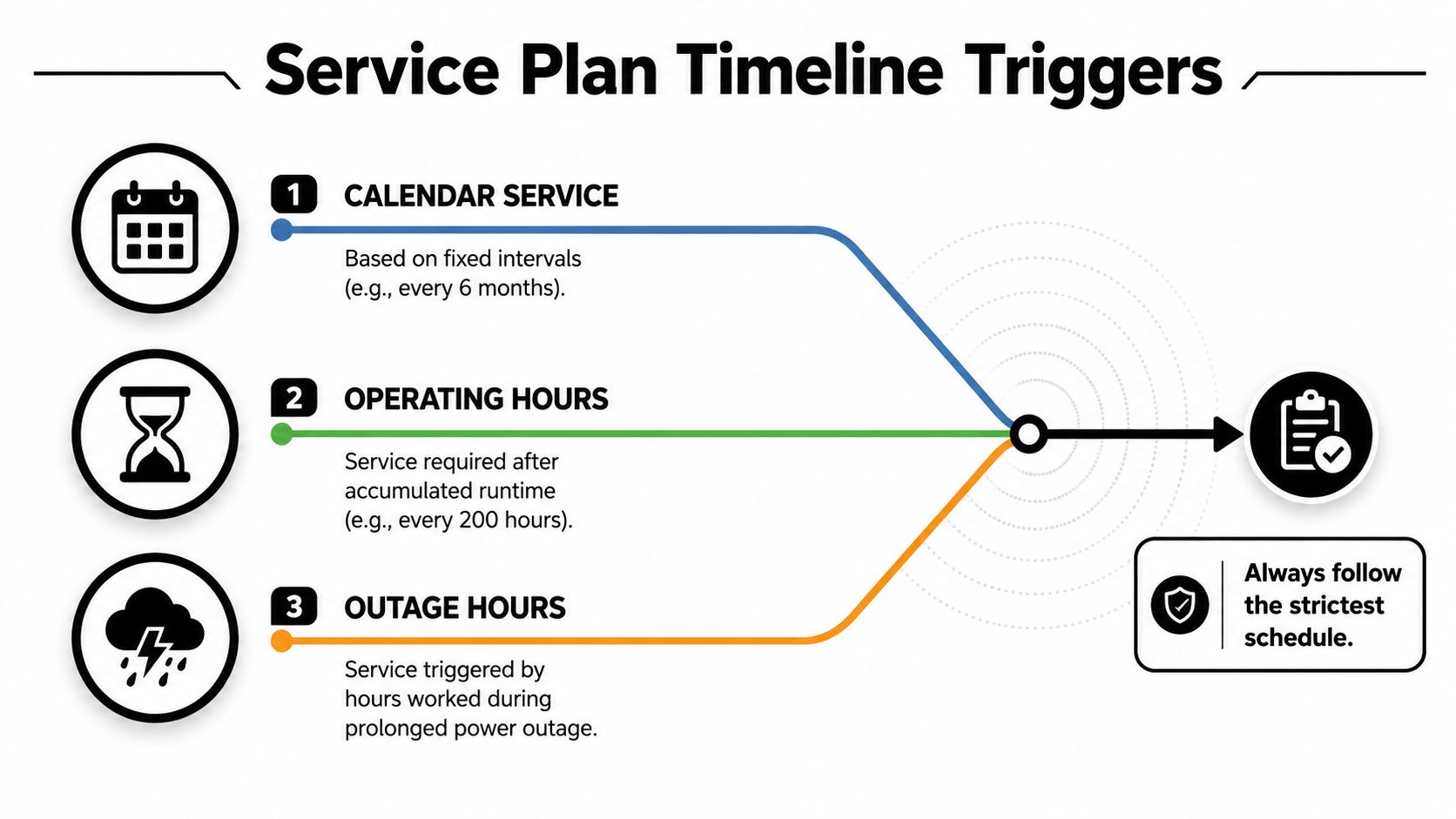
Record exercise runtime separately from outage runtime. A brief automatic exercise run does not equal several days supporting heating, cooling, pumps, and kitchen loads. After an extended outage, ask a technician to evaluate oil, filters, battery condition, cooling performance, and fault history, even if the generator never stopped.
Service decision: If the hour threshold arrives before the calendar appointment, service it. If a prolonged outage creates substantial runtime first, call for guidance rather than waiting for the scheduled date.
Respond to Outages and Troubleshoot Warning Signs
An automatic exercise run is useful, but it doesn't prove emergency readiness. Exercise cycles are often brief and lightly loaded, so they may not expose restricted fuel flow, cooling problems, transfer-switch faults, battery weakness, or a generator that struggles when the home draws several large loads at once.
During an outage, watch the controller from a safe position and listen for steady operation. Confirm that the home is receiving power normally, but don't keep opening the enclosure or touching hot, moving, or energized components. If only some circuits work, appliances restart unexpectedly, or lights dim repeatedly, the system may be experiencing a load, transfer, fuel, or voltage problem.
Shut the generator down and arrange service if you see smoke, fuel or oil leakage, overheating, knocking, stalling under load, a persistent fault, or repeated failed starts. A single dead battery can explain one no-start event. Repeated battery replacements, slow cranking, and charging warnings suggest a deeper issue with corrosion, the charger, cables, or the control system.
The standby generator failure analysis from Old Dominion University reports a failure rate of 0.00536 failures per run-hour and 0.0135 failures per start attempt, which highlights why starting deserves special attention. A separate repair-statistics summary reports that poorly maintained generators are 50% likely to fail within 48 hours of operation, as described in this 2026 generator repair overview. These figures don't predict what your individual unit will do, but they reinforce a practical priority: verify starting, battery health, and operation under meaningful load before severe weather.
If refrigeration or medical equipment depends on backup power, keep a contingency plan. Never attempt live electrical work, and after utility power returns, let the automatic transfer sequence complete before recording the outage hours, warnings, and unusual behavior.
Estimate Maintenance Time and Cost
Treat generator upkeep as a planned operating expense, with both calendar intervals and actual runtime influencing the schedule. A short homeowner check usually takes little time. A post-outage review may take longer after extended operation, especially if snow, debris, vegetation, or animal activity has restricted access or airflow. Finding a developing issue while the unit is idle is less disruptive than discovering it during the next outage.
Professional service time varies by model, access, fuel type, and operating hours. Air-cooled units generally have a simpler service scope than liquid-cooled models, which require closer inspection of coolant, belts, hoses, and larger engine systems. A routine visit may include oil and filter work, battery and charging checks, transfer-switch testing, and a load test. Extra runtime after a long outage can justify earlier oil, filter, cooling-system, or fault-history review, even if the calendar interval has not arrived.
Air-cooled service is often less expensive than liquid-cooled work, while a post-outage assessment can cost more when the technician must diagnose a fault or replace parts. The whole-house generator cost guide provides context for separating routine maintenance from larger ownership and installation expenses. Ask the technician to identify labor, parts, testing, and any repair separately.
| Service type | Typical time | Typical cost | Typical scope |
|---|---|---|---|
| Homeowner inspection | Short recurring check | Minimal direct cost | Controller, enclosure, airflow, visible leaks, and log review |
| Routine professional service | Varies by model and access | Scheduled service charge | Oil, filters, battery system, transfer function, and inspection |
| Post-outage assessment | Depends on runtime and findings | Quote based on required work | Runtime review, fluids, filters, cooling, battery, and fault history |
| Major repair | Highly variable | May exceed routine maintenance | Fuel, transfer-switch, engine, electrical, or enclosure diagnosis |
Before approving work, request a written scope and confirm whether the price includes transfer-switch or load testing. Keep receipts, meter readings, fault codes, outage hours, and technician notes together. A higher estimate may reflect extended runtime, a major service interval, or a genuine repair. A vague recurring charge deserves questions about exactly what the visit covers.
Create a Reliable Annual Maintenance Plan
Put the maintenance plan on a printed calendar that matches your region's storm season. Keep weekly exercise and visual checks visible, schedule quarterly battery and fluid observations, and arrange professional service before the period when hurricanes, ice storms, or extreme winter weather are most likely. For air-cooled units, confirm whether the manufacturer calls for a more frequent oil and filter schedule. For liquid-cooled equipment, make sure the annual visit addresses coolant, hoses, belts, and engine diagnostics.
Your log should include:
- Exercise history: Dates, duration, controller status, and any fault messages.
- Runtime record: Separate automatic exercises from outage hours and note the meter reading.
- Condition notes: Battery observations, fluid levels, fuel concerns, unusual sounds, and load behavior.
- Service documentation: Parts replaced, oil or coolant work, test results, technician notes, and warranty receipts.
When hiring, verify the technician's applicable state license, generator-specific training, insurance, and familiarity with your brand. Ask whether the company is factory-trained for Generac, Kohler, Briggs & Stratton, or the manufacturer installed at your home. Get the service scope in writing, including parts coverage, transfer-switch testing, load testing, emergency response, and the exact maintenance interval being followed.
Manufacturer requirements control warranty compliance. Don't assume a generic annual tune-up satisfies the manual, and review the generator maintenance warranty guide before authorizing work. Store the completed plan, manual, service contacts, and recent records inside or near the transfer-switch cabinet, where someone can find them during an outage.
GeneratorInstallerList offers a ZIP-based directory of generator-focused installers, with filters for standby installation, service, maintenance, and major brands, so homeowners can build a shortlist for scheduled work. Visit GeneratorInstallerList to compare nearby companies, then confirm licensing, insurance, factory training, written scope, and warranty procedures directly before booking service.
- whole house generator maintenance
- standby generator service
- generator upkeep
- home backup power
- generator maintenance cost
Ready to find who to call?
Open your state page or search by ZIP for a distance-sorted list.