Whole House Generator Prices and What Drives Cost
Compare whole house generator prices by size and fuel type, see what installed cost includes, and learn how to read quotes before you buy.
In 2026, whole-house generator prices typically run about $9,600 to $23,300 installed. Common installed ranges are $9,600–$16,900 for 8 kW, $11,200–$19,500 for 14 kW, and $13,400–$23,300 for 22 kW, including the generator, automatic transfer switch, fuel and electrical connections, pad, and permits.
The first quote often arrives after a storm, when the refrigerator is warming, the sump pump is silent, and everyone in the house is asking when the power will return. You search online and find a generator cabinet priced far below the contractor's estimate. Then another installer quotes thousands more for what appears to be the same kilowatt rating.
That confusion usually comes from comparing equipment price with installed project cost. A standby system isn't just an outdoor box. It must connect safely to your electrical panel, receive fuel, sit on a suitable base, pass inspection, and switch your home from utility power to generator power without creating a dangerous electrical connection.
This guide translates whole house generator prices into practical decisions. You'll see how capacity, fuel type, transfer equipment, site conditions, wiring, and permits affect a quote. You'll also learn how to compare proposals line by line, choose capacity without automatically buying the largest unit, and find installers who clearly work with standby systems.
Table of Contents
- Introduction to Whole House Generator Prices Today
- What Whole House Power Really Means for Your Home
- How Much Whole House Generators Cost by Size and Fuel Type
- Equipment Price Versus Installed Cost and What Is Included
- Choosing the Right Size Without Overpaying for Power
- How to Compare Quotes and Find Qualified Installers Near You
- Key Takeaways on Whole House Generator Prices
Introduction to Whole House Generator Prices Today
After an outage, a homeowner may find three very different prices for what appears to be the same generator project. A product page may list only the outdoor generator cabinet. A cost guide may provide a broad installed range. An installer's proposal may include the automatic transfer switch, fuel work, electrical labor, permits, and a concrete pad.
These figures describe different scopes, so they can all be reasonable.
For 2026, the broad installed range for a standby whole-house generator is about $9,600–$23,300, according to current whole-house generator cost guidance. Common size anchors include $9,600–$16,900 for 8 kW, $11,200–$19,500 for 14 kW, and $13,400–$23,300 for 22 kW. Those installed figures usually cover the generator, automatic transfer switch, gas and electrical connections, a pad, and permitting.
Why the same generator can receive different quotes
Two homes can receive quotes for the same 22 kW natural-gas system and still have very different totals. One may have a suitable gas connection near the installation area and enough electrical capacity at the panel. The other may require a longer gas run, heavier wiring, panel work, or more site preparation.
The generator model is only one part of the project. Its price is like the cost of buying an appliance, while the installed cost includes the delivery route, connections, foundation, inspections, and setup that make the appliance usable.
Practical rule: Compare the work included in each proposal before comparing the totals.
Published figures can also create confusion when older averages appear beside newer, site-specific estimates. A lower historical average may describe a smaller system, a simpler site, or a narrower definition of “installed.” A higher quote may include work that the lower figure excludes.
How to use this guide
Begin with the electrical meaning of “whole house.” Then compare generator sizes and fuel types, keeping equipment price separate from installation cost. Review the transfer equipment, gas and electrical work, pad, permits, and site conditions line by line.
The lowest number is not automatically the better choice. A useful proposal should show whether the system can power the loads you care about, connect safely and legally, and receive proper service after installation.
What Whole House Power Really Means for Your Home
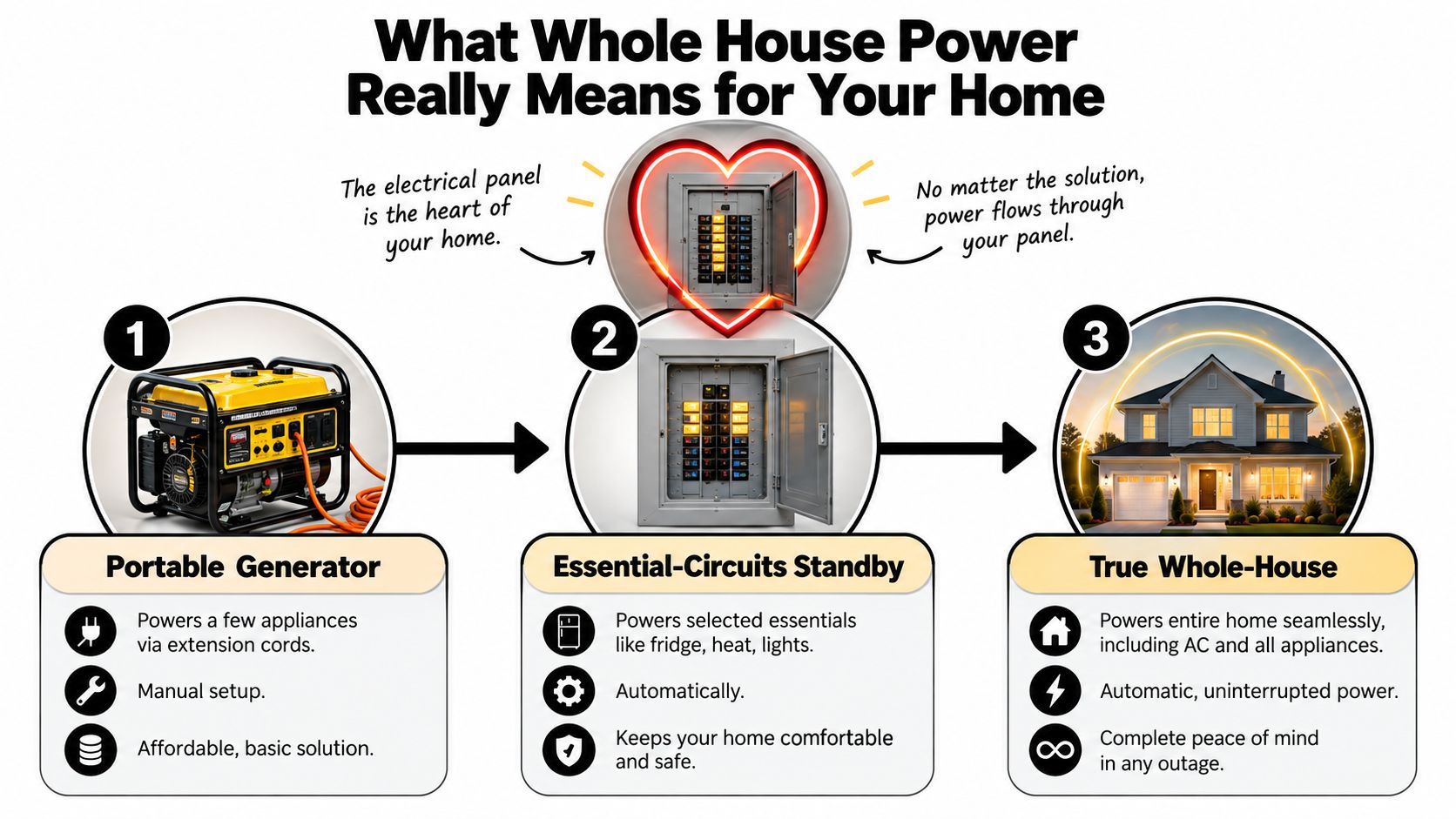
Think of your electrical panel as the highway that distributes electricity throughout the house. A portable generator usually reaches only a few destinations through extension cords or a temporary inlet. An essential-circuits standby system sends power down selected lanes. A true whole-house system connects to the panel so the home can use power across the circuits the generator is sized to support.
The automatic transfer switch acts like the traffic controller. When utility power fails, it disconnects the home from the grid and directs generator power into the approved electrical system. When utility service returns, it transfers the load back and allows the generator to shut down according to its controls.
Three levels of backup coverage
- Portable generator: You move and start the unit manually, then connect selected appliances or circuits. It can help with immediate essentials, but it doesn't provide complete coverage for the entire home.
- Essential-circuits standby: The system starts automatically and powers chosen circuits, such as refrigeration, heating controls, lighting, internet equipment, or a sump pump.
- True whole-house coverage: The generator connects through the home's electrical distribution system and is designed to serve the house broadly, including larger loads when the capacity and controls support them.
The phrase “whole house” doesn't mean every appliance can run simultaneously regardless of generator size. A home with electric heating, central air conditioning, an electric water heater, and an electric range may demand more power than a home with gas appliances and modest electrical loads.
Fuel and cooling choices
Natural gas and propane are common fuel options. Natural gas can work well where a suitable utility connection is available, while propane may suit properties without convenient natural-gas service but requires planning around storage and fuel delivery.
Air-cooled units are common in residential applications. Liquid-cooled systems use a different cooling arrangement and are often considered for larger or more demanding configurations. The choice affects both the equipment and the installation environment, so the installer should connect it to a documented load calculation rather than choosing by appearance or square footage alone.
How Much Whole House Generators Cost by Size and Fuel Type
A contractor may quote two generators with the same kW rating at very different totals. The cabinet is only one part of the project. Gas-line distance, electrical-panel work, permits, the pad, and site access can add thousands, so capacity is a starting point rather than a final price.
Typical installed ranges include $9,600–$16,900 for 8 kW, $11,200–$19,500 for 14 kW, and $13,400–$23,300 for 22 kW. A separate benchmark places a typical 20–22 kW natural-gas installation around $8,000–$15,000, including the automatic transfer switch and installation labor. Smaller propane systems often fall around $6,000–$10,000 installed, while larger diesel or premium-enclosure configurations can exceed $15,000, according to standby generator price and installation benchmarks.
| System size | Typical installed range | Common configuration | Why price shifts |
|---|---|---|---|
| 8 kW | $9,600–$16,900 | Smaller residential standby system | Equipment scope, transfer equipment, connections, and site conditions affect the total |
| 14 kW | $11,200–$19,500 | Mid-range home backup configuration | Larger equipment and potentially greater electrical integration raise project complexity |
| 20–22 kW | $8,000–$15,000 benchmark | Natural-gas standby system with automatic transfer switch and labor | Fuel-line distance, panel work, pad requirements, and permits create variation |
| 22 kW | $13,400–$23,300 common range | Broad whole-house residential configuration | Installation conditions matter more than the cabinet rating alone |
| 22–26 kW | $9,000–$16,000 reported range | Package quote with switch, pad, gas hookup, permits, and electrical labor | A new gas run or upgraded electrical service can move the quote upward |
| 36 kW and above | $15,000–$25,000 reported range | Larger whole-home build | Heavier equipment, larger connections, and more involved site preparation add cost |
These ranges describe different types of quotes. One may represent a common retail installation, another a technical benchmark, and another a bundled package. Compare the included work before treating one number as cheaper.
Why fuel type changes the project
Natural gas may need a connection from the existing utility line to the generator. Propane may require a tank arrangement, delivery planning, and suitable placement. Diesel and premium-enclosure systems can involve heavier equipment and more demanding site preparation.
Fuel choice works like choosing the route for a delivery. The generator may cost less at the equipment stage, yet the property may require more infrastructure before it can operate. For a practical comparison of fuel-related trade-offs, review this guide to natural gas versus propane generators.
Ask the installer to show fuel work, electrical integration, pad preparation, permits, and inspection requirements as separate quote items. That breakdown makes it easier to compare the installed cost of two similarly rated units.
Equipment Price Versus Installed Cost and What Is Included
An equipment-only listing answers one question: what might the generator cabinet cost before the property is prepared for it? An installed quote answers a much larger question: what will it take to place the system at your home, connect it, approve it, and make it operate safely?
That difference explains why online shopping can create false expectations. A cabinet may look like the main expense, but it can't transfer power automatically or connect itself to the fuel and electrical systems.
The six line items behind the total
- Generator cabinet: The engine, alternator, controls, enclosure, and related equipment.
- Automatic transfer switch: The device that manages the transition between utility and generator power.
- Concrete pad or foundation: The stable, properly positioned base for the unit.
- Gas hookup: The fuel-line connection, sizing, and related plumbing work.
- Electrical labor: Wiring, panel integration, disconnects, and other required electrical tasks.
- Permits and inspection: Local approvals, inspections, and code-compliance administration.
Most 22–26 kW whole-home systems are reported around $9,000–$16,000 installed, with package quotes commonly bundling those six categories, according to whole-home standby generator installation cost guidance. The same guidance places 36 kW and larger builds around $15,000–$25,000, because the project may require heavier equipment and more involved connections.
What makes two identical kW quotes different
A short gas run may require less work than a connection that travels around a building or across difficult ground. One electrical panel may integrate cleanly, while another may need upgrades or additional equipment. Local permitting requirements can also differ, and a quote that includes permit handling isn't directly comparable to one that leaves it to the homeowner.
Ask each installer to mark every line as included, excluded, or allowance. An allowance means the contractor has reserved a budget for an item that may change after site verification. That distinction matters because an apparently low total can rise when excluded work becomes necessary.
Use a written generator installation process guide while reviewing the proposal. You don't need to become an electrician. You need enough scope detail to see whether both contractors priced the same project.
Choosing the Right Size Without Overpaying for Power
The right generator size begins with the loads you want to operate, not the size of the house alone. Square footage can provide context, but it doesn't tell an installer whether your home has electric heat, a well pump, central air conditioning, an electric range, or other large starting loads.
A load calculation adds up the equipment that matters during an outage and considers how those loads start and run. A home with gas heat and a limited backup plan may need a different configuration from an all-electric home where heating and cooling consume much of the available capacity.
Match the system to the coverage goal
Start with one decision: do you want essential-circuit backup or broad whole-house coverage? Essential coverage can prioritize refrigeration, lights, communications, heating controls, security, and medical equipment. Whole-house coverage aims to serve more of the panel, but the generator still needs enough capacity for the loads that may operate together.
Load management can help control the required capacity. A management module can delay or shed selected loads so the generator doesn't need to carry every large appliance at the same moment. That approach may be useful when a homeowner wants automatic operation but doesn't want to size the system for every possible simultaneous demand.
Consider two broad examples. A home with gas heat, gas cooking, and modest cooling demand may fit a smaller standby configuration after a proper calculation. An all-electric home with central air conditioning may need more capacity or controls that prioritize loads. The examples show why a contractor should document the assumptions instead of recommending a size from a quick visual inspection.
Know when a larger configuration is justified
A larger unit may make sense when the home has substantial starting loads, several major electric systems, or a firm requirement to keep cooling and other comfort equipment operating together. It can also push the project toward liquid-cooled equipment or more extensive infrastructure, which changes the installation category rather than adding a little more output.
Published 2026 ranges remain broad. Many sources place projects in a $7,000–$25,000-plus band, while earlier summaries cited $6,000–$11,000 installed or about $5,160 on average. Historical and current generator cost comparisons attribute the spread to size, fuel, transfer-switch requirements, and site work. The same source places some liquid-cooled whole-home units for large houses around $21,000–$36,700.
Sizing advice: Ask the installer to show which loads drive the recommendation and which loads a management module can control.
How to Compare Quotes and Find Qualified Installers Near You
Once you know the coverage goal, ask for itemized proposals from installers who regularly handle standby systems. A generic electrical quote may not explain generator commissioning, fuel coordination, service intervals, or manufacturer warranty procedures.
Use the same checklist for every proposal
- System specification: Record the manufacturer, model, capacity, fuel, cooling type, and transfer-switch arrangement.
- Load assumptions: Ask whether the proposal reflects a documented load calculation and which large appliances it covers.
- Site work: Confirm the pad, clearances, excavation, mounting, drainage, and access requirements.
- Fuel scope: Check whether the gas connection, regulator work, propane equipment, or other fuel tasks are included.
- Electrical scope: Look for panel integration, wiring, disconnects, load management, and any upgrades.
- Permits: Confirm who pulls permits, schedules inspections, and handles corrections if an inspector requires changes.
- Service plan: Ask who performs startup, maintenance, troubleshooting, and warranty coordination after installation.
- Payment terms: Review deposits, progress payments, exclusions, allowances, financing terms, and cancellation language before signing.
A useful quote doesn't hide uncertainty. If the installer hasn't verified the gas pressure, panel condition, or installation location, the proposal should say so and explain how that uncertainty will be resolved.
For more conversation prompts, use this questions-to-ask-generator-installer checklist. It can help you distinguish a contractor who is pricing a complete system from one who has priced only the visible equipment.
Narrow the local search carefully
GeneratorInstallerList is one buyer-oriented option for researching standby and whole-house generator installers. Its directory uses ZIP-based search, adjustable distance settings, visible website signals for generator work, optional brand filters for Generac, Kohler, Cummins, and Briggs & Stratton, and indications of service or maintenance language. It's a research directory, not a licensing verification service or an endorsement, so confirm credentials and scope directly with the installer.
When you contact a company, describe the property, fuel availability, desired coverage, and any large electrical loads. A focused first message gives the installer better context and makes the responses easier to compare.
Key Takeaways on Whole House Generator Prices
Whole house generator prices make more sense when you treat them as installed-system prices, not cabinet prices. The broad 2026 range is about $9,600–$23,300 installed, with 8 kW, 14 kW, and 22 kW systems occupying progressively higher common bands. Those figures include more than the machine. They account for the transfer switch, connections, pad, permits, and installation scope.
Capacity still matters, but it isn't the only explanation for a high quote. Fuel-line distance, electrical upgrades, panel integration, site preparation, permitting, cooling type, and the amount of automation can shift the final number. Two homes with identical generator ratings may need very different construction work.
Before choosing a system, make four checks:
- Confirm the load: Identify the appliances and systems that must operate during an outage.
- Define coverage: Decide whether selected circuits meet your needs or whether you want broader whole-house operation.
- Request itemized proposals: Require each installer to identify included work, exclusions, allowances, permits, and startup responsibilities.
- Verify support: Ask who handles maintenance, warranty communication, repairs, and post-installation service.
A lower quote isn't automatically better if it omits the gas connection, electrical upgrades, permit handling, or commissioning. A higher quote deserves scrutiny too, especially if it recommends more capacity without showing the loads that require it.
Use GeneratorInstallerList to narrow your local search to companies showing clear standby or whole-house generator experience. Then send the same load and scope questions to several installers so you can compare complete installed proposals rather than isolated equipment prices.
- whole house generator prices
- standby generator cost
- generator installation cost
- home backup power
- generator sizing guide
Ready to find who to call?
Open your state page or search by ZIP for a distance-sorted list.